
Finding the real person behind a company should not take your team days. But with the wrong UBO data provider, it does.
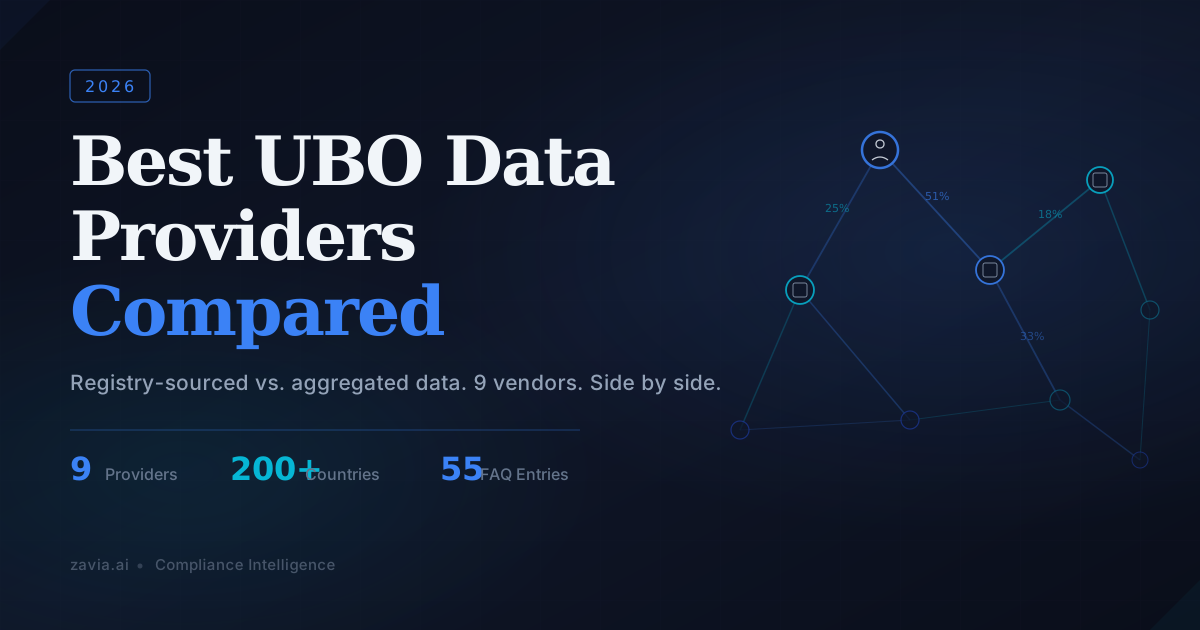
This guide compares nine UBO data providers side by side. We looked at where the data actually comes from, how many countries each provider covers, whether they offer an API, and what it costs.
Whether you run compliance at a bank, manage KYB at a fintech, or handle risk for a multinational, this article will help you pick the right tool.
Why UBO Data Quality Matters for Compliance Teams
Regulators are not waiting for proof of money laundering anymore. They fine institutions for weak systems. Danske Bank paid over €2 billion. Revolut, Starling, and Monzo all faced enforcement actions in the past two years. Not for laundering money. For having controls too weak to catch it.
The difference between good and bad UBO data comes down to one thing: where did it come from?
Data pulled directly from a government registry is auditable. It holds up in front of a regulator. Data scraped from the web or assembled from third-party feeds? It might be outdated. It might be wrong. And when a regulator asks for proof, you have nothing solid to show.
The real question for 2026: can your provider prove where every record came from?
How We Evaluated UBO Data Providers
We scored each provider on five things:
- Data Provenance — Does the provider pull data from official government registries? Or does it scrape the web and aggregate third-party feeds?
- Global Coverage — How many jurisdictions? More importantly, does it cover offshore and high-risk regions where ownership is hardest to trace?
- API Access — Is the data available through a modern REST API with structured outputs? Or do you have to log into a portal and search manually?
- Threshold Customization — Can you set custom UBO thresholds (10%, 25%, etc.) to match different jurisdictions?
- Pricing Transparency — Can you see the price before talking to a salesperson?
Top UBO Data Providers in 2026
1.Zavia.ai
Description
Zavia.ai does one thing and does it well: UBO discovery.
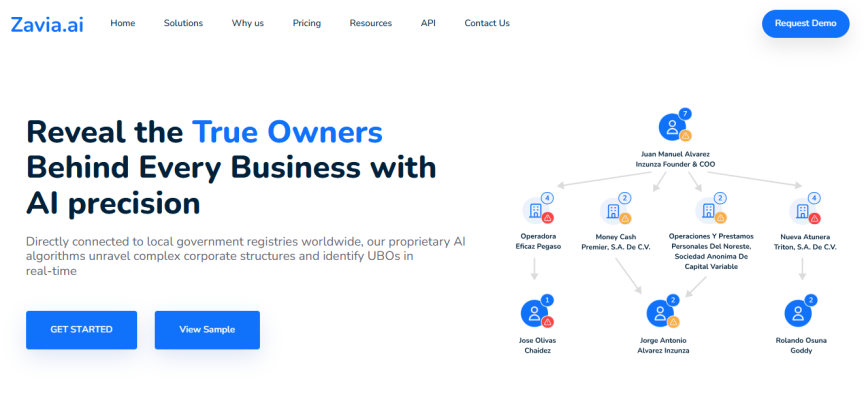
The platform connects to government registries in 100+ countries. It uses AI to trace ownership chains automatically — including parent companies, subsidiaries, nominee arrangements, and offshore structures. Most providers treat ownership as a side feature. Zavia makes it the entire product.
Key Features
- Direct connections to 100+ government registries
- AI and LLM-powered ownership chain tracing
- Interactive ownership maps with real-time visualization
- Custom UBO thresholds to match any jurisdiction
- Multilingual support for global teams
- Monitoring alerts for ownership changes
- LLM chatbot for on-demand ownership queries
Limitations
- Focused on UBO discovery — not a general sales intelligence tool
- No built-in sanctions or PEP screening as standalone module
- Newer platform compared to legacy providers
Pricing
Starter: $49/mo — 50 UBO checks, 30 API calls/min.
Growth: $99/mo — 150 UBO checks, 100 API calls/min.
Corporate: $199/mo — 400 UBO checks, 1,000 API calls/min.
Free trial available. No credit card required.
FAQ
- Does Zavia.ai pull data directly from government registries?
Yes. All company and ownership data comes from official government registries in 100+ countries. No third-party aggregators. - Can I set custom ownership thresholds?
Yes. Set any percentage — 10%, 25%, or anything else — to match your jurisdiction’s rules. - Does Zavia.ai use AI for UBO identification?
Yes. The platform uses proprietary AI and LLMs to trace ownership chains, uncover nominee arrangements, and find hidden beneficial owners. - What industries does Zavia.ai serve?
Financial institutions, legal teams, compliance departments, corporate governance, and M&A/investment teams. - Is there a free trial?
Yes. Sign up for free with no credit card. Paid plans start at $49/month.
2. Global Database
Description
Global Database is a full-stack B2B intelligence platform. It covers compliance, sales intelligence, and credit risk in one place.
The platform connects directly to 200+ government registries and covers more than 600 million companies worldwide. UBO identification is one of many capabilities, alongside financial data, sanctions screening, and CRM integrations.
Key Features
- 200+ government registry connections, 600M+ company profiles
- UBO identification and corporate linkage for 378M entities
- 20+ years of digitized financial statements (AI + OCR)
- API, Salesforce, HubSpot, and Dynamics integrations
- Chrome extension for LinkedIn verification
- Flexible licensing with full reseller and derivative rights
- Sanctions and PEP screening built in
Limitations
- Broad platform — teams focused only on UBO may find it wider than needed
- Advanced enterprise features require a sales conversation
Pricing
Pay-per-check starting at $1 per company verification. Enterprise plans available. Contact sales for API and bulk pricing.
FAQ
- How many companies does Global Database cover?
Over 600 million companies across 200+ countries, all sourced from official government registries. - Does Global Database offer UBO identification?
Yes. Corporate linkage and UBO data covering 378 million entities with cross-jurisdictional ownership tracing. - Can I resell the data?
Yes. Global Database offers flexible licensing with full reseller and derivative product rights — unlike D&B or BvD which restrict this. - Does it integrate with CRMs?
Yes. Salesforce, HubSpot, Microsoft Dynamics, and a Chrome extension for LinkedIn. - What is Global Database best for?
Teams that want compliance, UBO discovery, financial data, credit risk, and sales intelligence in a single platform.
3. Zephira.ai
Description
Zephira.ai is built for developers. It’s an API-first platform that delivers real-time company data from government registries in 100+ countries.
If your team builds onboarding flows, KYB automation, or data enrichment pipelines, Zephira is designed to plug directly into your stack.
Key Features
- Real-time API access to registry data in 100+ countries
- Tax ID validation (VAT, EIN, CNPJ, and more)
- Ownership and shareholder data with parent-subsidiary mapping
- AI normalization across jurisdictions (industry codes, legal forms, statuses)
- Developer-friendly REST API with fast response times
- Flexible licensing with reseller rights, no vendor lock-in
- Enrichment from validated third-party sources when registries are incomplete
Limitations
- Data provider only — no workflow automation or decisioning engine
- No individual identity verification (company-level data only)
- Requires integration work as an API-first platform
Pricing
Starting at $49/month. Custom enterprise pricing available.
FAQ
- Is Zephira.ai built for developers?
Yes. API-first with clear docs, structured JSON outputs, and scalable rate limits. Built for direct integration into KYB and onboarding systems. - Does Zephira.ai validate tax IDs?
Yes. VAT, EIN, CNPJ, and other country-specific identifiers. - How does Zephira.ai differ from Global Database?
Zephira focuses on API delivery for developers. Global Database is a broader platform with sales intelligence, CRM tools, and financial reporting. - Can I embed Zephira data into my own product?
Yes. Flexible licensing with reseller rights. No vendor lock-in. - Does Zephira.ai provide UBO data?
Yes. Ownership and shareholder data with parent-subsidiary mapping. For advanced AI-powered UBO tracing, Zavia.ai is the dedicated tool.
4. Bureau van Dijk (Moody’s Orbis)
Description
Orbis is one of the biggest corporate databases in the world. Owned by Moody’s, it’s the go-to for large banks, auditors, and regulators who need deep ownership trees and standardized financials.
It covers 200+ jurisdictions and pulls from a mix of direct registry connections and partner networks.
Key Features
- 200+ jurisdictions with deep ownership trees
- Standardized financials across countries and accounting standards
- Compliance modules for FATF and AML frameworks
- Sanctions and PEP screening
- Decades of archived company data
- Strong enterprise support
Limitations
- Expensive. Contracts start at $25K+/year
- Complex licensing that restricts redistribution
- Data quality varies by jurisdiction due to partner networks
- Onboarding can be slow for smaller teams
Pricing
Enterprise only. Annual contracts typically start above $25,000 and can exceed $100,000. Contact Moody’s for a quote.
FAQ
- How much does Orbis cost?
Annual contracts start above $25K and can exceed $100K depending on scope and users. - Does Orbis connect directly to government registries?
Partially. Orbis uses a mix of direct connections and partner networks. Quality and freshness vary by jurisdiction. - Is Orbis suitable for small teams?
Not really. Pricing, contracts, and implementation are designed for large institutions. - Can I redistribute Orbis data?
Typically no. Licensing restricts redistribution and derivative product creation. - What is Orbis best for?
Large banks, auditors, and regulators that need deep ownership data and standardized financials at enterprise scale.
5. Kyckr
Description
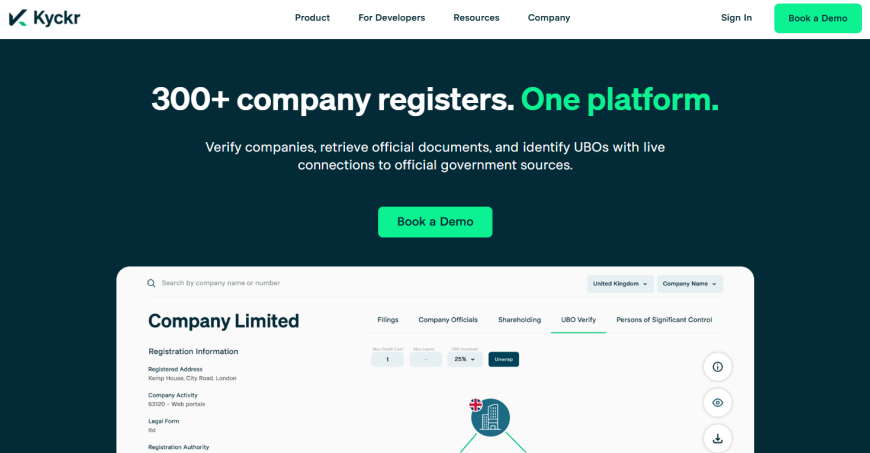
Kyckr is a registry-first KYB platform. It connects to commercial registers, financial authorities, and tax offices worldwide. One differentiator: it delivers original registry documents alongside structured data.
Key Features
- Real-time registry connections in 100+ countries
- Original registry documents plus structured data
- UBO discovery tool
- Tax ID verification and document translation
- API integration for compliance platforms
- Perpetual KYB monitoring
Limitations
- Smaller data footprint than Orbis or Global Database
- UBO is an add-on, not the core product
- Limited financial data
- Pricing not published
Pricing
Custom pricing based on volume. Contact Kyckr for a quote.
FAQ
- Does Kyckr provide original registry documents?
Yes. Both machine-readable data and original documents for audit trails. - Is Kyckr good for KYB automation?
Yes. Its API is commonly integrated into onboarding and lifecycle management platforms. - How many countries does Kyckr cover?
100+ countries, covering 328+ million companies. - Does Kyckr offer UBO identification?
Yes, as a value-added service alongside registry verification. - How does Kyckr compare to Zavia.ai for UBO?
Kyckr offers UBO as an add-on. Zavia.ai is purpose-built for UBO discovery with AI-powered ownership mapping.
6. Sayari
Description
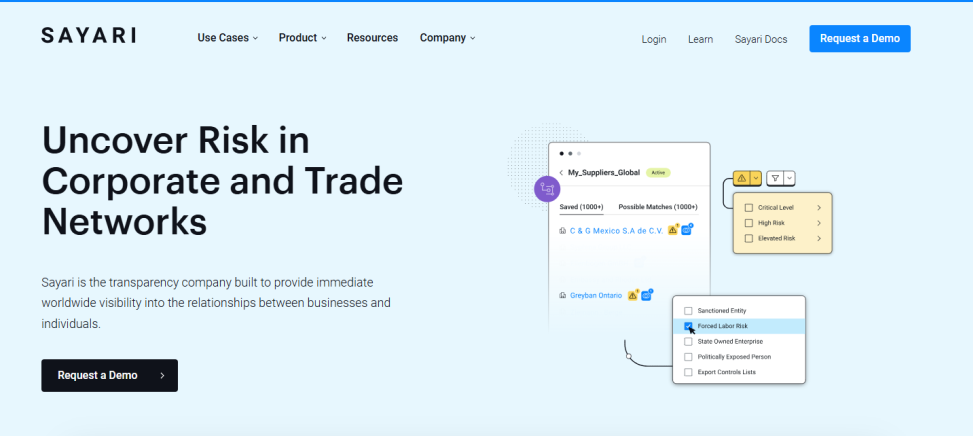
Sayari is a risk intelligence platform built for investigations. It combines corporate data, trade records, and maritime information with graph analytics to uncover hidden connections between entities.
Backed by In-Q-Tel (the CIA’s investment arm), it’s widely used by government agencies and Fortune 100 companies.
Key Features
- Graph analytics across 645M+ companies and 711M individuals
- 250+ jurisdictions including hard-to-reach regions
- Embedded watchlists, trade data, and maritime data
- Supply chain mapping (Sayari Map)
- Network visualization for investigations
- REST API and bulk data delivery
Limitations
- Enterprise-only pricing, not public
- Investigation tool, not an automated KYB platform
- Relies on open-source public records, not direct registry connections
- Requires onboarding and training investment
Pricing
Annual subscription. Pricing not public. Enterprise contracts required.
FAQ
- What is Sayari used for?
Sanctions screening, UBO investigations, supply chain due diligence, and financial crime investigations. - Does Sayari provide real-time registry data?
No. Sayari aggregates open-source public records from 250+ jurisdictions. It doesn’t connect to registries in real time like Zavia.ai or Global Database. - How much does Sayari cost?
Not publicly disclosed. Enterprise contracts required. - Is Sayari good for automated KYB?â
No. It’s built for analyst-driven investigations. For automated KYB, use Zephira.ai or Zavia.ai. - Who uses Sayari?
Government agencies, banks, Fortune 100 corporations, and investigative teams in 35+ countries.
7. OpenCorporates
Description
OpenCorporates is the world’s largest open database of company information. It has data on 220+ million companies across 140+ jurisdictions. The focus is transparency: making basic company filings publicly searchable.
Key Features
- Open access to basic company data from 140+ jurisdictions
- Strong data provenance and source transparency
- API access for searching company records
- Gazette notice tracking
- Free tier for basic searches
Limitations
- No UBO identification or beneficial ownership data
- No sanctions, PEP, or adverse media screening
- About half of data sources are offline and no longer updated
- API limit: 500 calls/month on standard plans
- Not built for compliance automation
Pricing
Free tier for basic searches. Paid API plans available. Enterprise pricing on request.
FAQ
- Does OpenCorporates provide UBO data?
No. It shows basic parent-subsidiary relationships from filings but does not identify ultimate beneficial owners. - Is OpenCorporates free?
Basic search is free. API access requires a paid plan (500 calls/month on standard). - Can I use OpenCorporates for AML compliance?
Not really. It lacks UBO tracking, sanctions screening, and PEP databases. It’s better for basic company lookups. - How current is OpenCorporates data?
Varies. Roughly half of its data sources are currently labeled offline and no longer receive updates. - How does OpenCorporates compare to Zavia.ai?
OpenCorporates provides basic company filings. Zavia.ai is built specifically for UBO discovery with AI, direct registry connections, and customizable thresholds.
8. Dun & Bradstreet
Description
D&B is one of the oldest names in business data. Its D-U-N-S Number is a global standard for business identification. UBO and ownership data is bundled into larger products like D&B Hoovers and D&B Direct.
Key Features
- D-U-N-S Number as a global identifier
- PAYDEX and financial stress scores
- Corporate linkage and ownership hierarchies
- Credit risk, supplier risk, and compliance modules
- Decades of archived business data
Limitations
- Expensive with complex contracts
- Restrictive licensing — limits redistribution
- UBO data bundled into larger suites, not standalone
- Slow onboarding for smaller teams
Pricing
Enterprise only. Custom quotes. Contact D&B.
FAQ
- Does D&B provide UBO data?
Yes, but bundled into broader products (D&B Hoovers, D&B Direct). Not available standalone. - What is the D-U-N-S Number?
A unique nine-digit business identifier used globally for verification, government contracts, and supply chain management. - How much does D&B cost?
Enterprise pricing with custom contracts. Costs vary by product, volume, and license terms. - Can I resell D&B data?
Typically no. D&B imposes restrictive licensing. - Is D&B good for startups?
Not ideal. Pricing and contracts are designed for enterprises. Zavia.ai, Zephira.ai, or Global Database are more accessible.
9. FinScan
Description
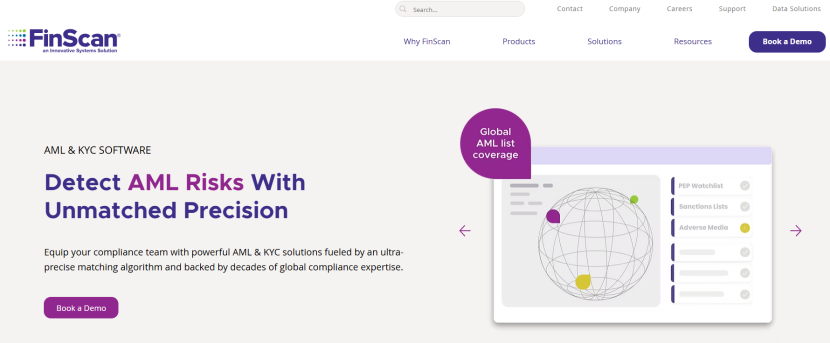
FinScan is an AML screening platform. It combines UBO identification with sanctions, PEP, and adverse media screening. Its UBO data comes from Dun & Bradstreet, and risk data comes from LSEG World-Check.
Key Features
- Automated UBO identification with PEP and watchlist screening
- Multi-layer ownership analysis
- Integration with D&B UBO data and LSEG World-Check
- Single platform for entity and individual risk assessment
Limitations
- UBO data sourced through D&B, not direct registries
- Screening platform, not a standalone UBO data provider
- Pricing not public
Pricing
Enterprise only. Contact FinScan for a quote.
FAQ
- Does FinScan connect to government registries?
No. UBO data comes through Dun & Bradstreet. - What is FinScan best for?
AML screening that combines UBO checks with sanctions, PEP, and adverse media in one platform. - Is UBO data available standalone from FinScan?
No. It’s integrated into the screening platform. - How does FinScan compare to Zavia.ai?
FinScan is a screening tool using third-party UBO data. Zavia.ai provides direct registry-sourced UBO identification with AI-powered ownership mapping. - How much does FinScan cost?
Enterprise pricing only. Contact FinScan for a custom quote.
UBO Data Providers at a Glance
| Provider | Data Source | Countries | UBO Focus | API | Thresholds | Starting Price |
|---|---|---|---|---|---|---|
| Zavia.ai | Direct Registry | 100+ | Core | Yes | Yes | $49/mo |
| Global Database | Direct Registry | 200+ | Yes | Yes | Yes | $1/check |
| Zephira.ai | Direct Registry | 100+ | Yes | Yes | Via API | $49/mo |
| Orbis (BvD) | Mixed | 200+ | Yes | Yes | Limited | $25K+/yr |
| Kyckr | Direct Registry | 100+ | Add-on | Yes | Limited | Custom |
| Sayari | Public Records | 250+ | Yes | Yes | No | Custom |
| OpenCorporates | Open Data | 140+ | No | Limited | No | Free tier |
| D&B | Mixed | 200+ | Bundled | Yes | No | Custom |
| FinScan | Via D&B | Global | Screening | Yes | No | Custom |
Registry-Sourced vs. Aggregated UBO Data
This is the most important distinction when choosing a UBO provider.
Registry-sourced data comes directly from government authorities. It’s legally defensible. It has clear provenance. Regulators accept it as evidence.
Aggregated data is assembled from secondary sources — web scraping, user submissions, credit agency feeds, outdated directories. It might be broader, but you can’t always prove where it came from. And when a regulator asks, that’s a problem.
Zavia.ai, Global Database, Zephira.ai, and Kyckr connect directly to government registries. Sayari and OpenCorporates rely on open-source public records. BvD and D&B use a mix.
If your compliance framework requires you to prove data provenance, registry-sourced is the only safe choice.
What to Look for in a UBO Data Provider
1. Data Sourcing
Ask one question: does the provider connect directly to government registries? If the answer is unclear, that tells you something.
2. Jurisdictional Depth
Country count is a vanity metric. What matters is whether the provider covers the specific jurisdictions you need — especially offshore and high-risk regions.
3. API Quality
Modern compliance runs on APIs. You need structured JSON outputs, clear docs, and scalable rate limits. If the provider’s main interface is a web portal, it won’t scale.
4. Threshold Customization
The EU uses 25%. Some countries use 10%. If your provider locks you into one threshold, you’ll have gaps in every jurisdiction that uses a different standard.
5. Pricing Transparency
If you can’t see the price without talking to sales, expect enterprise pricing. That’s fine for large institutions. But if you’re a 10-person compliance team, you need a provider that respects your time.
UBO Compliance by Region (Quick Reference)
- European Union: AML Directives require beneficial ownership registers across member states. Standard threshold: 25% ownership or control. A 2022 court ruling restricted public access in some EU jurisdictions.
- United Kingdom: ECCTA introduces mandatory identity verification for directors and Persons of Significant Control (PSCs). Rollout starts late 2025, full compliance by autumn 2026.
- United States: FinCEN removed the CTA reporting requirement for US-formed companies in March 2025. Foreign companies registered in the US must still report.
- Asia-Pacific: Singapore, Australia, and Hong Kong maintain active UBO registers. Australia’s AML/CTF reforms take effect March 31, 2026.
- Offshore Jurisdictions: BVI, Cayman Islands, and Jersey have historically limited UBO disclosure. FATF pressure is gradually increasing transparency requirements.
Frequently Asked Questions
1. What is a UBO data provider?
A company that supplies verified information about the real people who own or control legal entities. They connect to registries and databases to map ownership chains.
2. Why does UBO identification matter?
It’s required by AML, KYC, and KYB regulations in 149+ countries. Without it, you can’t verify who you’re doing business with — and regulators will fine you for that.
3. What’s the difference between registry-sourced and aggregated UBO data?
Registry-sourced data comes from government authorities and is legally defensible. Aggregated data comes from secondary sources and may have accuracy or freshness issues.
4. What ownership percentage defines a UBO?
Most commonly 25%, per FATF and EU guidelines. But it varies. Some jurisdictions use 10%. Some also consider control mechanisms beyond direct ownership.
5. How much do UBO data providers cost?
From $49/month (Zavia.ai) to $100K+/year (Orbis). Most enterprise vendors require a sales call before sharing pricing.
6. Can I use UBO data for M&A due diligence?
Yes. UBO data reveals true ownership structures, hidden risks, and sanctioned individuals behind target companies.
7. What is the Corporate Transparency Act?
A US law enacted in 2021 requiring beneficial ownership reporting to FinCEN. As of March 2025, US-formed companies are exempt. Foreign companies registered in the US must still report.
8. Do all UBO providers offer API access?
Most do, but quality varies. API-first platforms like Zephira.ai and Zavia.ai are built for programmatic use. Legacy providers may have slower, less documented APIs.
9. How often should UBO data be refreshed?
Best practice: continuous monitoring with real-time alerts. Minimum: at onboarding, annual reviews, and any trigger event (ownership change, regulatory update).
10. Which provider is best for small compliance teams?
Zavia.ai ($49/mo) for purpose-built UBO discovery. Global Database ($1/check) for broader intelligence. Both offer self-serve onboarding with no enterprise contract.