Circular Ownership Structures: How Companies Use Loops to Hide Beneficial Owners

A compliance team's guide to detecting, calculating, and resolving circular ownership — the technique that turns a 2% shareholder into a 100% controller.
Imagine a compliance analyst reviewing a new client. The corporate registry shows the company is owned by a holding entity. That holding entity is owned by another. And another. Eventually, the trail leads back to the original company.
The analyst has just walked into a circular ownership structure — and most compliance systems are not designed to catch it.
Circular ownership is one of the most effective methods for hiding who actually controls a company. It exploits a simple limitation: most UBO checks trace ownership linearly, from bottom to top. When the chain loops back on itself, the check breaks. The real beneficial owner — the natural person pulling the strings — stays invisible.
This guide breaks down how circular ownership works, why it evades standard compliance checks, and how to detect it. We include the actual math behind effective ownership calculation, a jurisdiction-by-jurisdiction legality comparison, and a walkthrough of how graph-based AI resolves loops that human analysts miss.
What Is Circular Ownership?
Circular ownership occurs when companies hold stakes in each other, creating a closed loop of control. In its simplest form: Company A owns a stake in Company B. Company B owns a stake in Company C. Company C owns a stake back in Company A.
This creates a situation where the entities collectively own themselves. No single external person appears to hold a controlling stake. The loop absorbs ownership, making it difficult — sometimes impossible — to trace control to a natural person using traditional methods.
The critical distinction: circular ownership is not the same as cross-ownership. Cross-ownership is when two companies hold stakes in each other (A owns B, B owns A). Circular ownership involves three or more entities forming a closed loop. Real-world loops often involve five to ten or more entities, spanning multiple jurisdictions.
The structure has legitimate uses. Conglomerates like Samsung and many Japanese keiretsu evolved circular ownership organically through decades of mergers and acquisitions. But the same structure is deliberately engineered by those looking to hide beneficial ownership, launder money, evade sanctions, or avoid regulatory disclosure thresholds.
How Circular Ownership Hides Beneficial Owners
Most regulatory frameworks use a threshold to define a beneficial owner. Under FATF guidance and adopted in the EU, anyone holding 25% or more of shares or voting rights must be identified as a UBO. Under OFAC's 50 Percent Rule, the threshold for sanctions screening is 50%.
Circular ownership defeats these thresholds through a mathematical trick: self-ownership.
When entities in a loop own stakes in each other, a portion of the total ownership circulates inside the loop itself. This means the ownership "available" to external shareholders is less than 100%. But because the loop entities don't appear on any sanctions list or PEP database — they are just companies, not natural persons — the circulating ownership is effectively invisible to threshold-based compliance checks.
The result: an individual can hold a tiny direct stake (2%, 5%, even less than 1%) while controlling the entire structure. They fall below every regulatory threshold. Every automated check returns "no UBO identified." And the real controller stays hidden.
If your UBO check only examines direct shareholding percentages against a regulatory threshold, circular ownership will defeat it every time. You need to calculate integrated ownership — the total of all direct and indirect paths, including the amplification effect created by the loop.
The Math: From 2% Direct to 100% Effective Ownership
This is where most articles on circular ownership stop. They describe the concept but never show the calculation. Compliance professionals need to understand the math, because it is the math that reveals whether someone is a beneficial owner — not the surface-level shareholding percentage.
Example 1: The Closed-Circle Structure
Three companies form a closed loop. No external person holds any shares. Company A owns 100% of Company B. Company B owns 100% of Company C. Company C owns 100% of Company A.
The self-ownership of the loop is:
The entities collectively own 100% of themselves. There is no external beneficial owner on paper. The structure is entirely self-referential.
Result: No UBO identified under any threshold-based check. The entities appear to own themselves.
This is the structure commonly seen in Russian corporate formations, where a subject entity is simultaneously its own ultimate parent. Traditional linear tracing cannot resolve it.
Example 2: The Open-Circle Structure (The Dangerous One)
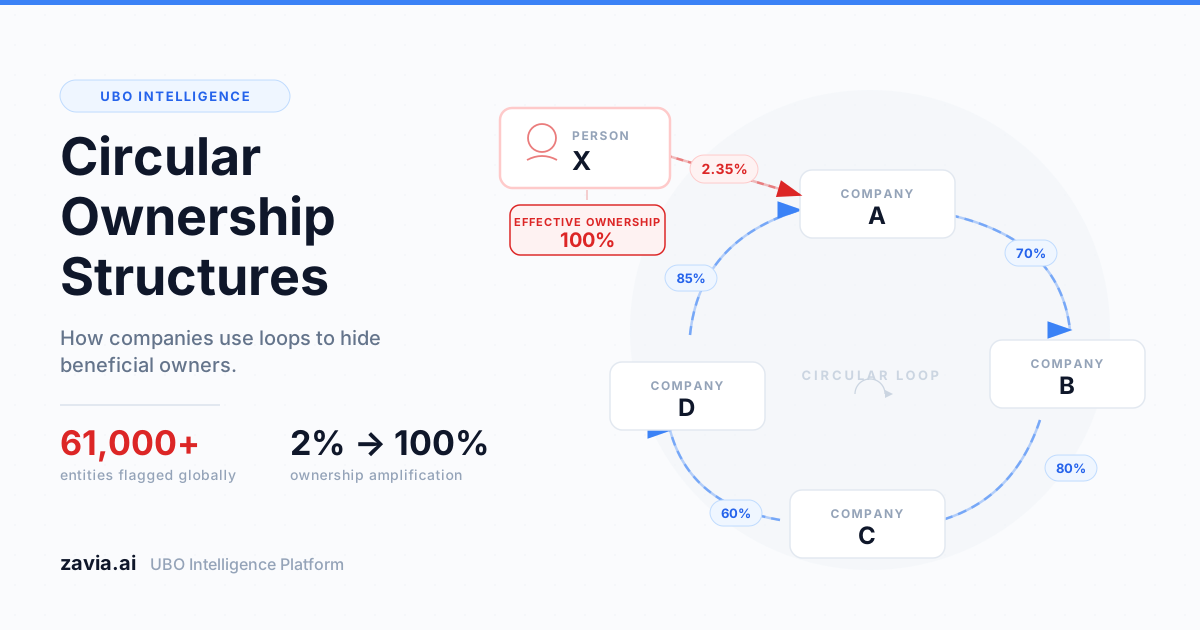
This is the structure that catches compliance teams off guard. An individual sits outside the loop, holding a small direct stake. The rest of the ownership circulates inside.
Person X holds 2.35% of Company A directly.
Company A owns 85% of Company B.
Company B owns 90% of Company C.
Company C owns 75% of Company D.
Company D owns 80% of Company A.
Step 1: Calculate the circular self-ownership of Company A.
Trace the loop: A → B → C → D → back to A.
Step 2: Calculate the externally available ownership.
Step 3: Calculate Person X's integrated ownership.
Person X is the only external shareholder. Their 2.35% direct stake must be evaluated against the 54.1% that is actually available to external holders.
But we also need to account for the fact that Person X's 2.35% stake gives them ownership of the loop itself, which feeds back. Since Person X is the only external owner, all externally available ownership ultimately belongs to them.
But since Person X is the sole external owner:
Result: Person X holds 2.35% on paper. Effective ownership: 100%. They control the entire structure. No threshold-based check flags them.
The circular loop "absorbs" 45.9% of the ownership into itself. The remaining 54.1% belongs entirely to Person X, because they are the only external shareholder. And since they control the entities that make up the loop, they effectively control 100% of all entities in the chain. The 2.35% direct stake is the only thread connecting the loop to a natural person — and it is easily missed.
Example 3: Multi-Path with Circular Feedback
Real-world structures are often more complex. An individual may hold stakes through multiple paths, some of which pass through a circular loop.
Person Y holds 10% of Company E directly.
Person Y also holds 50% of Company F.
Company F owns 80% of Company G.
Company G owns 50% of Company E.
Company E owns 10% of Company G (creating the circular loop: E → G → E).
Step 1: Find the circular self-ownership of Company E.
Wait — we need to trace carefully. E owns 10% of G. G owns 50% of E. So:
Step 2: Person Y's integrated ownership of E through all paths.
Direct path: 10%
Indirect path via F → G → E: 50% × 80% × 50% = 20%
Raw total: 10% + 20% = 30%
Adjust for self-ownership:
Result: Person Y's integrated ownership in Company E = 31.58%. Above the 25% FATF/EU threshold. Person Y is the UBO — but a linear check only finds 10% direct ownership.
Types of Circular Ownership Structures
| Type | Description | Detection Difficulty |
|---|---|---|
| Closed circle | All entities are inside the loop. No external natural person holds shares. The structure owns itself entirely. | Low — easily flagged by graph analysis, but often ignored because "no UBO" is returned. |
| Open circle | One or more natural persons hold small stakes outside the loop. The loop amplifies their effective control far beyond their direct shareholding. | High — requires calculating integrated ownership to reveal the true controller. |
| Multi-loop | Multiple circular structures nested within a larger ownership network. One entity may participate in two or more loops simultaneously. | Very high — manual analysis is essentially impossible. |
| Cross-jurisdictional loop | Loop entities are incorporated in different countries, often mixing transparent jurisdictions (UK, EU) with opaque ones (BVI, Cayman, Seychelles). | Very high — requires aggregating data from multiple government registries simultaneously. |
| Reciprocal (two-entity) | Company A owns Company B; Company B owns Company A. The simplest form of circular ownership. | Medium — detectable if both entities appear in the same ownership trace. |
Legality by Jurisdiction
Circular ownership is not universally illegal. Its legality varies by country, and the rules are more nuanced than a simple yes/no.
| Jurisdiction | Legal Status | Notes |
|---|---|---|
| Russia | Legal, common | Frequently used in corporate structures. Full closed-circle structures are common. |
| Japan | Legal | Historical keiretsu structures involve extensive cross- and circular ownership among group companies. |
| South Korea | Restricted | Reforms since 2014 have limited new circular shareholding within chaebol conglomerates. Legacy structures remain. |
| Italy | Restricted | Reciprocal shareholding limited to 2% for listed companies. Unlisted entities face fewer restrictions. |
| Netherlands | Conditional | Permitted under certain conditions. Subject to corporate law restrictions on voting rights of self-held shares. |
| United Kingdom | Prohibited | Companies Act prohibits subsidiaries from holding shares in their parent companies. The Economic Crime Act strengthened transparency requirements. |
| Norway | Prohibited | Direct and indirect self-ownership is illegal under Norwegian corporate law. |
| Germany | Restricted | Reciprocal shareholdings are legal but voting rights are limited when mutual holdings exceed 25%. |
| United States | No federal prohibition | Varies by state. The Corporate Transparency Act requires UBO disclosure but does not explicitly prohibit circular structures. |
| Offshore (BVI, Cayman, Seychelles) | Generally permitted | Limited corporate transparency requirements make these jurisdictions common components of cross-border circular structures. |
A circular structure can be perfectly legal and still be a vehicle for money laundering, sanctions evasion, or tax fraud. Compliance teams should evaluate the purpose of the structure, not just its legality. If there is no clear commercial rationale for the loop, enhanced due diligence is warranted.
Why Manual Compliance Checks Miss Circular Ownership
The compliance workflow at most financial institutions follows a linear process: identify the subject entity, trace ownership upward through each corporate layer, stop when a natural person is found above the regulatory threshold. This works for pyramidal structures. It fails catastrophically for circular ones.
The chain never terminates. In a linear structure, you eventually reach a natural person. In a circular structure, the chain loops back to an entity you already visited. If your system does not explicitly check for this, it either enters an infinite loop, runs out of budget for the investigation, or — more commonly — the analyst gives up and marks the case as "unable to determine UBO."
Jurisdictional gaps break the trace. Real-world loops span multiple countries. An analyst tracing ownership through the UK registry may reach a BVI entity. The BVI does not publicly disclose shareholder data. The trace ends. The fact that the BVI entity owns a stake back in a Dutch entity (which feeds back to the UK entity) is never discovered.
Threshold-only analysis misses amplified control. Even when an analyst traces the loop correctly, if they only compare direct shareholdings against the 25% threshold, they will not flag a 2% direct holder as a UBO. The integrated ownership calculation is complex enough that most analysts do not attempt it manually.
Volume makes it impossible. A mid-size bank processes thousands of new customers per year. Each requires a UBO check. Running a manual graph analysis on every single one is not operationally viable. Only automated systems can do this at scale.
Red Flags That Signal Circular Ownership
Compliance teams should watch for these indicators during onboarding and periodic reviews:
| Red Flag | What to Look For |
|---|---|
| Entity appears twice in ownership chain | If any entity name appears both above and below the subject entity in the ownership trace, a loop exists. |
| Shareholding just below threshold | An individual holding 24.9% in a 25%-threshold jurisdiction is suspicious. Circular structures are often designed to keep direct stakes below the disclosure line. |
| Same registered address across entities | Multiple entities in the ownership chain sharing an address — especially a virtual office or corporate services provider — suggests a manufactured structure. Moody's data found 61,000 businesses at a single South African address. |
| Directors in 20+ entities | A natural person serving as director across many entities in the chain is a common pattern in constructed loops. These are often nominee directors. |
| Entities in secrecy jurisdictions | When an ownership chain passes through BVI, Cayman, Seychelles, or Panama with no clear business rationale, the opacity may be intentional. |
| No identifiable UBO returned | "No UBO found" is not a clean result. It may mean the ownership loops back on itself, and the structure needs deeper investigation. |
| Holding entities with no operations | Companies in the chain with no employees, no revenue, and no apparent business activity are likely structural vehicles. |
Regulatory Requirements
No major regulation explicitly names "circular ownership." But the obligation to identify persons with ultimate effective control implicitly requires it. If you cannot demonstrate that you have investigated and resolved circular structures, your UBO determination may be considered incomplete.
| Regulation | Relevant Requirement |
|---|---|
| FATF Recommendations | Identify the natural person(s) who "ultimately owns or controls" a customer. The word "ultimately" requires tracing through all layers, including loops. |
| EU 6AMLD / AMLD6 | Requires assessing "direct or indirect shareholding with 25% or more." Indirect ownership includes ownership through intermediate entities — which includes circular paths. |
| US Corporate Transparency Act | Companies must report beneficial owners to FinCEN. The rule defines beneficial ownership through "any contract, arrangement, understanding, relationship or otherwise" — broad enough to cover circular control. |
| OFAC 50 Percent Rule | Entities owned 50% or more (directly or indirectly) by a sanctioned person are themselves considered blocked. Circular ownership can push effective ownership above 50% while keeping direct ownership below it. |
| UK Economic Crime Act | Strengthened PSC (Persons with Significant Control) requirements. Companies must identify anyone exercising significant influence or control — explicitly covering non-shareholding control mechanisms. |
How AI Detects and Resolves Circular Ownership
Graph-based AI is the only practical way to detect circular ownership at scale. The approach works in three stages.
Stage 1: Build the Ownership Graph
The system ingests ownership data from government registries and builds a directed graph where each entity is a node and each ownership relationship is an edge with a percentage weight. For circular ownership detection to work, the system must have multi-jurisdictional coverage — a loop spanning the UK, BVI, and Cyprus cannot be detected if you only have UK data.
Zavia.ai connects directly to government registries in 100+ countries, ingesting the official shareholder records as filed. This first-party data approach means the graph reflects what is actually registered, not what third-party aggregators have estimated or inferred.
Stage 2: Detect Cycles
Once the graph is built, the system runs cycle detection algorithms — typically a variant of depth-first search (DFS) — to identify any path that leads back to a node already visited. When a cycle is found, the system flags it and extracts the loop for analysis.
This is the step that separates graph-based tools from linear tracing. A linear check follows one path upward. DFS explores every path simultaneously, across all entities and jurisdictions in the graph. If a loop exists, it will be found — regardless of how many entities it spans.
Stage 3: Calculate Integrated Ownership
Once the cycle is identified, the system calculates integrated ownership using the method shown earlier in this article. For each external natural person, the system determines their effective ownership by accounting for the self-ownership created by the loop. Any person whose integrated ownership exceeds the regulatory threshold is flagged as a UBO.
Zavia.ai performs this calculation automatically across unlimited ownership layers. The result is a resolved ownership structure showing the true beneficial owner — even when the direct shareholding is below 1%.
A manual analyst investigating a 10-entity cross-border circular structure might take 3-5 days — if they detect the loop at all. Zavia.ai resolves the same structure in seconds, with full audit trail showing every entity, every ownership percentage, and the mathematical proof of the UBO determination.
Detect Circular Ownership in Your Portfolio
Upload a company name. Zavia.ai traces every ownership path — including loops — across 100+ jurisdictions and returns the resolved UBO in seconds.
Start Free Trial →Frequently Asked Questions
Stop Circular Structures from Hiding Your Clients' True Owners
Zavia.ai connects to 100+ government registries, detects ownership loops automatically, and calculates integrated ownership in seconds. See it work on your data.
Try Zavia.ai Free →