France Beneficial Ownership Register (RBE): UBO Data, Access & 2026 Changes

1. France's UBO Register: The State of Play in 2026
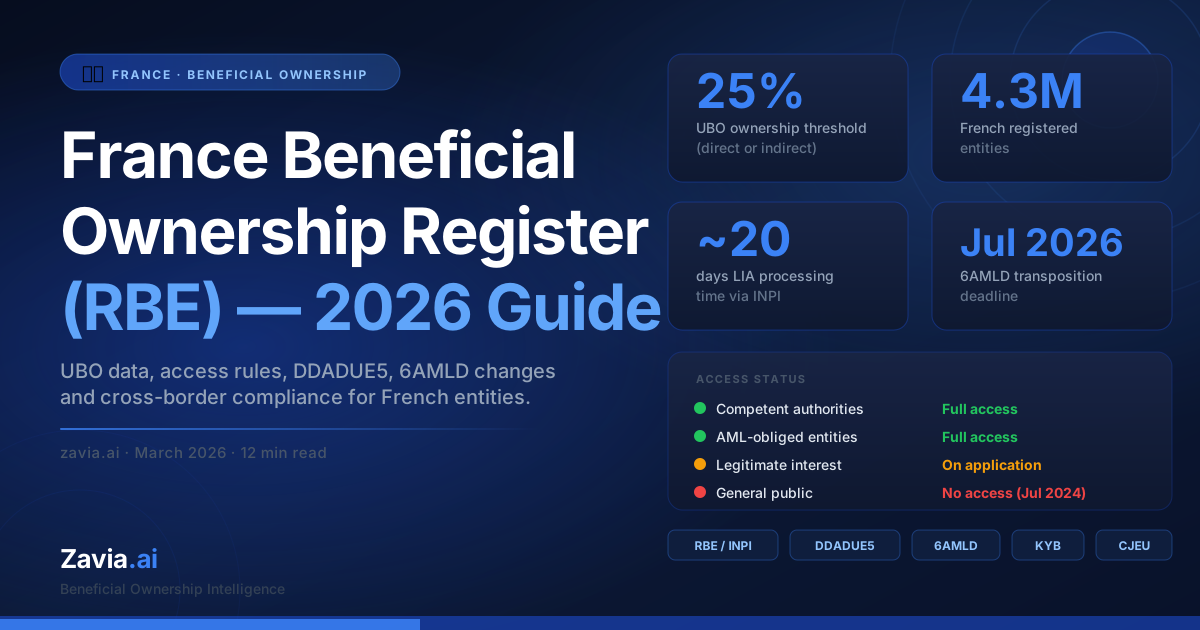
France maintains one of the largest corporate registers in the EU, with over 4.3 million active registered entities. For compliance teams, KYB platforms, and due diligence analysts working with French counterparties, understanding who ultimately controls those companies is a regulatory requirement.
France's answer is the Registre des Beneficiaires Effectifs (RBE) — the Register of Beneficial Owners. Created in 2017 under Ordinance No. 2016-1635 (transposing the EU's Fourth Anti-Money Laundering Directive), it requires every non-listed company registered in France to declare its beneficial owners. The data is held centrally by the Institut National de la Propriete Industrielle (INPI) via the data.inpi.fr platform.
Three forces are converging simultaneously right now: the post-CJEU closure of public access in July 2024, new enforcement powers introduced in June 2025, and the approaching 6AMLD harmonisation deadline in July 2026. The compliance window is tight and the rules keep changing.
This article is part of Zavia.ai's Global Ownership Data Index, covering UBO and corporate data availability across 173 countries. France is covered in the EU & EEA section, scored as Partial for UBO access.
2. What Is a UBO Under French Law?
The French Monetary and Financial Code (Articles L.561-2-2 and R.561-1 to R.561-3-0) defines a UBO as the natural person who ultimately controls or owns a company. The threshold is more than 25% of capital or voting rights — directly or indirectly, through the entire holding chain.
The 25% threshold
A natural person qualifies as a UBO if they directly or indirectly hold more than 25% of capital shares or more than 25% of voting rights. The calculation takes into account the full holding chain. A person with 60% of a company that holds 50% of the target entity qualifies, because their indirect stake (30%) exceeds the threshold.
Control by other means
If no individual meets the 25% threshold through ownership or voting rights, French law applies the "control by other means" test. This covers individuals who can appoint or dismiss a majority of the board, or who exercise dominant influence over management decisions under Article L.233-3 of the French Commercial Code.
The "last resort UBO" rule
If exhaustive analysis produces no identifiable natural person through either ownership or control tests, the legal representatives of the company — managers, presidents, executive directors — are declared as UBOs of last resort. France applied this from the register's inception in 2017.
Under the EU Anti-Money Laundering Regulation (AMLR) applying from July 10, 2027, the threshold shifts from "more than 25%" to "25% or more." Any person holding exactly 25% will qualify as a UBO. For obliged entities conducting CDD today, current clients holding exactly 25% may require additional UBO filings when the new threshold applies.
Which entities must file?
| Entity Type | Must File? | Notes |
|---|---|---|
| Commercial companies (SARL, SAS, SA, SNC) | ✓ Yes | All companies registered with the RCS |
| Civil societies and partnerships (SCI, SCP) | ✓ Yes | Including civil real estate companies |
| Foreign entities with a French branch or tax presence | ✓ Yes | Must file via the relevant commercial court |
| Trusts and fiduciaries with a French nexus | ✓ Yes | Subject to adapted criteria |
| Subsidiaries of listed companies | ✓ Yes | Must declare legal representatives as last resort UBOs |
| Listed companies (EU/EEA or equivalent) | ✗ Exempt | Parent only; subsidiaries must still file |
| Foundations and associations (not RCS-registered) | ✗ Exempt | Endowment funds (fonds de dotation) also exempt |
3. What UBO Data Is Actually Available in France's RBE
France's RBE holds two layers: company-level data and individual UBO data. Not all of it is accessible to all parties. Here is what the register captures and who can see what:
| Data Field | Available? | Publicly Accessible? | Notes |
|---|---|---|---|
| Corporate name & legal form | ✓ Yes | ✓ Public | SA, SARL, SAS, SCI, etc. |
| SIREN number | ✓ Yes | ✓ Public | Unique 9-digit French company identifier |
| Registered address (siege social) | ✓ Yes | ✓ Public | Available via data.inpi.fr |
| RCS registration details | ✓ Yes | ✓ Public | Commercial court, registration date |
| Full name (surname & first names) | ✓ Yes | ● Authorised parties | Available after LIA approval or as obliged entity |
| Nationality | ✓ Yes | ● Authorised parties | — |
| Country of residence | ✓ Yes | ● Authorised parties | Country only, not full address |
| Month and year of birth | ✓ Yes | ● Authorised parties | Full DOB (including day) for account holders only |
| Personal address | ✓ Yes | ● Account holders only | Restricted to approved INPI accounts |
| Date became UBO | ✓ Yes | ● Account holders only | Historical ownership dates not yet available |
| Nature and extent of control (%) | ✓ Yes | ● Authorised parties | Ownership %, voting rights, or type of control |
| Ownership chain / corporate structure | ✗ No | ✗ No | Register shows declared UBO, not the path to them |
| Historical ownership changes | ✗ No | ✗ No | Required under 6AMLD from July 2026 |
| PEP / sanctions flags | ✗ No | ✗ No | Must be cross-referenced from external sources |
France's RBE captures the declared UBO — the natural person at the end of the ownership chain. But if a French company is owned by a Luxembourg holding company, which is controlled by a BVI entity, the RBE stops at the declared UBO. It does not show the intermediate structure. For full ownership chain mapping, you need cross-border data beyond the French register.
4. Who Can Access France's UBO Register?
France went through three distinct access phases in three years. Understanding the history is critical for compliance teams that may have built workflows based on the previous public access model.
Current access categories (as of March 2026)
| Category | Access Level | Process | Cost |
|---|---|---|---|
| Competent authorities (police, judiciary, TRACFIN, tax, customs) | Full — all fields | Direct access | Free |
| AML-obliged entities (banks, insurers, notaries, accountants, lawyers) | Full — all fields | INPI account + AML role documentation | Free after approval |
| Journalists, researchers, civil society (AML-related work) | Full — all fields | Legitimate interest application to INPI | Free after approval (~20 days) |
| Persons with legitimate interest (entering business relationship) | Full — all fields | INPI application + supporting documents | Free after approval |
| Authorised Treasury and customs officials | Full — all fields | Official designation | Free |
| General public | None | No access route as of July 2024 | N/A |
How to apply for legitimate interest access
- Create an account on data.inpi.fr
- Complete the INPI legitimate interest access request form, specifying legal basis and purpose
- Submit supporting documents: passport, proof of AML professional role or legitimate interest — translated into French where required
- Wait for INPI review — typically 15–25 working days
- Upon approval, access UBO data through the INPI portal or API endpoint
- Documents obtained cannot be disclosed to third parties
INPI's access application form requires a SIREN number — a French company identifier unavailable to foreign entities without a French presence. Transparency International reported waiting approximately 20 days for access after a complete submission. All documentation and correspondence is in French only.
5. Is Access Free? Cost and Availability Breakdown
| Access Method | Cost | What You Get |
|---|---|---|
| data.inpi.fr portal (basic company data) | Free | Company name, SIREN, legal form, address, directors — no UBO without approval |
| data.inpi.fr portal (after LIA approval) | Free | Full UBO fields for entities queried individually |
| INPI API (after LIA or obliged entity approval) | Free | Programmatic access to company and UBO data |
| Greffe du Tribunal de Commerce extract | ~€23 per extract | Certified document including UBO data — accepted for KYC purposes |
| Infogreffe (third-party portal) | Paid per query | Directors, shareholders, company documents — UBO requires certification |
| Bulk data / machine-readable export | Not currently available | Required under 6AMLD from July 2026 |
The RBE has no annual maintenance fee for companies filing UBO declarations. Company formality fees — including the initial UBO declaration — amount to approximately €23 per filing under the government tariff order.
6. Penalties for Non-Compliance
France significantly tightened enforcement in 2025. Non-compliance with UBO filing obligations now carries both criminal and administrative consequences.
Since June 15, 2025, the clerk of the local commercial court can automatically remove a non-compliant company from the Trade and Companies Register (RCS) after a formal 3-month notice period. This revokes the company's legal standing in France. Deregistration can be triggered by the clerk's own identification of the failure, or by a report from an AML-obliged entity or regulatory authority.
The 30-day update requirement is strictly interpreted. Any change to a UBO's information — change of address, change in shareholding, arrival of a new UBO, departure of an existing one — must be filed with the RBE within 30 days. Missing this window constitutes a separate violation.
7. Existing Legislation
| Legislation | Year | Key Provision |
|---|---|---|
| EU 4th AML Directive (AMLD4) | 2015 | Required member states to establish UBO registers for companies |
| Ordinance No. 2016-1635 (Sapin II transposition) | 2017 | Created the French RBE; filing mandatory from August 2017 |
| EU 5th AML Directive (AMLD5) | 2018 | Required public access to beneficial ownership registers |
| CJEU Ruling (Cases C-37/20 & C-601/20) | Nov 2022 | Struck down blanket public access as a violation of EU Charter privacy rights |
| French Government Decree (public access closure) | Jul 2024 | Formally restricted RBE access to legitimate interest and authorised parties |
| DDADUE5 — Act No. 2025-391 | Apr 2025 | Codified access rules in French national law; defined the authorised entity list |
| New enforcement powers (court registrar deregistration) | Jun 2025 | Enabled automatic RCS removal of non-compliant companies after 3-month notice |
| EU AML Package (6AMLD + AMLR) | 2024 adopted | Mandates harmonised LIA rules, historical data, bulk access; deadline July 2026–2027 |
8. Upcoming Changes: The 2026–2027 Roadmap
The EU's Anti-Money Laundering package — 6AMLD and the AMLR — was adopted in 2024. It reshapes beneficial ownership access across the EU from 2026 onward.
1. Presumed legitimate interest for journalists and civil society (July 2026)
Journalists, academics, and civil society organisations with work connected to AML or its predicate offences will no longer need to prove legitimate interest case-by-case. They will have presumed legitimate interest — generalised register access without individual approval. France must implement this by July 2026. The European Commission had already initiated infringement proceedings against 11 EU member states for failing to transpose initial 6AMLD requirements on time; France was not among them.
2. Historical ownership data (July 2026)
From July 2026, all EU member states must provide legitimate-interest users with access to historical ownership records — showing when a person became or ceased to be a beneficial owner. Currently, no EU UBO register including France's provides this. It is significant for retrospective due diligence and financial crime investigations.
3. Machine-readable bulk data access (2026–2027)
6AMLD requires member states to make UBO register data available in machine-readable format for authorised users. For France, this will mean API access and bulk data file delivery at scale — a significant improvement for KYB platforms currently relying on individual INPI queries.
4. BORIS cross-border integration
France's RBE feeds into the EU's Beneficial Ownership Registers Interconnection System (BORIS). By 2026–2027, accessing a French company's beneficial ownership data should be possible through a single EU-level gateway — without navigating INPI directly.
5. Threshold shift from "more than 25%" to "25% or more" (July 2027)
The AMLR shifts the ownership threshold slightly. Any person holding exactly 25% of capital or voting rights will qualify as a UBO from July 10, 2027. This may require re-screening existing entity data to identify previously borderline cases.
The 2026–2027 roadmap is broadly positive for compliance teams. The combination of presumed legitimate interest, historical data requirements, and mandatory machine-readable access will substantially reduce the friction of working with French UBO data. Teams should plan now for a more automated, API-driven workflow.
9. The Real Challenges of Accessing French UBO Data
9.1 No API and no bulk access (currently)
The INPI API is available to approved users but not freely accessible without the account approval process. There is no bulk data download equivalent to the UK's Companies House bulk PSC dataset. For compliance platforms managing thousands of entity verifications, this is a critical operational bottleneck — the same problem that makes Germany's Transparenzregister nearly unusable at scale.
9.2 French-language process only
The INPI access application, forms, and supporting documentation requirements are in French. Non-French entities must translate documents. Unlike some EU registers that accept English-language submissions, INPI has no official English-language application pathway.
9.3 The SIREN barrier for non-EU applicants
The INPI application form requires a SIREN number — a French company identifier. Foreign entities without a French legal presence cannot complete the standard form without workarounds. This structural barrier was not addressed in the DDADUE5 law.
9.4 No ownership chain resolution
The RBE captures the declared UBO but does not map the intermediate corporate structure. For a French SAS owned by a Dutch holding company owned by a Cayman Islands entity, the RBE tells you who the UBO is; it does not show how they control the French entity. Tracing the chain requires combining French RBE data with corporate data from multiple foreign registries.
9.5 No historical data
The current RBE provides no historical ownership records. Who was the UBO two years ago? What was their ownership percentage before the last restructuring? This is unavailable until July 2026 at the earliest — a significant gap for retrospective due diligence.
9.6 Data quality and update lag
Despite the 30-day filing requirement, real-world update compliance varies significantly. Smaller SMEs and dormant companies frequently have outdated UBO records. The new deregistration enforcement introduced in June 2025 is intended to address this, but improving data quality across 4.3 million entities will take time.
9.7 Approval uncertainty
Legitimate interest applications are reviewed case-by-case. INPI can reject applications it finds insufficiently substantiated. The approximately 20-day processing time creates operational unpredictability for high-volume use cases. Unlike Belgium, Finland, or Malta which offer straightforward email-based access requests, France's process involves more documentation and longer review cycles.
10. How Zavia.ai Resolves France UBO Access
Zavia.ai connects directly to INPI and France's official company data infrastructure — providing structured, API-accessible UBO and corporate data for French entities without requiring your team to navigate the INPI approval process, manage French-language documentation, or build and maintain a separate INPI integration.
🇫🇷 France UBO Data via the Zavia.ai API
One API endpoint. Real-time access to French beneficial ownership, directors, shareholders, and company registry data — sourced directly from INPI and the French Trade Register. No per-query INPI account required.
- Real-time UBO queries for any French SIREN
- Cross-border ownership chain resolution
- Corporate linkage — subsidiaries, parents, group structure
- Bulk data delivery — licensed file exports at scale
- Sanctions overlay and KYB verification workflow
- Historical company data and director history
- 173-country coverage — one integration, global reach
- Full reseller and redistribution rights available
Cross-border ownership chain resolution
France's RBE tells you who the declared UBO is. But if that person controls a French company through a Luxembourg holding entity, a trust in Liechtenstein, and an intermediary in the UAE, the French register stops at the declaration. Zavia.ai resolves the ownership chain across jurisdictions — connecting French RBE data with 173 countries of corporate and ownership data from official government registries worldwide.
For a French SAS owned by a UK holding company, owned by a Dutch BV, ultimately controlled by an individual in Singapore — Zavia.ai maps the entire chain in a single API call. The output is a structured JSON ownership graph with UBO identification, shareholding percentages, and data provenance at each layer.
Bulk data delivery
For compliance platforms, financial institutions, or data products that need French UBO data at scale — not just individual lookups — Zavia.ai offers structured bulk data file delivery. Licensed extracts of French corporate and UBO data, updated on a defined cadence, delivered in your preferred format. Full reseller rights available for redistribution use cases.
A French company whose declared UBO holds exactly 26% through three holding entities may look clean in the RBE. Zavia.ai traces the full chain above and below the French entity — surfacing indirect controllers, circular ownership structures, and cross-border linkages that the RBE alone won't show you.