
What Are UBO Regulations?
UBO regulations are laws that force companies to disclose the real people who own or control them. UBO stands for Ultimate Beneficial Owner. Every major economy now requires some form of UBO disclosure, though the rules differ widely from one jurisdiction to the next.
These laws exist for a simple reason. Without them, criminals can hide behind layers of shell companies to launder money, evade taxes, and dodge sanctions. UBO regulations strip away that cover. They make companies name the natural person at the end of the ownership chain.
The challenge for compliance teams is that no two countries handle this the same way. Ownership thresholds vary. Some registries are public. Others are restricted to law enforcement. Filing deadlines, penalty frameworks, and enforcement intensity all differ.
This guide breaks down UBO rules across 17 jurisdictions — covering Europe, the Americas, the Middle East, Africa, and Asia-Pacific. It includes thresholds, registry names, access rules, key laws, and upcoming 2026 deadlines. If you operate across borders, this is the reference you need.
Global UBO Standards: FATF Recommendations 24 and 25
The Financial Action Task Force sets the global baseline for UBO regulation. Two recommendations matter most.
Recommendation 24 covers legal persons — companies, LLCs, partnerships. It requires countries to ensure that competent authorities can access accurate, up-to-date information on who owns and controls these entities. FATF updated R.24 in March 2022 and published revised guidance in March 2023, calling for a “multi-pronged approach” that combines registry data, information held by the entity itself, and data gathered by financial institutions.
Recommendation 25 covers legal arrangements — trusts and similar structures. It requires countries to assess the money laundering and terrorist financing risks linked to trusts and take proportional measures to ensure transparency.
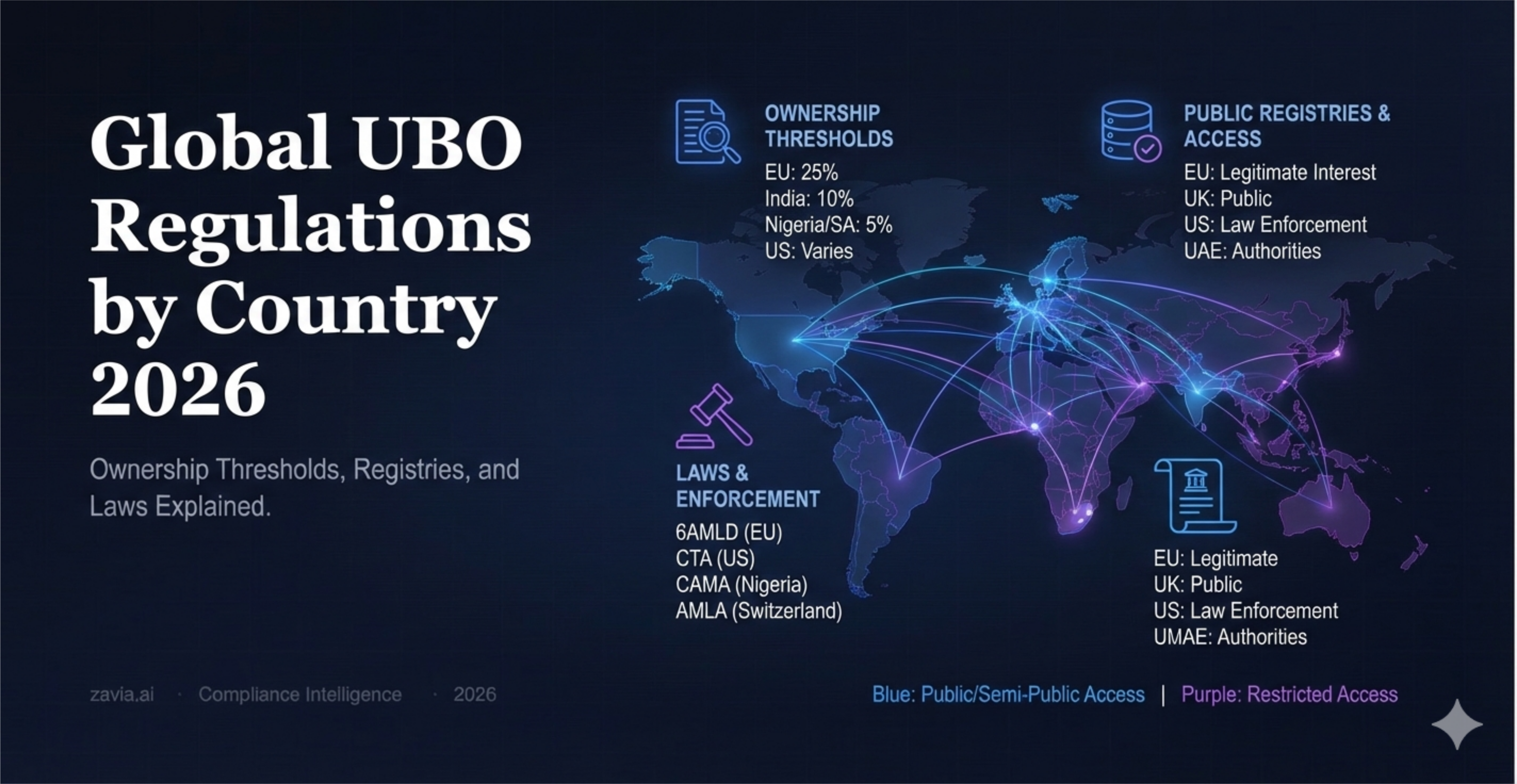
FATF does not mandate a specific ownership threshold. It recommends that 25% should be the maximum, not the minimum. Countries are free to set lower thresholds. India uses 10%. South Africa uses 5%. Nigeria uses 5%. Several EU member states are moving toward 15% for high-risk sectors under the new 6AMLD.
FATF’s mutual evaluations — the peer reviews that grade each country’s AML framework — are the enforcement mechanism. A poor rating can result in grey-listing, which restricts a country’s access to international capital markets. This pressure is why UBO regulations have expanded so rapidly since 2020.
UBO Regulations in the European Union
The EU has the most layered UBO framework in the world. It has evolved through four successive Anti-Money Laundering Directives, each one tightening the rules.
4AMLD (2015) first required member states to create central UBO registers. 5AMLD (2018) made those registers publicly accessible. Then came the Court of Justice of the EU (CJEU) ruling in November 2022, which struck down blanket public access as a violation of privacy rights under the EU Charter of Fundamental Rights.
The result was a patchwork. Some member states, like Poland, kept public access. Others, like Cyprus, restricted it to national obliged entities and authorities. A majority adopted a “legitimate interest” test, where access is granted to journalists, civil society, obliged entities, and anyone involved in anti-money laundering work — but only after proving their interest.
6AMLD, passed in May 2024, aims to fix this fragmentation. Key changes include:
- Legitimate interest access becomes the standard across all member states.
- UBO data must be machine-readable, enabling automated verification.
- A pan-EU “Blue Card” system is planned: once access is granted in one member state, it should work across all EU registers.
- The new EU Anti-Money Laundering Authority (AMLA), based in Frankfurt, will oversee enforcement starting in 2025.
Member states must transpose 6AMLD into national law by July 10, 2026. Many are behind schedule. In late 2025, the European Commission opened infringement proceedings against Belgium, Denmark, Germany, Estonia, Greece, Italy, Cyprus, Croatia, Poland, Slovakia, and Sweden for failing to notify transposition progress.
Threshold: 25% ownership or voting rights (member states may lower to 15% for high-risk sectors with Commission approval).
Registry: National beneficial ownership registers in each member state.
Public access: Legitimate interest basis from 2026.
UBO Regulations in the United Kingdom
The UK runs one of the most transparent beneficial ownership systems in the world through its Persons of Significant Control (PSC) register at Companies House.
Any individual who holds more than 25% of a company’s shares or voting rights, has the right to appoint or remove a majority of the board, or exercises significant influence or control must be registered as a PSC. This information is publicly accessible at no cost.
The Economic Crime and Corporate Transparency Act 2023 introduced major reforms that began rolling out in 2024 and 2025. Companies House now has powers to verify the identity of directors and PSCs, reject filings that appear suspicious, and share data proactively with law enforcement. Mandatory identity verification for new directors launched in late 2025, with existing directors required to verify by the end of 2026.
The UK has also cracked down on Scottish Limited Partnerships (SLPs), which were widely used as shell structures in money laundering schemes. SLPs now have the same PSC reporting obligations as standard companies.
Threshold: 25% ownership, voting rights, or significant influence or control.
Registry: Companies House PSC Register.
Public access: Yes. Free and unrestricted.
Key law: Companies Act 2006; Economic Crime and Corporate Transparency Act 2023.
UBO Regulations in the United States
The US UBO landscape shifted dramatically in 2025. Here is what happened.
The Corporate Transparency Act (CTA), passed in 2021, was designed to create a national beneficial ownership registry at FinCEN (Financial Crimes Enforcement Network). It originally required all domestic “reporting companies” — roughly 32 million small businesses — to file Beneficial Ownership Information (BOI) reports.
After a series of legal challenges and court injunctions, FinCEN issued an interim final rule on March 26, 2025, that fundamentally narrowed the scope of the CTA:
- All US-formed entities are now exempt from BOI reporting.
- Only foreign entities registered to do business in a US state or tribal jurisdiction must report.
- Even for foreign reporting companies, no US persons need to be identified as beneficial owners.
Foreign reporting companies that registered before March 26, 2025, had until April 25, 2025 to file. Those registering after that date have 30 days from the effective registration date.
In December 2025, the Eleventh Circuit Court of Appeals upheld the CTA as constitutional under the Commerce Clause. But the FinCEN interim rule exempting domestic entities remains in force. FinCEN has indicated it plans to finalize revised regulations, potentially reintroducing some domestic requirements, but as of early 2026, no final rule has been published.
Separately, New York’s LLC Transparency Act took effect on January 1, 2026, imposing state-level beneficial ownership disclosure for certain LLCs formed in or authorized to do business in New York. After a gubernatorial veto, the scope was narrowed to foreign LLCs only.
Threshold: 25% ownership or substantial control.
Registry: FinCEN BOI database (limited to foreign entities as of March 2025).
Public access: No. Law enforcement and authorized institutions only.
Key law: Corporate Transparency Act (2021); FinCEN Interim Final Rule (March 2025).
UBO Regulations in Singapore
Singapore has required companies to maintain a Register of Registrable Controllers (RORC) since July 2017. The RORC must identify every individual who has significant control over the company.
The threshold is 25% ownership of shares or voting rights, or the right to appoint or remove a majority of directors. Companies must file this information with the Accounting and Corporate Regulatory Authority (ACRA).
Unlike the UK, Singapore’s RORC is not publicly accessible. ACRA may share the data with domestic law enforcement agencies and certain regulatory bodies upon request, but the general public cannot search or view it. This reflects Singapore’s approach of balancing transparency with privacy and commercial confidentiality.
In 2024, ACRA struck off approximately 50,000 non-compliant entities — a clear signal that enforcement is tightening. Companies that fail to maintain or file their RORC face penalties of up to SGD 5,000 per offense.
Threshold: 25% ownership or voting rights, or right to appoint/remove majority of directors.
Registry: Register of Registrable Controllers (RORC), filed with ACRA.
Public access: No. Law enforcement only.
Key law: Companies Act 1967 (Part 11A); Companies (Amendment) Act 2017.
UBO Regulations in the United Arab Emirates
The UAE’s UBO framework is governed by Cabinet Resolution No. 58 of 2020, with penalties further defined in Cabinet Decision No. 109 of 2023. Since January 2024, regulatory authorities have actively enforced penalties, and audit intensity increased throughout 2025.
Nearly all companies licensed in the UAE — mainland, free zone, and offshore — must identify and report their beneficial owners. The threshold is 25% ownership of shares, voting rights, or decision-making power. Companies must maintain a Beneficial Ownership Register, a Register of Partners or Shareholders, and a Register of Nominee Directors or Managers.
Entities in the DIFC and ADGM are exempt from the federal UBO regulations because these financial free zones have their own, equally stringent beneficial ownership rules. Government-owned entities and publicly listed companies are also exempt.
Companies must designate a UAE-resident contact person responsible for providing UBO information to the licensing authority on request. Changes to beneficial ownership must be reported within 15 days. Records must be retained for at least five years after deregistration.
Non-compliance carries fines ranging from AED 50,000 to AED 1,000,000, escalating to license suspension for repeated violations.
Threshold: 25% ownership, voting rights, or decision-making power.
Registry: Maintained by each licensing authority (DED, free zone authorities).
Public access: No. Competent authorities only.
Key law: Cabinet Resolution No. 58/2020; Cabinet Decision No. 109/2023.
UBO Regulations in Australia
Australia is one of the last major economies without a centralized beneficial ownership register. But that is changing.
The country’s AML/CTF Act reforms (Tranche 2) have been under discussion for over a decade. The proposed reforms would extend AML obligations to lawyers, accountants, real estate agents, and dealers in precious metals — professions currently outside the regime. A key component is the establishment of a publicly accessible beneficial ownership register.
The Australian government has committed to launching the register, with a proposed go-live target in 2026. The Australian Securities and Investments Commission (ASIC) would oversee the register, with enhanced enforcement powers for non-compliance.
Currently, Australian companies are required to maintain a register of members (shareholders), but there is no mandatory UBO register that identifies the natural persons behind multi-layered ownership structures. This gap has drawn repeated criticism from FATF in its mutual evaluation reports.
Threshold: Proposed 25% (to be confirmed in final legislation).
Registry: Proposed public register under ASIC (not yet operational).
Public access: Proposed to be public.
Key law: AML/CTF Act 2006; Tranche 2 reforms (pending).
UBO Regulations in Germany
Germany operates the Transparenzregister (Transparency Register), which was converted from a catch-all register into a full beneficial ownership register in August 2021. All legal entities must file their UBO information directly, regardless of whether the information is already available in other public registers like the Handelsregister (Commercial Register).
Following the CJEU ruling in November 2022, Germany restricted public access to the Transparenzregister. Access is now granted only on the basis of “legitimate interest” — a standard that requires the applicant to demonstrate a specific reason for needing the data, such as AML compliance or investigative journalism.
Germany was among the member states cited by the European Commission for slow progress on transposing 6AMLD. Compliance teams should expect access rules to evolve as Germany brings its framework into line with the new directive by July 2026.
Threshold: 25% ownership or voting rights.
Registry: Transparenzregister.
Public access: Legitimate interest only (post-CJEU).
Key law: Geldwäschegesetz (GwG); EU 6AMLD transposition pending.
UBO Regulations in India
India has one of the most aggressive UBO thresholds among major economies. Under the Companies Act 2013 and the Companies (Significant Beneficial Owners) Rules 2018, the threshold for declaring significant beneficial ownership is 10% — far lower than the global standard of 25%.
Every company registered in India must identify any individual who, directly or indirectly, holds at least 10% of the shares, voting rights, or the right to receive or participate in dividends or other distributions. These individuals must be reported to the Registrar of Companies (RoC) through Form BEN-2.
India’s Securities and Exchange Board (SEBI) imposes additional UBO disclosure requirements for foreign portfolio investors and investment vehicles, with a 10% threshold applied to ownership of economic interests.
Failure to report or inaccurate reporting carries fines of up to INR 1,000 per day of default, with the potential for personal liability on directors.
Threshold: 10% ownership, voting rights, or right to dividends.
Registry: Registrar of Companies (RoC), Ministry of Corporate Affairs.
Public access: Limited. Available through MCA21 portal for a fee.
Key law: Companies Act 2013; Companies (Significant Beneficial Owners) Rules 2018.
UBO Regulations in Canada
Canada launched its federal beneficial ownership registry on January 22, 2024. The registry is maintained by Corporations Canada and applies to all federally incorporated corporations under the Canada Business Corporations Act (CBCA).
The threshold is 25% ownership of shares or voting rights, or significant control. Federal corporations must file initial UBO information and update it within 15 days of any change.
Canada’s challenge is its provincial structure. While the federal registry covers federally incorporated entities, most Canadian businesses are provincially incorporated. British Columbia has had its own beneficial ownership registry since 2019. Quebec launched a register of beneficial owners in March 2023. Ontario and other provinces are at various stages of implementation.
Access to the federal registry is restricted. It is available to Corporations Canada, the Canada Revenue Agency, law enforcement, and authorized foreign counterparts. There is no public access, though advocacy groups continue to push for transparency.
Threshold: 25% ownership, voting rights, or significant control.
Registry: Federal: Corporations Canada. Provincial: BC, Quebec (operational); Ontario (pending).
Public access: No. Government and law enforcement only.
Key law: Canada Business Corporations Act (CBCA), amended 2023.
UBO Regulations in Hong Kong
Hong Kong requires all companies incorporated under the Companies Ordinance (Cap. 622) to maintain a Significant Controllers Register (SCR). This requirement has been in effect since March 2018.
A significant controller is any person who holds, directly or indirectly, more than 25% of the company’s shares or voting rights, who has the right to appoint or remove a majority of directors, or who otherwise exercises significant control over the company.
The SCR must be kept at the company’s registered office or a prescribed location in Hong Kong. It is not publicly accessible. Only law enforcement officers may inspect the register upon request.
Hong Kong’s Companies Registry operates the Integrated Companies Registry Information System (ICRIS), which provides public access to basic company information. But UBO data from the SCR is not part of this system.
Trusts with connections to Hong Kong also have reporting obligations under the Anti-Money Laundering and Counter-Terrorist Financing Ordinance (AMLO), which requires trust and company service providers to conduct UBO checks on their clients.
Threshold: 25% ownership or voting rights, or significant control.
Registry: Significant Controllers Register (SCR), maintained by the company.
Public access: No. Law enforcement only.
Key law: Companies Ordinance (Cap. 622); AMLO.
UBO Regulations in South Africa
South Africa stands out globally for having one of the lowest UBO thresholds: 5%. Under the Companies Act 2008 and the General Laws (Anti-Money Laundering and Combating Terrorism Financing) Amendment Act, companies must identify any natural person who owns or controls 5% or more of the company’s shares, voting rights, or who exercises control through other means.
The Companies and Intellectual Property Commission (CIPC) maintains the beneficial ownership register. South Africa’s Financial Intelligence Centre (FIC) uses this data as part of its AML surveillance framework.
South Africa’s low threshold reflects its FATF mutual evaluation experience and its commitment to increasing transparency in a market historically vulnerable to illicit financial flows.
Threshold: 5% ownership, voting rights, or control.
Registry: CIPC Beneficial Ownership Register.
Public access: Limited. Government and authorized institutions.
Key law: Companies Act 2008; General Laws (AML/CFT) Amendment Act.
UBO Regulations in Switzerland
Switzerland is overhauling its beneficial ownership framework. On September 26, 2025, Parliament adopted the Legal Entities Transparency Act (LETA) alongside a revised Anti-Money Laundering Act (AMLA). Together, they create a centralized federal Transparency Register and extend AML obligations to advisory professionals for the first time.
The new register will cover all Swiss legal entities — corporations (AG/SA), limited liability companies (GmbH/Sàrl), cooperatives, and certain collective investment vehicles. Foreign entities with a Swiss nexus (branch, effective management in Switzerland, or Swiss real estate ownership) must also register. Foundations and associations are excluded.
The UBO threshold is 25% of capital or voting rights, aligned with FATF standards. If no individual meets this criterion, the most senior member of the governing body is deemed the UBO. The register will record the UBO’s full name, date of birth, nationality, address, and the nature and extent of their control.
The Transparency Register will not be publicly accessible. Access is restricted to criminal prosecution authorities, tax authorities (international assistance), MROS (Money Laundering Reporting Office), intelligence services, AML supervisory organizations, public procurement bodies, and social security enforcement agencies. Financial intermediaries subject to AMLA can access the register for KYC purposes.
Penalties for intentional violations can reach CHF 500,000. The implementing ordinances went through public consultation in late 2025, with entry into force expected mid-2026 — timed to align with Switzerland’s upcoming FATF mutual evaluation in 2027.
Threshold: 25% capital or voting rights, or control by other means.
Registry: Federal Transparency Register (Federal Office of Justice).
Public access: No. Designated authorities and financial intermediaries only.
Key law: Legal Entities Transparency Act (LETA); revised AMLA. Both adopted September 2025.
UBO Regulations in Japan
Japan operates a voluntary beneficial ownership system — an unusual approach among major economies. The Beneficial Ownership of Legal Persons List System, administered by the Legal Affairs Bureau (Ministry of Justice), has been operational since January 31, 2022.
Under this system, stock companies may request the Legal Affairs Bureau to verify and store a list of their beneficial owners. This is not a mandatory central register. Companies opt in, and the data is not publicly accessible — only law enforcement and financial institutions can request copies.
Japan uses a two-tier threshold defined in the Act on Prevention of Transfer of Criminal Proceeds (APTCP). Tier one: any natural person who holds more than 50% of total voting rights is the sole UBO — and critically, this excludes anyone at the 25% level. Tier two: if no one holds over 50%, then anyone holding more than 25% qualifies. This creates a loophole where a 51% shareholder can effectively render a 26% shareholder invisible to UBO declarations.
Japan supplements this voluntary registry with two other mechanisms: financial institutions must verify beneficial ownership at the time of specified transactions under the APTCP, and notaries verify beneficial ownership before certifying articles of incorporation for new companies.
In 2025, the Ministry of Justice began discussing mandatory beneficial shareholder disclosure through Companies Act amendments, driven by concerns that dematerialized shares create opacity. Japan’s Financial Intelligence Center (JAFIC) serves as the national FIU.
Threshold: >50% (sole UBO) or >25% (if no majority holder). Two-tier system.
Registry: BO of Legal Persons List System (voluntary), Legal Affairs Bureau.
Public access: No. Law enforcement and financial institutions only.
Key law: Act on Prevention of Transfer of Criminal Proceeds (APTCP); Companies Act.
UBO Regulations in Brazil
Brazil has required beneficial ownership disclosure since 2016, with the current framework governed by Normative Instruction RFB No. 2,119/2022, issued by the Federal Revenue Service (Receita Federal do Brasil, or RFB). The rules took full effect on January 1, 2023.
All companies registered in the CNPJ (National Registry of Legal Entities) — Brazil’s central corporate register — must declare their UBO within 30 days of registration. A UBO is defined as any natural person who directly or indirectly owns more than 25% of the company’s share capital, or who holds the preponderance in corporate resolutions and the power to elect the majority of administrators.
There is a key distinction between domestic and foreign entities. Foreign entities must declare the existence or non-existence of a UBO in all cases. Brazilian entities only need to declare if a UBO actually exists. If a Brazilian company has only individual shareholders where at least one holds more than 25%, the company is exempt.
Brazil’s enforcement mechanism is blunt but effective: non-compliance results in CNPJ suspension. A suspended CNPJ blocks the company from conducting any banking operations — no checking accounts, no investments, no loans, no dividend distributions. There are no financial fines. The penalty is operational paralysis.
Special rules apply to silent partnerships (all partners are UBOs regardless of stake) and trusts (all beneficiaries, settlors, administrators, and trustees qualify as UBOs). Changes must be reported by the last business day of the month following the change.
Threshold: 25% ownership or control via corporate resolutions.
Registry: CNPJ (National Registry of Legal Entities), Federal Revenue Service.
Public access: No. Government authorities only.
Key law: Normative Instruction RFB No. 2,119/2022.
UBO Regulations in Saudi Arabia
Saudi Arabia introduced its first UBO disclosure rules in February 2025. On November 26, 2025, the Ministry of Commerce issued Ministerial Decision No. 267, replacing the initial framework with stricter requirements effective January 4, 2026.
The rules apply to all companies registered in the Kingdom, with narrow exemptions for publicly listed joint-stock companies, state-owned entities, and companies under liquidation. The UBO definition uses a three-tier identification system: first, any individual owning 25% or more of capital or voting rights; second, anyone exercising effective control by any means; third, if neither applies, the company’s manager, board member, or chairman is deemed the UBO.
Companies must maintain a dedicated UBO register at their head office within Saudi Arabia. Disclosure is required at incorporation, annually (30 days before the registration anniversary), and within 15 days of any change. All filings go through the company’s Saudi Business Center (SBC) account.
UBO compliance is now directly linked to Commercial Registration (CR) issuance and renewal, banking procedures, and regulatory approvals. Missing or incomplete UBO data can block CR renewal and disrupt access to platforms like Qiwa, GOSI, and Mudad.
The November 2025 rules removed earlier confidentiality protections, authorizing the Ministry of Commerce to share UBO data with supervisory authorities and foreign entities upon request. A draft ministerial decision proposes financial penalties of SAR 500 for non-disclosure, with a 50% increase for repeat violations, though this has not yet been enacted.
Threshold: 25% ownership or voting rights, or effective control.
Registry: Ministry of Commerce UBO Register (via Saudi Business Center).
Public access: No. Supervisory authorities and approved foreign entities.
Key law: Ministerial Decision No. 267 (November 2025); UBO Rules effective January 4, 2026.
UBO Regulations in Nigeria
Nigeria has one of the most ambitious beneficial ownership transparency programs in Africa. The Companies and Allied Matters Act (CAMA) 2020 provides the legal foundation, requiring all companies and limited liability partnerships (LLPs) to identify and report their Persons of Significant Control (PSCs) — Nigeria’s term for UBOs.
The threshold is 5% of shares or voting rights — one of the lowest in the world, matching South Africa. The Corporate Affairs Commission (CAC) administers the register and has actively worked with Open Ownership and the World Bank to build a modern, standards-compliant system.
In May 2023, Nigeria launched its Open Central Register of Persons with Significant Control — becoming the first African country to collect beneficial ownership data in line with the Beneficial Ownership Data Standard (BODS). This makes the data interoperable with international datasets and usable by agencies like the Bureau of Public Procurement, the Federal Inland Revenue Service, and the Nigerian Financial Intelligence Unit (NFIU).
The register is designed to be publicly accessible, though compliance among legacy companies remains a challenge. The CAC has focused outreach efforts on professional service providers — lawyers, company secretaries, and auditors — to increase disclosure rates.
Nigeria’s framework also covers the extractives sector separately through the Nigeria Extractive Industries Transparency Initiative (NEITI), which maintains its own beneficial ownership portal for oil, gas, and mining companies.
Threshold: 5% ownership or voting rights, or significant control.
Registry: PSC Register (Corporate Affairs Commission). Public access planned.
Public access: Yes (planned). Currently accessible to government agencies.
Key law: Companies and Allied Matters Act (CAMA) 2020; PSC Regulations 2022.
UBO Thresholds Compared: Country-by-Country Table
The table below provides a side-by-side comparison of UBO regulations across 17 major jurisdictions. Use it as a quick reference for thresholds, registry names, access rules, and upcoming deadlines.
| Country | Threshold | Registry Name | Public Access | Key Law | Enforcement | 2026 Deadline |
|---|---|---|---|---|---|---|
| European Union | 25% (15% high-risk) | National BO registers | Legitimate interest | 6AMLD | AMLA + national FIUs | July 10, 2026 |
| United Kingdom | 25% | PSC Register (Companies House) | Yes – free | Companies Act 2006; ECCTA 2023 | Companies House / NCA | Director ID verification |
| United States | 25% | FinCEN BOI (foreign entities only) | No – law enforcement | CTA; FinCEN IFR March 2025 | FinCEN | Final rule TBD |
| Singapore | 25% | RORC (filed with ACRA) | No – law enforcement | Companies Act 1967 (Part 11A) | ACRA | None announced |
| UAE | 25% | Licensing authority registers | No – authorities | Cabinet Res. 58/2020 | MOE / licensing authorities | Ongoing audits |
| Australia | 25% (proposed) | Proposed ASIC register | Proposed public | AML/CTF Act (Tranche 2) | ASIC (proposed) | Register launch 2026 |
| Germany | 25% | Transparenzregister | Legitimate interest | GwG | BaFin / FIU | 6AMLD transposition |
| India | 10% | Registrar of Companies | Limited (MCA21) | Companies Act 2013 | MCA / SEBI | None announced |
| Canada | 25% | Corporations Canada + provincial | No – government only | CBCA (amended 2023) | Corporations Canada / CRA | Provincial expansion |
| Hong Kong | 25% | SCR (company-held) | No – law enforcement | Companies Ordinance (Cap. 622) | Companies Registry | None announced |
| South Africa | 5% | CIPC BO Register | Limited | Companies Act 2008 | CIPC / FIC | None announced |
| Switzerland | 25% | Federal Transparency Register | No – authorities + FIs | LETA; revised AMLA (2025) | FOJ / FDF inspection body | Register launch mid-2026 |
| Japan | 25% / 50% | BO List System (voluntary) | No – law enforcement | APTCP; Companies Act | Legal Affairs Bureau / JAFIC | Companies Act reform TBD |
| Brazil | 25% | CNPJ (Federal Revenue) | No – government only | IN RFB 2,119/2022 | Federal Revenue Service | Ongoing enforcement |
| Saudi Arabia | 25% | MoC UBO Register (SBC) | No – supervisory auth. | Min. Decision 267 (Nov 2025) | Ministry of Commerce | January 4, 2026 |
| Nigeria | 5% | PSC Register (CAC) | Yes (planned) | CAMA 2020; PSC Regs 2022 | CAC / NFIU | Register expansion ongoing |
Key Trends Shaping UBO Regulations in 2026
Several forces are reshaping the global UBO landscape heading into 2026 and beyond.
Thresholds are dropping. The global standard of 25% is becoming a ceiling, not a floor. India operates at 10%. South Africa and Nigeria at 5%. The EU’s 6AMLD allows member states to lower thresholds to 15% for high-risk sectors. Expect more jurisdictions to follow this trend, especially those facing FATF pressure.
Registry interoperability is coming. The EU’s planned “Blue Card” system and the BRIS (Business Registers Interconnection System) network aim to create cross-border registry access. Nigeria’s adoption of the Beneficial Ownership Data Standard (BODS) signals a push toward machine-readable, globally interoperable data. The Legal Entity Identifier (LEI) is becoming mandatory across more markets, providing a common key to link entities across jurisdictions.
The holdouts are falling in line. Switzerland — historically synonymous with financial secrecy — is launching a centralized UBO register in 2026. Saudi Arabia enacted its first UBO rules in 2025. Japan is debating mandatory disclosure. Australia is building a public register. The direction is unmistakable: every major economy will have centralized UBO infrastructure within the next two to three years.
AI-driven verification is replacing manual checks. Compliance teams that once spent hours manually tracing ownership chains through fragmented registries are adopting AI tools that automate the process. Platforms like Zavia.ai connect to 100+ government registries and use AI to map multi-layered ownership structures in seconds rather than days.
Enforcement is getting teeth. The EU’s new AMLA, Switzerland’s CHF 500,000 penalty ceiling, Australia’s proposed ASIC enforcement powers, the UAE’s escalating fines, Saudi Arabia’s CR-linked compliance, and Singapore’s mass strike-offs all point in the same direction: regulators are moving from rule-making to rule-enforcing.
The US is the wild card. FinCEN’s interim rule exempting domestic entities has created a significant gap in global UBO coverage. Whether the final rule reinstates domestic reporting, and when, remains the biggest open question in the UBO space heading into 2026.
How to Stay Compliant Across Multiple Jurisdictions
If your organization operates across borders, managing UBO compliance manually is unsustainable. Thresholds differ. Registries are fragmented. Access rules change. Deadlines overlap.
Here is what high-performing compliance teams do differently:
- Centralize UBO data. Maintain a single source of truth for beneficial ownership across all jurisdictions. Do not rely on siloed spreadsheets or country-by-country processes.
- Automate registry lookups. Use platforms that connect directly to government registries and pull verified data in real time. This eliminates manual searches and reduces the risk of stale data.
- Set threshold alerts. Different jurisdictions use different thresholds. Configure your system to flag ownership changes that cross any applicable threshold — not just the 25% standard.
- Monitor continuously. UBO compliance is not a one-time exercise. Ownership structures change. Regulations evolve. Annual reviews are the minimum; real-time monitoring is the new standard.
- Document everything. Regulators expect an audit trail. Every lookup, every verification, every change should be logged and time-stamped.
Zavia.ai was built specifically for this challenge. It connects to over 100 government registries worldwide and uses AI to identify UBOs across complex, multi-layered ownership structures. You can set custom ownership thresholds, get real-time alerts when structures change, and maintain a complete audit trail — all from a single platform. Plans start at $49/month. Visit zavia.ai to see how it works.
Frequently Asked Questions
Q: What is the standard UBO ownership threshold?
Most jurisdictions use 25% as the standard threshold for identifying a UBO. This means any individual who directly or indirectly holds 25% or more of a company’s shares, voting rights, or equivalent control is classified as an Ultimate Beneficial Owner. However, FATF treats 25% as a maximum, not a minimum. Several countries use lower thresholds — India at 10%, South Africa and Nigeria at 5%, and the EU now allows 15% for high-risk sectors.
Q: Which countries have public UBO registries?
The United Kingdom offers the most transparent system through its free, publicly accessible PSC register at Companies House. Nigeria is building a public register using the Beneficial Ownership Data Standard. Most EU member states have UBO registers, but public access was restricted after the 2022 CJEU ruling. Under 6AMLD, access will shift to a “legitimate interest” basis across all EU member states by July 2026. The US, Singapore, Switzerland, Japan, Canada, Hong Kong, Brazil, Saudi Arabia, and the UAE do not offer public UBO access.
Q: What is the EU’s 6AMLD and when does it take effect?
The 6th Anti-Money Laundering Directive (6AMLD) is the EU’s latest framework for combating money laundering and terrorist financing. Passed in May 2024, it standardizes UBO definitions, mandates legitimate interest access to UBO registers, requires machine-readable data, and establishes a pan-EU access system. Member states must transpose it into national law by July 10, 2026.
Q: Do US companies still need to file beneficial ownership reports?
As of March 2025, all US-formed entities are exempt from filing Beneficial Ownership Information (BOI) reports with FinCEN. Only foreign entities registered to do business in a US state or tribal jurisdiction are required to report. FinCEN has indicated it plans to issue a final rule that may modify these requirements, but no final rule has been published as of early 2026.
Q: Is Switzerland’s new UBO register publicly accessible?
No. Switzerland’s Federal Transparency Register, established under LETA (adopted September 2025), will not be open to the public. Access is limited to designated Swiss authorities — including criminal prosecution, tax, MROS, intelligence, and AML supervisory bodies — and to financial intermediaries for KYC purposes. This is a deliberate design choice that balances transparency with Switzerland’s tradition of financial privacy.
Q: How does Japan’s UBO system differ from other countries?
Japan’s system is voluntary. Stock companies can request the Legal Affairs Bureau to verify and store their beneficial ownership data, but there is no mandatory central register. Japan also uses a unique two-tier threshold: if someone holds over 50% of voting rights, they are the sole UBO and anyone at the 25% level is excluded. This differs from most jurisdictions where anyone above 25% qualifies regardless of whether a majority holder exists.
Q: What happens if a company in Brazil fails to disclose its UBO?
Brazil does not impose financial fines for UBO non-compliance. Instead, the Federal Revenue Service suspends the company’s CNPJ registration. This effectively paralyzes the business: the company cannot operate bank accounts, make investments, obtain loans, or distribute dividends. It is one of the most operationally disruptive penalties in any UBO regime.
Q: What is the difference between a UBO and a PSC?
UBO (Ultimate Beneficial Owner) is the global term used by FATF, the EU, and most jurisdictions to describe the natural person who ultimately owns or controls a company. PSC (Person of Significant Control) is the specific term used in the United Kingdom and Nigeria for the same concept. The criteria are similar — ownership, voting rights, or significant influence — but the terminology reflects local legislation rather than a substantive difference.
Q: How does FATF enforce UBO regulations globally?
FATF does not directly enforce UBO laws. Instead, it conducts mutual evaluations — peer reviews that assess each country’s AML framework against FATF’s 40 recommendations. Countries that fail to meet standards can be placed on the FATF grey list (increased monitoring) or black list (call for countermeasures). Grey-listing restricts access to international capital markets and correspondent banking, creating strong economic pressure for compliance.
Q: What penalties do companies face for not complying with UBO regulations?
Penalties vary widely by jurisdiction. In the UAE, fines range from AED 50,000 to AED 1,000,000, with potential license suspension. In Switzerland, intentional violations carry fines up to CHF 500,000. In India, fines accrue at INR 1,000 per day of default. In Brazil, the company’s CNPJ is suspended, blocking all banking operations. In the UK, failure to comply with PSC requirements is a criminal offense punishable by fines and up to two years’ imprisonment. Saudi Arabia proposes fines of SAR 500 per violation with escalation for repeat offenses.
Q: Can AI help with UBO identification and verification?
Yes. AI-powered platforms like Zavia.ai automate the process of tracing ownership chains across multiple jurisdictions. They connect to government registries, resolve indirect ownership structures, and flag changes in real time. This replaces the manual process of searching registries one by one, which is slow, error-prone, and does not scale. AI is especially useful for identifying circular ownership structures and nominee shareholders that manual checks often miss.
Q: What is a beneficial ownership register versus a shareholder register?
A shareholder register lists the legal owners of a company’s shares — which may include other companies, trusts, or nominees. A beneficial ownership register goes deeper. It identifies the natural person at the end of the ownership chain who ultimately controls or profits from the company. The two may overlap, but in complex structures they are very different. A company might appear on a shareholder register while the true beneficial owner is hidden several layers above.
Q: How often should UBO information be updated?
Most jurisdictions require UBO information to be updated whenever a change occurs — not on a fixed schedule. The UAE and Saudi Arabia require notification within 15 days of any change. Canada requires updates within 15 days. Brazil requires changes to be reported by the last business day of the following month. Switzerland will impose a one-month notification window. The EU’s 6AMLD mandates that UBO data be “adequate, accurate, and up-to-date.” As a practical matter, compliance teams should review UBO data at least annually and implement monitoring systems that detect ownership changes between reviews.