
Most UBO verification guides give you a definition and four generic steps. They read like product brochures, not operational playbooks.
This guide is different. It gives you a complete workflow your team can implement this week. Decision trees for the scenarios that actually slow you down. A jurisdiction threshold matrix you can pin to your desk. Monitoring triggers you can build into your systems today.
Whether you’re building a UBO verification program from scratch or tightening an existing one, this is the reference your team will keep coming back to.
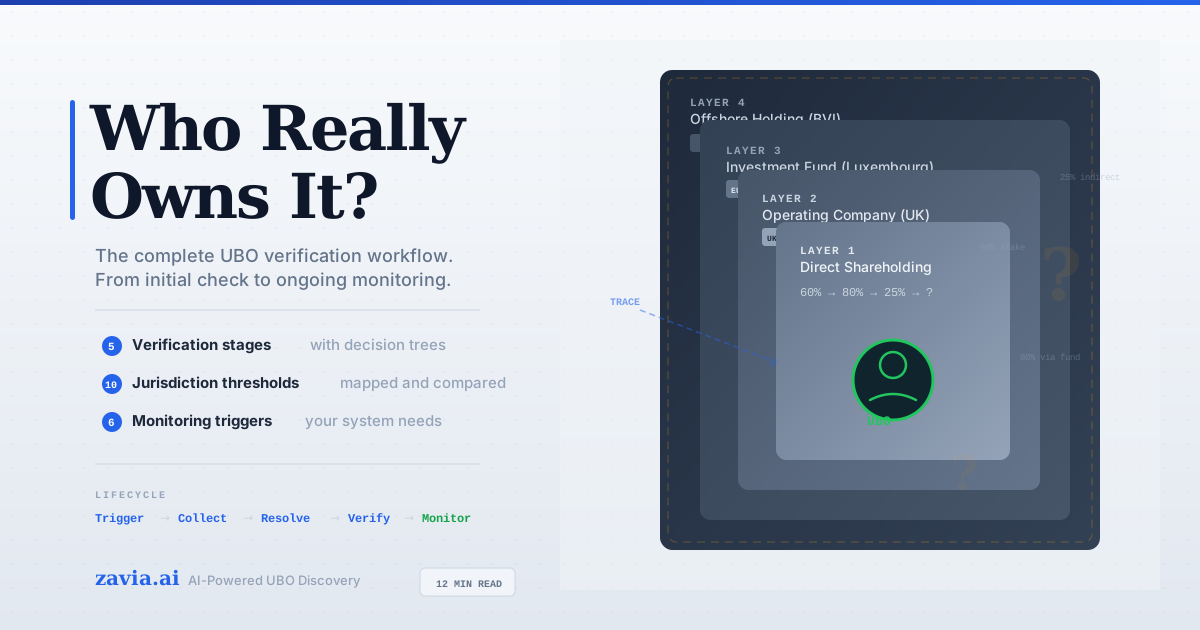
The 5-Stage UBO Verification Lifecycle
Every UBO verification follows five stages. Miss one, and you have gaps. Run them out of order, and you waste time. Here’s the complete lifecycle.
Stage 1: Trigger
Every UBO check starts with a trigger event. The trigger type determines how deep you need to go and how fast you need to move.
- Onboarding triggers are the most common. A new entity enters your ecosystem — client, counterparty, supplier, or investment target. The check must be completed before the business relationship is established. You have standard timelines to work with.
- Periodic review triggers are calendar-based. Your internal policy mandates re-verification at set intervals: every 12 months for high-risk entities, every 24 months for medium-risk, and every 36 months for low-risk. The clock starts from the last completed verification.
- Event-driven triggers require immediate attention. Something changed: the entity filed an ownership amendment, a sanctions list was updated, adverse media surfaced, or a transaction pattern deviated from baseline. These demand same-day triage regardless of where you are in the periodic cycle.
- Regulatory triggers force bulk reassessment. A new law takes effect, a threshold changes, or a jurisdiction joins the FATF Grey List. Your entire portfolio may need re-screening against updated criteria.
- Practical tip: Document your trigger criteria in writing. If your compliance manual doesn’t specify exactly which events initiate a UBO check, your team will apply them inconsistently. Inconsistency is the number one finding in regulatory audits.
Stage 2: Collection
The quality of your UBO verification is only as good as your data sources. Not all sources carry equal weight.
- Government registries are your primary source and the most reliable. They’re the authoritative record of legal ownership — the same source regulators use. Countries like the UK (Companies House), Luxembourg (RBE), Netherlands (KVK), and Germany (Transparenzregister) maintain beneficial ownership data directly. The limitation: not every jurisdiction has a public BO register, and filings may lag behind actual changes.
- Entity self-declarations are your secondary source. Annual reports, stock exchange filings, onboarding forms, and trust deeds. These are high-quality but self-reported, so they must be cross-referenced against independent data. Entities may under-report or omit complex indirect structures.
- Commercial databases and other third-party sources are supplementary. Data aggregators, news databases, court records, and leaked datasets (where legally accessible). Reliability varies widely depending on update frequency and sourcing methodology. Some databases are months stale.
- The golden rule: never rely on one source. Cross-reference registry data against self-declaration against at least one independent source. When sources disagree, that’s not an error to resolve quietly — it’s a red flag.
Platforms such as Zavia.ai take this approach by connecting directly to registries across 100+ countries rather than relying on intermediary databases where data freshness is uncertain. When evaluating any UBO tool, the question to ask is: where does the data actually come from?
Stage 3: Resolution
This is the stage where most compliance teams lose time. You have raw data. Now you need to follow every ownership path to its end and identify the natural person at the bottom of the chain.
- Direct ownership is straightforward. Person A owns 40% of Company X. Person A is a UBO. Done.
- Indirect ownership requires calculation. Person B owns 60% of Holding Company Y, which owns 80% of Company X. Person B’s effective ownership of Company X is 48% (60% multiplied by 80%). Person B is a UBO.
- Multi-path ownership adds the paths together. Person C owns 30% of Company X directly, and also owns 50% of Holding Company Z, which owns 20% of Company X. Person C’s total: 30% plus (50% multiplied by 20%) equals 40%. Person C is a UBO.
- Circular ownership is where manual processes fail. Company A owns 30% of Company B. Company B owns 20% of Company A. Human analysts following the chain in one direction rarely catch the loop. This is one of the strongest use cases for AI-powered resolution — tools like Zavia.ai detect circular structures automatically and flag them for review.
When ownership chains cross into opaque jurisdictions — BVI, Cayman Islands, Panama, Seychelles — the trail often goes cold. This is where your escalation procedures, covered in the decision trees below, become critical.
Stage 4: Verification
You’ve identified who you believe the UBOs are. Now confirm their identity and screen them for risk. This stage has four components that should run in parallel, not sequentially.
- Identity verification confirms that the natural person actually exists and matches the ownership records. Cross-reference against government-issued ID. For high-risk entities, require certified passport copies and proof of address.
- Sanctions screening checks whether the identified UBO appears on any sanctions list: OFAC SDN, EU Consolidated List, UN Sanctions, HMT, and any jurisdiction-specific lists relevant to your operations. A sanctioned UBO makes the entire business relationship prohibited.
- PEP screening determines whether the UBO is a Politically Exposed Person, or a close associate or family member of one. PEPs carry elevated corruption and bribery risk, which triggers Enhanced Due Diligence requirements.
- Adverse media screening scans news sources in multiple languages for coverage related to financial crime, fraud, corruption, or regulatory enforcement. A clean ownership structure means nothing if the UBO is under investigation for money laundering.
Modern UBO platforms — including Zavia.ai — integrate ownership resolution with all four screening layers in a single workflow, so the output is a complete risk picture rather than disconnected results from different tools.
Stage 5: Monitoring
The most neglected stage. Most teams file their UBO results and don’t look at them again until the next periodic review. That’s an 11-month blind spot where risk accumulates undetected.
Effective monitoring is continuous, not periodic. It runs in the background and triggers re-verification when specific conditions are met. We cover the six specific triggers your system should track in a dedicated section below.
Decision Trees: What to Do When Things Get Complicated
Every compliance team encounters these scenarios. Most handle them inconsistently because they don’t have documented procedures. Here’s a standard response for each.
| Scenario | Decision Path | How Technology Helps |
|---|---|---|
| No individual crosses the ownership threshold | 1) Check for control through voting agreements, veto rights, or board appointment powers. 2) If no control found, identify the senior managing official (CEO/MD) as fallback UBO. 3) Document analysis including all ownership percentages found. Red flag: If ownership is deliberately fragmented (e.g., five individuals each at 24%), treat as threshold-avoidance. | AI-powered platforms can flag fragmentation patterns automatically — detecting when multiple shareholders sit just below the threshold. Zavia.ai identifies these patterns during the resolution stage and routes them for Enhanced Due Diligence review. |
| Ownership trail leads to an opaque jurisdiction | 1) Request certified ownership chart and share registers directly from the entity. 2) If no response or incomplete data, escalate to EDD: check leaked datasets (where legal), court records, investigation databases. 3) If UBO still cannot be identified, decline the relationship or file a SAR. | Platforms with broad registry coverage can trace chains further than manual research. Zavia.ai connects to registries in 100+ countries, including jurisdictions where public access is limited. When a dead end is hit, the platform documents every source checked for audit purposes. |
| Declared UBO does not match registry data | 1) Check filing dates — is the registry data older than the self-declaration? 2) Ask the entity to explain the discrepancy. Legitimate explanations: recent restructuring, transfer pending registration. 3) If explanation is unsatisfactory, escalate to MLRO. Deliberate mismatch is a significant red flag. | Cross-referencing tools compare self-declared ownership against live registry data automatically. Discrepancies surface before onboarding completes rather than during a later audit. Zavia.ai performs this cross-reference as part of its standard workflow. |
| Nominee structure detected | 1) Identify the nominator. Request nominee agreement or declaration of trust. 2) Verify the nominator through standard Stages 2–4. The nominee is not the UBO. 3) Assess reason for the arrangement (legitimate privacy vs. concealment). Hard stop: If nominee refuses to disclose, decline or file a SAR. | Entity resolution engines can identify common nominee patterns — corporate service providers, law firms, or individuals appearing as shareholders across multiple unrelated entities. Zavia.ai flags these patterns during collection so analysts know to look deeper. |
| Entity is a trust or foundation | For trusts: identify the settlor, trustee, all beneficiaries, and any protector. For foundations: identify the founder, governing board, and beneficiaries. All identified individuals must be verified and screened through Stages 3–4. | Purpose-built UBO tools recognize trust and foundation structures and apply the appropriate identification framework automatically, rather than requiring analysts to manually switch between corporate and trust verification procedures. |
| Jurisdiction has no UBO registry | 1) Request the entity’s share register, articles of association, and board resolutions directly. 2) Use alternative sources: court filings, annual returns, stock exchange disclosures. 3) Apply EDD automatically — no registry = higher risk by definition. | Platforms like Zavia.ai aggregate alternative ownership evidence from jurisdictions where registries are incomplete, using government filings, corporate announcements, and cross-jurisdictional linking to fill gaps. |
UBO Threshold Matrix by Jurisdiction
Ownership thresholds vary by country. This quick-reference covers the jurisdictions compliance teams encounter most often.
| Jurisdiction | Threshold | Key Nuances | Registry / Authority |
|---|---|---|---|
| European Union | 25% | Standard across all member states under AMLD. AMLD6 discussions may lower to 15% for high-risk entities. Trusts have separate rules. | Varies by member state |
| United States | 25% | Corporate Transparency Act (CTA) requires FinCEN BOI reporting. “Substantial control” test applies alongside ownership %. | FinCEN BOI Registry |
| United Kingdom | 25% | PSC register uses “significant influence or control” test. Goes beyond just ownership percentage. | Companies House |
| UAE | 25% | Updated after FATF review. Free zone entities have additional requirements. Nominee arrangements must be disclosed. | Ministry of Economy |
| Singapore | 25% | ACRA register of controllers. Nominee shareholders must declare the nominator. | ACRA |
| Germany | 25% | Transparenzregister is separate from commercial register. Fictitious UBOs must be identified. | Transparenzregister |
| Canada | 25% | Federal transparency register launched. Provincial requirements vary (Quebec, BC have extra rules). | Corporations Canada |
| Luxembourg | 25% | RBE (Register of Beneficial Owners). Financial sector entities face stricter CSSF guidance. | RBE Luxembourg |
| Switzerland | 25% | Bearer shares abolished 2019. Foundation structures have specific rules. | Commercial Register |
| Cayman Islands | 25% | BO Regime since 2017. Not publicly accessible — available to competent authorities only. | Cayman BOR (restricted) |
Important: Thresholds are a floor, not a ceiling. Even below 25%, individuals can qualify as UBOs through control mechanisms — voting agreements, board appointment powers, veto rights. Always apply both the ownership test and the control test.
When evaluating UBO platforms, check whether they apply jurisdiction-specific thresholds automatically. Zavia.ai applies the correct ownership and control tests based on each entity’s registration jurisdiction, removing the need for analysts to look up and configure thresholds manually for every check.
6 Monitoring Triggers That Should Force Re-Verification
Don’t just “monitor changes.” Build these specific triggers into your compliance system. Each one should initiate a re-verification workflow automatically.
| # | Trigger | What to Watch For | Action Required |
|---|---|---|---|
| 1 | Ownership change above materiality threshold | Any share transfer, capital increase, or restructuring that moves an individual’s effective ownership above or below the UBO threshold. Flag movements of 5%+ even below the regulatory threshold. | Re-run Stage 3 (Resolution) and Stage 4 (Verification) for affected individuals. |
| 2 | Address change to high-risk jurisdiction | An entity re-domiciles from a transparent jurisdiction (e.g., Netherlands) to an opaque one (e.g., BVI). Or a new subsidiary is incorporated in a high-risk jurisdiction. | Re-assess risk tier of entire ownership chain. May require EDD. |
| 3 | Adverse media hit on existing UBO | A previously cleared UBO appears in news related to financial crime, corruption, fraud, or regulatory enforcement. | Immediate review. Update risk assessment. May require SAR filing. |
| 4 | Sanctions list update | OFAC, EU, UN, or HMT updates their lists. Any existing UBO’s nationality, residence, or associated entities appear on updated lists. | Immediate re-screening of all UBOs against updated lists. |
| 5 | Regulatory threshold change | A jurisdiction changes its UBO threshold (e.g., EU moving from 25% to 15%). Or a new regulation introduces additional requirements. | Bulk re-assessment of all entities in affected jurisdiction(s). |
| 6 | Periodic review cycle | Calendar-based fallback. High-risk: every 12 months. Medium-risk: every 24 months. Low-risk: every 36 months. | Full re-verification: Stages 2–5 with current data. |
Triggers 1 through 4 require continuous data feeds — something periodic reviews by definition cannot provide. This is one of the strongest arguments for adopting a platform with built-in monitoring. Zavia.ai monitors government registry filings, sanctions databases, and adverse media sources on an ongoing basis, surfacing the specific change that caused each alert so analysts can act on evidence rather than spending time searching for it.
Where Manual Processes Break
Even well-designed workflows fail when execution is manual. Here’s where the process typically breaks down and how automation addresses each gap.
| Stage | Manual Process | Automated Approach | Impact |
|---|---|---|---|
| Collection | Analyst logs into 5+ government registry portals. Different languages, formats, access requirements. 3–4 hours per entity. | Platform pulls from 100+ registries in a single request. Data returned in standardized format. Seconds per entity. | Eliminates transcription errors. 95%+ time reduction per entity. |
| Resolution | Analyst draws ownership chart in a spreadsheet. Calculates indirect ownership manually. Circular structures go undetected. | AI traces every ownership path, detects circular structures, flags opaque jurisdictions, calculates all indirect chains. | Eliminates calculation errors. Catches structures humans consistently miss. |
| Verification | Separate logins to sanctions databases, PEP lists, adverse media tools. Each screened individually. | All identified UBOs screened against global sanctions, PEP, and adverse media databases in parallel. | No UBO slips through unscreened. Results in seconds, not hours. |
| Monitoring | Calendar reminder for annual review. No alerts between reviews. Changes discovered months late. | Continuous monitoring of registries, sanctions lists, and news. Alerts fire within hours of a change. | Closes the 11-month gap between periodic reviews. |
Manual UBO verification doesn’t scale. If your compliance team manages more than 50 entities, the time spent on registry checks, ownership calculations, and periodic reviews compounds quickly. This is the core problem that automated platforms are designed to solve — not by replacing compliance teams, but by handling the data-intensive stages so analysts can focus on the judgment calls that actually require human expertise.
Frequently Asked Questions
1. What is UBO verification?
UBO verification is the process of identifying and confirming the natural persons who ultimately own or control a legal entity. It’s a core requirement under Anti-Money Laundering (AML) and Counter-Terrorist Financing (CTF) regulations worldwide. The process involves collecting ownership data from government registries, tracing it through corporate layers to find the real people at the end of the chain, verifying their identity, and screening them for risk. Modern platforms like Zavia.ai automate much of this by connecting directly to government registries and using AI to resolve complex ownership structures.
2. What is the standard ownership threshold for identifying a UBO?
The most common threshold is 25% of shares or voting rights. This applies across the EU (under AMLD), the UK, UAE, Singapore, Canada, and most other major jurisdictions. However, the percentage threshold is only one test. Individuals can also qualify as UBOs through control mechanisms like board appointment rights, veto powers, or contractual arrangements — even if they own less than 25%. Always apply both the ownership test and the control test.
3. How often should UBO checks be updated?
Best practice is a risk-tiered schedule: every 12 months for high-risk entities, every 24 months for medium-risk, and every 36 months for low-risk. However, periodic reviews alone leave dangerous blind spots. Continuous monitoring for ownership changes, sanctions updates, and adverse media should run alongside scheduled reviews to catch event-driven triggers as they happen.
4. What happens if no individual meets the UBO ownership threshold?
First, check for control exercised through non-ownership mechanisms such as voting agreements, board powers, or contractual arrangements. If no individual exercises control through any means, most regulations require you to identify the senior managing official — typically the CEO or Managing Director — as the fallback UBO. Document your analysis thoroughly, including all ownership percentages examined and the reasoning for the fallback determination.
5. What is the difference between KYB and UBO verification?
KYB (Know Your Business) is the broader process of verifying a legal entity — its legal existence, registration status, address, directors, and financial standing. UBO verification is a specific step within KYB that focuses on identifying the natural persons who ultimately own or control the entity. You cannot complete KYB without UBO verification, but UBO verification alone does not constitute complete KYB. Both are required under AML regulations.
6. How do you trace ownership through multiple corporate layers?
Calculate effective ownership by multiplying percentages through each layer. If Person A owns 60% of Company B, and Company B owns 50% of Company C, Person A’s indirect ownership of Company C is 30% (60% multiplied by 50%). When a person has ownership through multiple paths, add all paths together. This becomes complex and error-prone beyond two layers, which is why many compliance teams use AI-powered tools to automate the calculation across unlimited layers and detect circular ownership structures.
7. What is a nominee shareholder and how does it affect UBO verification?
A nominee is an individual or entity that holds shares on behalf of another person (the nominator). The nominee is not the beneficial owner — the person behind the nominee is. During UBO verification, you must look through the nominee arrangement to identify and verify the real beneficial owner. Request the nominee agreement or declaration of trust. If the nominee refuses to disclose the nominator, the UBO cannot be established, and the relationship should be declined or a Suspicious Activity Report (SAR) filed.
8. Can UBO verification be fully automated?
The data collection, ownership resolution, screening, and monitoring stages can be automated effectively. However, the escalation decisions — whether to proceed with a relationship, file a SAR, or request additional documentation — require human judgment. The most effective approach combines automated data processing with human oversight at critical decision points. Platforms like Zavia.ai handle the data-intensive stages while surfacing findings for analysts to review and act on.
9. What are the penalties for getting UBO verification wrong?
Penalties vary by jurisdiction but can be severe. In the EU, fines under AMLD can reach €5 million or 10% of annual turnover for financial institutions. In the US, FinCEN penalties under the CTA include up to $500 per day for late filings, with willful violations carrying up to $10,000 and two years imprisonment. The UK can impose unlimited fines for failure to maintain a PSC register. Beyond financial penalties, the reputational damage from a compliance failure often exceeds the fine itself.
10. How do I evaluate UBO verification platforms?
Ask five questions. First, where does the data come from — government registries directly, or aggregated commercial databases? Second, how many jurisdictions are covered? Third, can the platform handle indirect and circular ownership structures automatically? Fourth, does it include integrated sanctions, PEP, and adverse media screening? Fifth, does it offer continuous monitoring, or only point-in-time checks? These criteria help distinguish between tools that automate the full lifecycle and those that only handle individual steps.