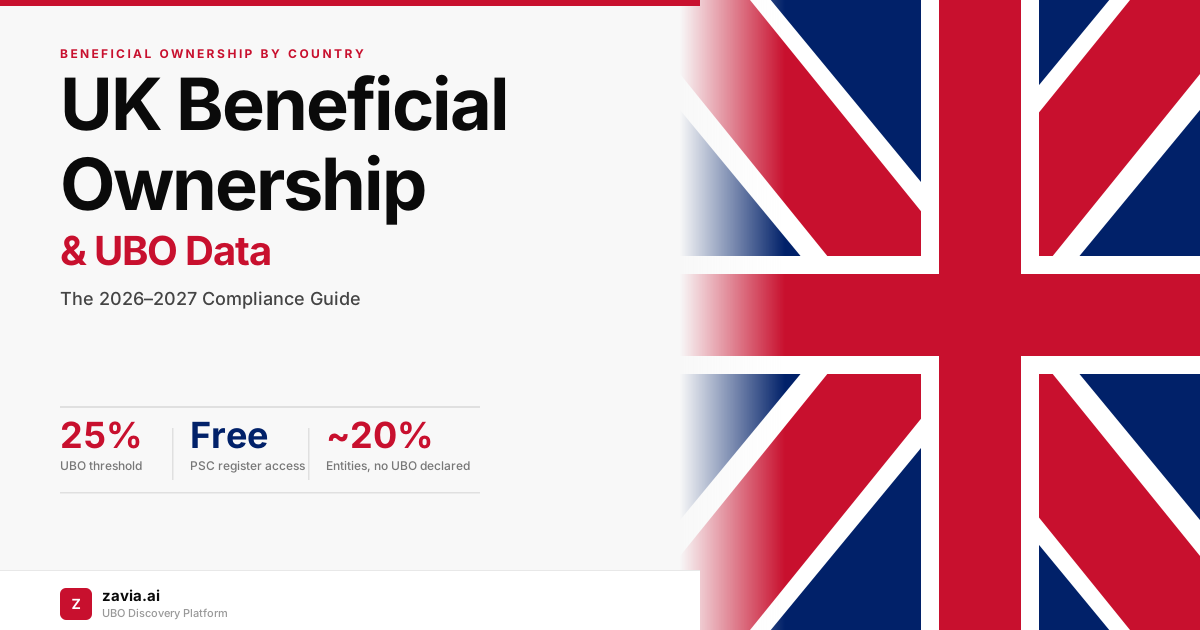
UK Beneficial Ownership & UBO Data: The 2025–2026 Compliance Guide

1. How the UK Defines a UBO
The UK does not use the term "Ultimate Beneficial Owner" in its primary legislation. Instead, it uses Person with Significant Control (PSC) — but the concept is the same. A PSC is the natural person who ultimately owns or controls a company.
Under UK company law, an individual qualifies as a PSC if they meet one or more of the following five conditions:
| # | Condition | Threshold |
|---|---|---|
| 1 | Holds shares in the company | More than 25% (directly or indirectly) |
| 2 | Holds voting rights | More than 25% (directly or indirectly) |
| 3 | Right to appoint or remove the majority of the board of directors | Any level of majority control |
| 4 | Exercises significant influence or control over the company | Subjective — no numeric threshold |
| 5 | Exercises significant influence or control over a trust or firm that itself meets conditions 1–4 | Subjective — no numeric threshold |
Conditions 4 and 5 are important — and often underused. They capture individuals who control through informal means: side agreements, nominee arrangements, or indirect influence over a holding entity. The UK has published official guidance on what constitutes "significant influence or control," but in practice, enforcement of these subjective conditions has been limited.
Indirect ownership is also in scope. If an individual holds a majority stake in a corporate entity, and that entity holds shares in the company being registered, the individual still qualifies as a PSC of the underlying company.
Indirect ownership is where most risk hides
Conditions 4 and 5 — significant influence and control through trusts or firms — are rarely declared voluntarily. Zavia.ai surfaces indirect controllers by tracing ownership layers that the PSC register alone won't show you.
See how Zavia traces indirect ownership →2. What UBO Data Is Available
The UK's PSC register is one of the most data-rich public beneficial ownership registers in the world. Here is what is actually disclosed:
| Data Field | Available? | Publicly Accessible? | Notes |
|---|---|---|---|
| Full legal name | Yes | Public | |
| Date of birth (month & year) | Yes | Public | Full day not shown publicly |
| Full date of birth (day included) | Yes | Restricted | Available to AML-obligated entities on request |
| Nationality | Yes | Public | |
| Country of residence | Yes | Public | |
| Correspondence / service address | Yes | Public | Often a law firm or agent address |
| Residential address | Yes | Restricted | Protected by default; available to AML-obligated entities |
| Nature of control (categories) | Yes | Public | e.g. ownership-of-shares-75-to-100-percent |
| Date of becoming a PSC | Yes | Public | |
| Date ceased to be a PSC | Yes | Public | |
| Verified identity (personal code) | Partial | Phased | Mandatory from Nov 2025 for new PSCs; existing phased to Nov 2026 |
| Exact percentage of shareholding | No | Not disclosed | Only banded ranges (e.g. 25–50%, 50–75%, 75–100%) |
| Trust information | Partial | Restricted | Held on Trust Register (HMRC); not publicly searchable by default |
3. Free vs. Restricted Access
One of the UK's major advantages is openness. The base layer of PSC data is freely accessible:
| Access Method | Cost | What You Get |
|---|---|---|
| Companies House web portal | Free | All public PSC fields for individual companies, manual search |
| Companies House REST API | Free | Programmatic access to public fields; requires API key registration |
| Bulk data download | Free | Full PSC dataset snapshots, published monthly |
| Full date of birth / residential address | Restricted | Available to AML-regulated entities only, via formal request to Companies House |
| Trust Register (HMRC) | Restricted | Trustees can download proof of registration; not publicly searchable |
| ROE trust information (from Aug 2025) | Partial | Any member of the public can apply to Companies House for specific trust data (£55 per entity fee); some cases require demonstrating legitimate interest |
The API is powerful but requires significant engineering to work with at scale. Data is not normalised across jurisdictions, field names vary, and the API does not resolve multi-layer ownership chains automatically. Building a real-time, production-grade UBO pipeline on top of it requires dedicated infrastructure and ongoing maintenance.
4. The Three UK Beneficial Ownership Registers
The UK does not have a single UBO database. Beneficial ownership is split across three separate registers, each covering a different type of entity:
4.1 The PSC Register (Companies House)
Covers UK companies, LLPs, and eligible Scottish partnerships. This is the primary register — publicly searchable, API-accessible, and in place since April 2016. It is the main reference point for any KYB or AML workflow involving a UK-registered entity.
4.2 The Register of Overseas Entities (ROE)
Created by the Economic Crime (Transparency and Enforcement) Act 2022. It covers overseas companies that own UK land or property. Entities must declare their beneficial owners to Companies House before registering any transaction on the UK land register. As of August 2025, trust information held on the ROE became accessible to the public on application, for a £55 fee per entity. Significant gaps remain: research from the University of Warwick found that for 35% of overseas-owned UK properties, even law enforcement agencies lack confirmed beneficial owner information.
4.3 The Trust Register (HMRC)
Operated by HM Revenue & Customs, not Companies House. It covers UK express trusts and some non-UK trusts with UK connections. The Trust Register is not publicly accessible — trustees can download a proof of registration document for use with financial institutions, but the data is not searchable by third parties. Proposed regulatory changes expected in early 2026 will expand non-UK trust registration requirements further, particularly for trusts holding UK land.
5. Where the Data Falls Short
The UK PSC register is among the most open in the world. It is also significantly incomplete. Here are the documented gaps:
5.1 Self-Reporting With Historically Weak Enforcement
Until ECCTA 2023 took effect, Companies House operated primarily as a passive collector — it accepted what was filed with limited ability to verify or challenge. Research by the Tax Justice Network found that approximately 20% of UK entities had declared no individual beneficial owner at all. This reflects a mix of legitimate structures (e.g. publicly listed companies exempt from PSC requirements), non-compliance, and deliberate concealment.
5.2 Nominee Arrangements and Circular Ownership
Complex ownership structures — circular shareholdings, nominee directors, multi-layer holding companies — remain difficult to detect from the PSC register alone. An individual might be listed as a PSC of a holding company but not of the underlying operating company. The register records what is reported; it does not trace ownership chains automatically.
5.3 No Unique Identifier for PSCs
The register does not assign a persistent unique identifier to individual PSCs. The same individual can appear under slightly different name spellings or different correspondence addresses across hundreds of company records, making cross-referencing difficult. Analysis has identified individuals listed as PSCs in over 1,000 separate entities — raising clear concerns about nominee use — but the lack of a unique ID makes definitive analysis hard.
5.4 Ownership Bands, Not Percentages
The PSC register uses four banded ownership categories: 25–50%, 50–75%, 75–100%. Exact ownership percentages are not disclosed. This limits the ability to calculate economic exposure or model concentration risk accurately.
5.5 No Coverage of Unlisted Partnerships and Some LLPs
General partnerships without legal personality are not required to file PSC information. Scottish Limited Partnerships (SLPs) have been identified as a specific risk area — they have separate legal personality and can open bank accounts, but their PSC filings have historically been weaker than those for companies.
5.6 Stale Data
PSC changes must be filed within 14 days of the change occurring. In practice, updates can lag significantly. The register reflects what was filed, not necessarily the current ownership reality.
5.7 No Cross-Border Resolution
When a corporate PSC is registered — meaning a company, not an individual, is listed as the PSC — the register stops there. It does not link through to the foreign register where that corporate entity is incorporated. Resolving the full ownership chain requires accessing multiple national registries, often in different languages, formats, and jurisdictions. This is the core use case that drives demand for platforms like Zavia.ai.
6. Existing Legislation
UK beneficial ownership rules are spread across several laws. Here is the relevant legislative stack:
| Legislation | Year | What it covers |
|---|---|---|
| Companies Act 2006 | 2006 | Core company law framework; PSC obligations embedded via 2015 amendment |
| Small Business, Enterprise and Employment Act 2015 | 2015 | Introduced the PSC register requirement |
| Money Laundering Regulations 2017 (MLR 2017) | 2017 | Requires regulated entities to identify UBOs as part of customer due diligence |
| Limited Liability Partnerships (Register of People with Significant Control) Regulations 2016 | 2016 | Extends PSC obligations to LLPs |
| Scottish Partnerships (Register of People with Significant Control) Regulations 2017 | 2017 | Extends PSC obligations to Scottish partnerships |
| Economic Crime (Transparency and Enforcement) Act 2022 (ECTEA) | 2022 | Created the Register of Overseas Entities (ROE) |
| Economic Crime and Corporate Transparency Act 2023 (ECCTA) | 2023 | Major reform: identity verification, enhanced Companies House powers, new offences |
The UK implemented the 4th and 5th EU Anti-Money Laundering Directives before Brexit. It is no longer bound by new EU directives, including the 6th AMLD. From this point, UK and EU beneficial ownership rules may diverge — the UK is pursuing its own reform agenda via ECCTA.
7. ECCTA 2023: What's Changing Now
The Economic Crime and Corporate Transparency Act 2023 is the most significant reform to UK company law in decades. Its core goal: move Companies House from a passive record-keeper to an active regulator.
Companies must confirm a lawful purpose at incorporation and on every annual confirmation statement. PO boxes banned as registered addresses. Between March 2024 and March 2025, Companies House queried or removed false information affecting over 100,000 companies and rejected more than 10,200 suspicious applications.
Individuals can voluntarily verify their identity with Companies House via GOV.UK One Login or through an Authorised Corporate Service Provider (ACSP). Over 1 million people voluntarily completed verification before the mandatory deadline.
A new corporate criminal offence comes into force. Large organisations can now be held criminally liable for failing to prevent fraud committed by employees or agents on their behalf.
All new individual directors and PSCs must verify their identity before being appointed. New incorporations cannot proceed without verified identities. Existing directors and PSCs enter a 12-month transition period linked to their next confirmation statement date. An estimated 6–7 million individuals will need to complete verification by November 2026.
From 18 November 2025, companies no longer maintain their own internal PSC registers. Companies House becomes the single, authoritative central record. All changes must be filed with Companies House within 14 days.
8. What's Coming Next (2026 and Beyond)
ECCTA implementation continues through 2026 and 2027:
| Expected Timing | Change |
|---|---|
| Spring 2026 | Companies House restricts filing submissions — only verified individuals or ACSPs can submit documents. Unverified parties will be blocked. |
| Spring 2026 | Identity verification for corporate directors, corporate LLP members, and officers of corporate PSCs (currently not covered under the November 2025 rules) |
| April 2027 | Mandatory digital filing of accounts for all companies |
| Early 2026 | Expanded Trust Register requirements — non-UK trusts holding UK land included regardless of trustee residence |
| 2026–2027 | Identity verification extended to limited partnerships |
The trajectory is clear: the UK is building a fully verified, digitally signed beneficial ownership infrastructure. When complete, every PSC on the Companies House register will have a government-issued personal code linked to a biometric identity check. That is a meaningful shift in register integrity.
9. Why the Register Is Not Enough
Even a fully verified PSC register only captures the first declared layer of ownership. It does not automatically resolve multi-layer structures. It does not cross jurisdictions. And it does not reconcile what is filed with what is real.
Consider a common compliance scenario: a UK company files a corporate PSC — a holding company registered in Luxembourg. The PSC register entry is technically correct. But to find the natural person at the top of the chain, you need to access the Luxembourg business register, identify that holding company's shareholders, and check whether any of those shareholders are themselves corporate entities registered elsewhere.
This is the core gap between register data and beneficial ownership intelligence. The register tells you what was declared. It does not tell you who actually controls the entity.
Three layers of additional work are almost always required:
Group structure mapping. Tracing the ownership chain through multiple corporate intermediaries — often across several jurisdictions — to reach the natural person. This requires access to multiple national registries simultaneously.
International registry coverage. The UK register is only one piece. A robust UBO workflow needs to reach the underlying corporate PSC's home registry — Germany, Netherlands, Luxembourg, BVI, or elsewhere — and follow the chain from there. Platforms that aggregate and normalise multi-jurisdictional registry data fill this gap.
Sanctions and adverse media screening. Knowing who owns the entity is step one. Understanding whether that person is sanctioned, PEP-linked, or flagged in adverse media requires an additional enrichment layer on top of the structural data.
From UK PSC to natural person — across any jurisdiction
Zavia.ai resolves beneficial ownership chains through 400+ government registries. When a UK PSC is a holding company in another country, Zavia traces the next layer automatically — connecting structured registry data with group hierarchy mapping across borders.
Explore Zavia.ai →10. Frequently Asked Questions
What is the UK PSC register?
The PSC (People with Significant Control) register is the UK's public register of beneficial owners, maintained by Companies House. It has been mandatory since April 2016 and requires companies to disclose individuals who hold more than 25% of shares, voting rights, or exercise significant influence or control.
Is UK beneficial ownership data free to access?
Yes, basic PSC data is publicly accessible for free via the Companies House website and REST API. Full dates of birth, residential addresses, and Trust Register data are either restricted or require a formal request to access.
What is the UBO threshold in the UK?
A person qualifies as a PSC if they hold more than 25% of shares or voting rights, have the right to appoint or remove the majority of the board, or exercise significant influence or control. There is no lower threshold — unlike some EU jurisdictions, which can apply a 15% threshold in high-risk sectors.
What are the main limitations of the UK PSC register?
Historically self-reported with limited enforcement. Approximately 20% of entities have declared no individual beneficial owner. No unique identifier for PSCs. Only banded ownership ranges disclosed, not exact percentages. Does not cover trusts or resolve cross-border corporate chains automatically.
What does ECCTA 2023 change for UK beneficial ownership data?
ECCTA introduces mandatory identity verification for all directors and PSCs, effective 18 November 2025. Companies House becomes the sole central record for PSC information. New criminal offences apply for false filings. An estimated 6–7 million individuals must complete verification by November 2026.
Does the UK have a register for overseas entities owning UK property?
Yes — the Register of Overseas Entities (ROE), established in 2022. Overseas companies that own UK land must declare their beneficial owners to Companies House. Trust information became accessible on public application from 31 August 2025. Significant compliance gaps remain, with large portions of overseas-owned UK property still lacking confirmed beneficial owner information.
Can I access UK beneficial ownership data via API?
Yes. Companies House provides a free REST API that returns PSC data for any registered company. Access requires registering for an API key. The API returns public fields only — restricted fields (full date of birth, residential address) require a separate process for AML-obligated entities.
Does the UK PSC register include information on trusts?
Not directly. Where a trust is involved in the ownership chain, the trustee is listed as the PSC on the Companies House register — the underlying trust beneficiaries and settlors are not disclosed. That information is held separately on the HMRC Trust Register, which is not publicly searchable.