
If you work in compliance, risk, or financial services, you have heard the term UBO hundreds of times.
But what does it actually mean? And more importantly, why does getting it wrong cost companies billions?
UBO stands for Ultimate Beneficial Owner. It refers to the real human being who ultimately owns or controls a company. Not a holding company. Not a trust. Not a nominee shareholder. A real person.
That sounds simple. It is not.
Corporate structures cross borders. Ownership chains run through shell companies, offshore trusts, and nominee arrangements. The person who truly controls a business can be hidden behind five, ten, or twenty layers of legal entities.
Regulators worldwide now require businesses to identify the UBO behind every corporate client. Failure to do so leads to massive fines, criminal prosecution, and reputational damage that takes years to repair.
This guide explains everything you need to know about UBOs. What they are. How to identify them. What the law requires. And how modern technology is changing the way compliance teams uncover hidden ownership.
What Is an Ultimate Beneficial Owner (UBO)?
An Ultimate Beneficial Owner is the natural person who ultimately owns or controls a legal entity. The key word is natural person. A UBO must be a human being. It cannot be another company, trust, or legal arrangement.
The Financial Action Task Force (FATF) defines a UBO as:
“The natural person(s) who ultimately owns or controls a customer and/or the natural person on whose behalf a transaction is being conducted. It also includes those persons who exercise ultimate effective control over a legal person or arrangement.”
In practical terms, a UBO is typically someone who:
- Owns 25% or more of shares or voting rights in a company (the most common threshold)
- Exercises control through board appointments, veto rights, shareholder agreements, or other mechanisms
- Benefits financially from the company’s transactions or assets, even without direct ownership
The 25% threshold is a starting point, not a ceiling. In many jurisdictions and high-risk scenarios, someone with less than 25% ownership can still be classified as a UBO if they exercise effective control.
UBO vs. Beneficial Owner: What Is the Difference?
These two terms are often used interchangeably. They should not be.
A beneficial owner is anyone who benefits from a company’s assets or profits. This can include intermediary entities, trusts, and legal arrangements. There can be many beneficial owners in a corporate structure.
The Ultimate Beneficial Owner is the person at the top of the chain. The natural person who sits behind every layer of ownership and ultimately profits from, or controls, the entity. There may be one UBO. There may be several. But they are always human beings.
Think of it this way: trace the ownership chain from the bottom to the top. Every entity along the way may be a beneficial owner. The person standing at the very end of that chain is the UBO.
Why UBO Identification Matters
UBO identification is not optional. It is a legal requirement for regulated businesses in most countries. Here is why it matters.
Regulatory Compliance
Anti-money laundering (AML) regulations require financial institutions, fintechs, banks, and other regulated entities to identify the UBOs of their corporate clients. This is part of Know Your Business (KYB) and Customer Due Diligence (CDD) processes.
Failing to identify UBOs is not treated as a minor administrative oversight. Regulators treat it as a systemic compliance failure.
Preventing Financial Crime
Criminals use complex corporate structures to launder money, evade sanctions, finance terrorism, and hide the proceeds of corruption. Shell companies, nominee shareholders, and multi-layered offshore arrangements are all designed to obscure the identity of the person who truly controls the money.
UBO identification cuts through these structures. It forces transparency on entities that are designed to be opaque.
The Cost of Getting It Wrong
The enforcement record speaks for itself:
- Danske Bank — €2 billion fine after failing to verify UBOs in its Estonian branch. Share price dropped 50%. 28,000 customers left.
- Revolut — fined for weaknesses in AML controls, including beneficial ownership verification.
- Starling Bank — fined £29 million by the FCA for failings in its financial crime framework.
- Monzo — faced regulatory action over AML deficiencies in its compliance systems.
Regulators are no longer waiting for proven money laundering to act. They now fine institutions for having weak systems, even when no criminal activity has been confirmed.
How to Identify a UBO: Step by Step
UBO identification follows a structured process. The specifics vary by jurisdiction, but the core steps are consistent worldwide.
Step 1: Gather Company Credentials
Start with the basics. Collect the company’s registration number, legal name, registered address, official status, and details of directors and senior management.
This information is typically available from government company registries. In many countries, it is publicly accessible.
Step 2: Map the Ownership Structure
Identify every person and entity that holds shares, voting rights, or a controlling interest in the company. Determine whether their ownership is direct or indirect.
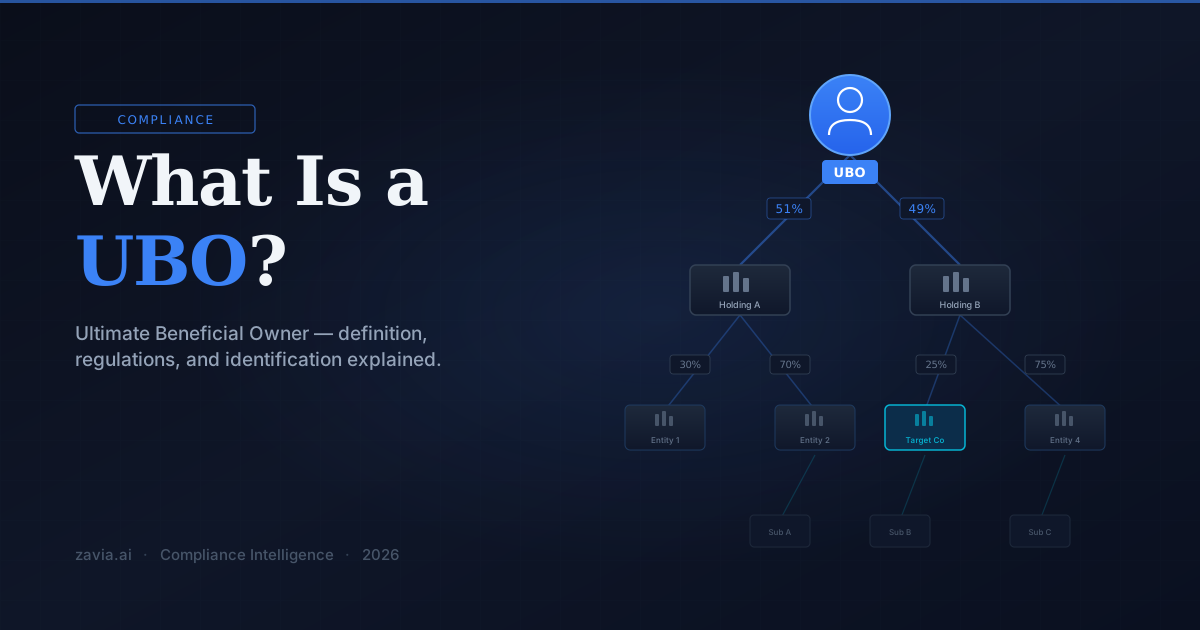
Direct ownership means a person holds shares in the company themselves. Indirect ownership means they control the company through another entity. For example, if Person A owns 60% of Company B, and Company B owns 50% of Company C, then Person A has an indirect 30% stake in Company C (60% × 50% = 30%).
Step 3: Calculate Ownership Thresholds
Apply the relevant jurisdiction’s ownership threshold to determine which individuals qualify as UBOs. The most common threshold is 25%, but this varies. Some jurisdictions use 10%. Others use 15% for high-risk sectors.
Do not stop at percentages. Evaluate whether anyone exercises effective control through other means, such as board appointment rights, veto powers, or shareholder agreements.
Step 4: Verify the UBO’s Identity
Once a UBO is identified, verify their identity through standard KYC procedures. This includes document verification, screening against sanctions lists (OFAC, UN, EU, HMT), PEP checks, and adverse media screening.
Step 5: Assess Risk and Apply Due Diligence
Classify each UBO by risk level. Low-risk UBOs may require standard due diligence. High-risk UBOs—those with PEP status, adverse media hits, or connections to high-risk jurisdictions—require Enhanced Due Diligence (EDD), including source of funds and source of wealth checks.
Step 6: Monitor Continuously
UBO identification is not a one-time event. Ownership structures change. People acquire and sell shares. Companies restructure. Compliance teams must monitor for changes and update UBO records accordingly.
FATF guidance explicitly requires ongoing monitoring. Most jurisdictions mandate at least annual reviews, with event-driven updates whenever ownership changes are detected.
Direct vs. Indirect Ownership: Why It Matters
One of the most common mistakes in UBO identification is stopping at the first layer of ownership.
Direct ownership is straightforward. If John owns 30% of Company X, he meets the 25% threshold and qualifies as a UBO.
Indirect ownership requires tracing through multiple entities. Consider this structure:
- Person A directly owns 30% of Company X. Person A is a UBO.
- Person B owns 60% of Company Y, which owns 50% of Company X. Person B’s indirect stake is 30% (60% × 50%). Person B is also a UBO.
- Person C owns 100% of Company Z, which owns 20% of Company X. Person C’s indirect stake is 20% (100% × 20%). Person C is not a UBO under the 25% rule.
Complex structures with multiple layers, cross-border holdings, and circular ownership make these calculations significantly harder. This is where manual processes break down and technology becomes essential.
UBO Regulations by Region
UBO requirements are not globally standardized. Each jurisdiction sets its own rules, thresholds, and enforcement mechanisms. Here is how the major regulatory frameworks compare.
| Region | Threshold | Registry | Public Access | Enforcement | Key Law |
|---|---|---|---|---|---|
| European Union | 25% (15% for high-risk) | Mandatory | Limited (post-ECJ ruling) | Up to 10% of turnover | 6AMLD (July 2026) |
| United Kingdom | 25% | PSC Register | Public | Fines + criminal | ECCTA 2023 |
| United States | 25% (foreign entities only) | FinCEN BOI | Law enforcement only | Up to $10K + 2 years prison | CTA (revised March 2025) |
| Singapore | 25% | RORC | Regulators only | Fines + prosecution | Companies Act |
| Australia | 25% (proposed) | Proposed | Proposed public | Fines + ASIC powers | AML/CTF reforms (March 2026) |
| UAE | Varies by free zone | Required | Regulators only | Fines + license suspension | AML Law + CBUAE guidelines |
European Union: 6th Anti-Money Laundering Directive (6AMLD)
The EU’s 6AMLD standardizes UBO definitions across all member states. The standard threshold is 25%, but high-risk sectors may be subject to thresholds as low as 15% with European Commission approval.
Member states must implement UBO rules by July 10, 2026. The directive extends beneficial ownership requirements to trusts and similar legal arrangements, not just companies. National registers must be operational and accessible to competent authorities.
The European Court of Justice’s 2022 ruling restricted public access to UBO registers, but regulators, financial institutions, and obliged entities still retain access.
United Kingdom: ECCTA and PSC Register
The UK requires companies to maintain a public register of Persons with Significant Control (PSC), which aligns closely with UBO requirements. The Economic Crime and Corporate Transparency Act (ECCTA) 2023 expanded Companies House verification powers and introduced identity verification for directors and PSCs.
The UK also maintains a Register of Overseas Entities for foreign companies owning UK property, requiring disclosure of beneficial owners.
United States: Corporate Transparency Act (CTA)
The CTA required beneficial ownership information (BOI) reporting to FinCEN. However, a March 2025 interim rule fundamentally changed the scope. The revised rule exempts all US-formed entities and their beneficial owners from BOI reporting. Only foreign entities registered to do business in the US are now required to report.
Penalties for non-compliance remain severe: up to $500 per day in civil penalties and criminal penalties of up to $10,000 and two years imprisonment.
Singapore: Register of Registrable Controllers
Singapore requires all companies to maintain a Register of Registrable Controllers (RORC), which must be filed with the Accounting and Corporate Regulatory Authority (ACRA). The threshold is 25% ownership or voting rights. ACRA may share RORC information with law enforcement agencies.
Australia: AML/CTF Reforms (March 2026)
Australia is implementing its most significant AML/CTF reforms in over a decade. Changes commencing March 31, 2026, include proposals for a publicly accessible beneficial ownership register, expanded disclosure requirements, and enhanced enforcement powers for ASIC.
What Is a UBO Declaration?
A UBO declaration is a formal document submitted by a company to disclose the identity and details of its Ultimate Beneficial Owners. Regulated entities typically require UBO declarations during client onboarding, and many jurisdictions require companies to file UBO information with a central register.
A standard UBO declaration includes:
- Full legal name of each UBO
- Date of birth and nationality
- Country of residence
- Percentage of ownership or voting rights
- Nature of control (direct ownership, indirect ownership, board control, etc.)
- PEP status (whether the individual is a Politically Exposed Person)
- Date of the declaration
UBO declarations are only as reliable as the information provided. Self-reported data may contain deliberate falsehoods, especially when ownership is being concealed. This is why verification against official government registry data is essential.
Common Challenges in UBO Identification
If UBO identification were easy, regulators would not need to issue billions in fines every year. Here are the most common obstacles compliance teams face.
- Complex Multi-Layered Structures
Large corporations can have ownership chains that run through dozens of entities across multiple jurisdictions. Tracing the natural person at the end of a chain that crosses from Luxembourg to the BVI to Singapore to Panama requires access to registry data in each country. - Nominee Shareholders and Shell Companies
Nominees hold shares on behalf of someone else. Their name appears on the register, but they are not the true owner. Shell companies exist solely to hold assets and have no real operations. Both are designed to hide the identity of the real UBO. - Jurisdictions Without Public Registers
Not every country maintains a beneficial ownership register. Even where registers exist, the data may not be publicly accessible. Some offshore jurisdictions provide minimal disclosure requirements, making it difficult to trace ownership. - Self-Reported Data Quality
Most UBO registers rely on companies to self-report ownership information. There is limited cross-checking in many jurisdictions. Bad actors can submit false information. Accidental errors in names, dates, and addresses are also common. - Language and Format Barriers
Government registries publish data in local languages and formats. A compliance team in London researching a company in South Korea needs to navigate Korean-language filings, understand local corporate structures, and map ownership terminology that may not directly translate. - Keeping Data Current
Ownership changes constantly. Shares are bought and sold. Companies restructure. New entities are created. A UBO identified six months ago may no longer be accurate today. Without continuous monitoring, compliance teams are always working with outdated information.
How AI and Technology Are Changing UBO Identification
Manual UBO identification does not scale. A compliance analyst tracing ownership through five jurisdictions, translating documents, calculating indirect stakes, and screening against sanctions lists can spend hours on a single entity.
Modern UBO identification platforms use technology to automate this process.
- Direct Registry Connections
The most reliable UBO data comes from government company registries. Platforms that connect directly to official registries in each country access the same data that regulators use. This is fundamentally different from relying on aggregated, third-party data that may be months or years out of date. - AI-Powered Ownership Mapping
AI algorithms can map corporate structures automatically. They trace ownership through multiple layers, calculate indirect stakes, and identify the natural persons at the end of complex chains. What takes a human analyst hours, AI can complete in seconds. - Customizable Thresholds
Different jurisdictions, risk levels, and internal policies require different ownership thresholds. Modern platforms allow compliance teams to set custom thresholds—identifying UBOs at 25%, 15%, 10%, or any level required by the specific regulatory context. - Real-Time Monitoring
Rather than relying on annual reviews, automated monitoring tracks ownership changes in real time. When a shareholder changes, a new entity is added to the structure, or a UBO’s status changes, the system alerts the compliance team immediately. - Multilingual Data Processing
AI-powered platforms process registry data in the original language, normalize it into a standard format, and present it in the compliance team’s working language. This eliminates the need for manual translation and reduces errors.
Registry-Sourced vs. Aggregated UBO Data
Not all UBO data is created equal. The source of the data fundamentally affects its reliability, defensibility, and compliance value.
Registry-sourced data comes directly from official government company registries. This is the same data that regulators reference. It is primary-source, verifiable, and carries legal weight.
Aggregated data is collected from multiple secondary sources, often scraped from websites, compiled from news articles, or purchased from third-party providers. It may be months old, inconsistently formatted, or impossible to trace back to an official source.
FATF guidance specifically recommends that regulated entities use multiple official sources of company information, not just UBO registry data. The emphasis is on data provenance: where did this information originate, and can you prove it?
When a regulator audits your UBO verification process, the question is not whether you had data. The question is whether you had the right data from a defensible source.
Frequently Asked Questions
- What does UBO stand for?
UBO stands for Ultimate Beneficial Owner. It refers to the natural person who ultimately owns or controls a legal entity, directly or indirectly. - What is the difference between a UBO and a beneficial owner?
A beneficial owner is anyone who benefits from a company’s assets, including intermediary entities. A UBO is the natural person at the top of the ownership chain—the individual who ultimately controls or profits from the entity. - What percentage of ownership makes someone a UBO?
The most common threshold is 25% of shares or voting rights. However, jurisdictions vary. The EU allows thresholds as low as 15% for high-risk sectors. Some regulators classify individuals as UBOs based on effective control, even without meeting a percentage threshold. - Who is required to identify UBOs?
Banks, financial institutions, fintechs, insurance companies, real estate agents, legal professionals, accountants, and other entities regulated under AML/KYC laws are required to identify UBOs as part of their Customer Due Diligence (CDD) process. - What happens if you fail to identify a UBO?
Penalties vary by jurisdiction but can include substantial fines (up to €1 million or more per violation in the EU), criminal prosecution, imprisonment, loss of operating licenses, and severe reputational damage. - Can a company have more than one UBO?
Yes. A company can have multiple UBOs. Any natural person who meets the ownership or control threshold qualifies. If no individual meets the threshold, the senior managing official may be designated as the UBO. - What is a UBO declaration?
A UBO declaration is a formal document that discloses the identity, ownership percentage, and nature of control of a company’s Ultimate Beneficial Owners. It is required during client onboarding and in many jurisdictions must be filed with a central register. - How often should UBO information be updated?
At minimum, annually. In practice, UBO information should be updated whenever ownership changes occur—such as share transfers, mergers, capital increases, or regulatory changes. Continuous monitoring is considered best practice. - What is the difference between direct and indirect ownership?
Direct ownership means a person holds shares in a company themselves. Indirect ownership means they control the company through one or more intermediary entities. Both count toward UBO thresholds. - How does AI help with UBO identification?
AI automates ownership mapping across complex corporate structures, calculates indirect ownership stakes through multiple layers, processes multilingual registry data, and monitors for ownership changes in real time. It reduces what takes hours of manual work to seconds. - What is the Corporate Transparency Act?
The CTA is a US law requiring certain companies to report beneficial ownership information to FinCEN. A March 2025 interim rule narrowed the requirement to foreign entities registered in the US only, exempting all US-formed companies. - What is 6AMLD and how does it affect UBO requirements?
The EU’s 6th Anti-Money Laundering Directive standardizes UBO definitions across EU member states, extends requirements to trusts, and allows lower thresholds (down to 15%) for high-risk sectors. Member states must implement it by July 2026. - What is a Persons of Significant Control (PSC) register?
The PSC register is the UK’s equivalent of a UBO register. Companies must publicly disclose individuals who hold more than 25% of shares or voting rights, or who otherwise exercise significant control over the company. - Why is registry-sourced data better for UBO verification?
Registry-sourced data comes directly from official government registries, making it primary-source and legally defensible. Aggregated data from third-party providers may be outdated, inconsistently formatted, or impossible to trace to an official source. - What is Enhanced Due Diligence (EDD) for UBOs?
EDD is a deeper level of scrutiny applied to high-risk UBOs. It includes source of funds and source of wealth checks, more frequent monitoring, additional background searches, and evaluation of the purpose of the business relationship.
Simplify UBO Identification with Zavia.ai
Zavia.ai connects directly to official government registries in 100+ countries. Our AI maps complex ownership structures, identifies Ultimate Beneficial Owners, and monitors for changes in real time.
No aggregated data. No guesswork. Just verified ownership intelligence from the source regulators trust.
- AI-powered UBO identification across 100+ jurisdictions
- Customizable ownership thresholds (25%, 15%, 10%, or custom)
- Real-time monitoring for ownership changes
- Multilingual data processing
- Plans starting at $49/month
Start your free trial at zavia.ai or contact our team to see how Zavia.ai can streamline your UBO identification process.