Published in:
Blog
Norway Beneficial Ownership Data: What’s Public, What’s Locked, and How to Verify a Norwegian UBO in 2026

Norway Beneficial Ownership Register (Brønnøysund): UBO Data, Access & the 2025 Rollout
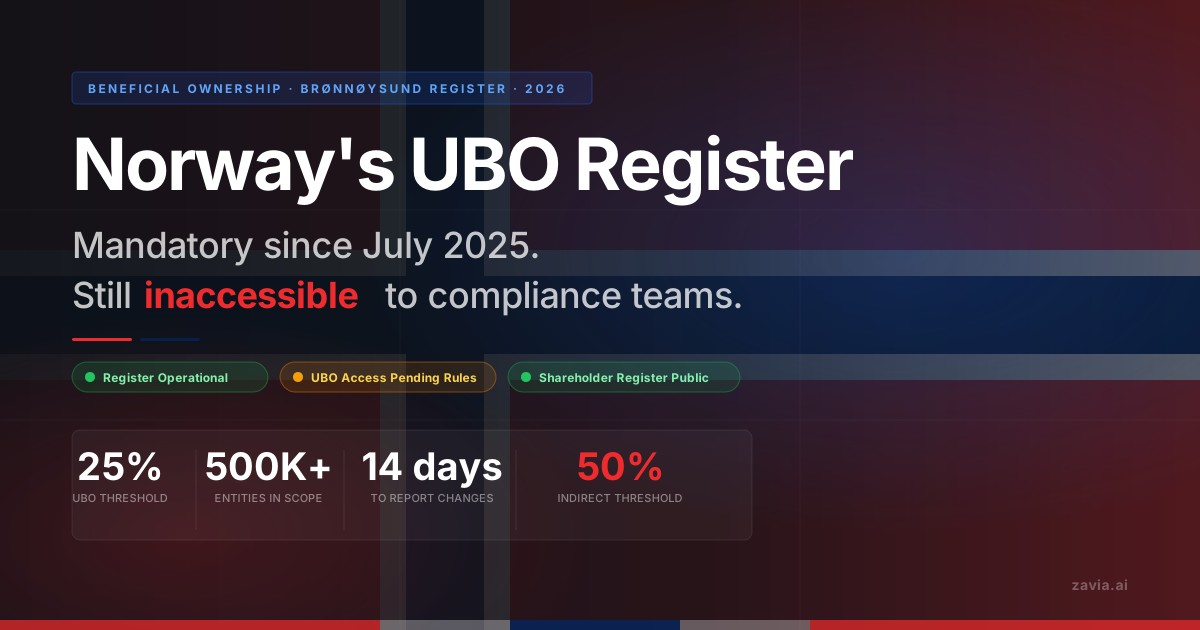
Norway's Register of Beneficial Owners — Register over reelle rettighetshavere — is one of the newest UBO registers in Europe. It opened for voluntary registration on 1 October 2024, became mandatory from 31 July 2025, and covers more than 500,000 entities registered or operating in Norway. The register is maintained by the Brønnøysund Register Centre, Norway's central public register authority.
Norway is not an EU member but is part of the European Economic Area (EEA). It is not directly bound by EU AML directives but implements equivalent obligations under EEA membership. The UBO Act (Lov om register over reelle rettighetshavere) was enacted in 2019 and reflects the EU's fourth AML directive requirements. Its implementation was delayed by the same CJEU November 2022 ruling (joined cases C-37/20 and C-601/20) that forced EU member states to close public access to their UBO registers.
The register is now operational and filing obligations are enforced. But the access framework — who can query the register, under what conditions, and at what cost — is still being finalised. As of March 2026, full access remains limited to public authorities. Norway also has unusually strong shareholder register transparency, one of the most accessible in Europe. This guide covers the UBO definition, data filed, access rules, penalties, upcoming changes, and a step-by-step verification workflow. Part of the Global Ownership Data Index.
25%
UBO threshold — direct ownership or voting rights
14 days
To report any change in beneficial ownership
500K+
Norwegian entities in scope of the UBO Act
1 year
Max imprisonment for intentional non-compliance
1. Norway's UBO Register: The State of Play in 2026
Norway's Register of Beneficial Owners is one of the newest UBO registers in Europe. The register is maintained by the Brønnøysund Register Centre and opened for voluntary filing on 1 October 2024, becoming mandatory from 31 July 2025. Norway is EEA but not EU — it implements equivalent AML obligations but is not directly bound by EU directives. The CJEU November 2022 ruling that closed public access to EU member state UBO registers also prompted Norway to redesign how its register would be accessed before launching.
The register is populated and fines are active. But the access framework is still being written. A Ministry of Finance consultation on access rules was published in September 2024. Until implementing regulations are finalised, only Norwegian public authorities can query the register. Norway's shareholder register, by contrast, is among the most transparent in Europe — publicly accessible to anyone upon request since February 2025.
Register Operational
UBO Access — Pending Rules
Shareholder Register Public
EEA Member — Not EU
2. What Is a UBO Under Norwegian Law?
Norway's UBO definition is established in the Act on the Register of Beneficial Owners (2019). The Norwegian term is reell rettighetshaver. The definition differs from the EU standard in one important respect: it applies a higher threshold for indirect ownership through intermediate companies.
Direct beneficial ownership: the 25% threshold
A person is a direct beneficial owner if they own more than 25% of the business, control more than 25% of the voting rights, have the right to appoint or remove more than half of the board members, or exercise influence or control in other ways — such as veto rights or situations where the person's recommendation is consistently followed by majority shareholders.
Indirect beneficial ownership: the 50% intermediary rule
Norway applies a different threshold for indirect ownership compared to most EU countries. To qualify as an indirect beneficial owner, the individual must own or control 50% or more of the intermediary company, and that intermediary must control more than 25% of the registering entity. This is stricter than the simple look-through approach used across EU jurisdictions.
UBO Threshold Comparison — Norway vs EU Countries
Direct threshold vs indirect intermediary threshold by country
0%25%50%75%100%
Norway
25%
50% intermediary
Germany
25%
25% look-through
France
25%
25% look-through
Netherlands
25%
No separate indirect threshold — 25% look-through
⚠️ Norway unique: 50% threshold for indirect ownership vs 25% EU standard
Direct threshold
Indirect / intermediary threshold
⚠️
Two UBO definitions exist simultaneously in Norwegian law
Norway has two separate definitions of beneficial ownership: one under the UBO Act (for register filings) and one under the Anti-Money Laundering Act (for CDD by obliged entities). The thresholds differ, particularly for indirect ownership. AML-obliged entities — banks, lawyers, notaries — must use the AML Act definition for customer due diligence, while entities filing with the register use the UBO Act definition. This dual-definition framework is unique to Norway.
⚠️ Two Different Definitions in Norwegian Law
The UBO Act uses a 50% threshold for intermediary company control; the AML Act uses a lower threshold. This means the person identified as UBO for filing purposes may differ from the person a bank would identify in a CDD workflow — a genuine source of discrepancy risk unique to Norway.
Pseudo-UBO / no UBO fallback
If no natural person meets the criteria, the entity must still file — registering either that it has no beneficial owners or that it was unable to identify them. Unlike many EU systems, there is no automatic fallback to senior management. The entity must document its identification efforts and make that documentation available to authorities on request.
Entities that must register
| Entity Type | In Scope? | Notes |
|---|---|---|
| Private limited companies (AS) | ✓ Yes | Most common Norwegian entity; mandatory from 31 July 2025 |
| Public limited companies (ASA) | ✓ Yes | Exempt if listed on Oslo Børs or equivalent EEA market |
| Partnerships (ANS, DA, KS) | ✓ Yes | General and limited partnerships all in scope |
| Cooperatives (SA) | ✓ Yes | — |
| Commercial foundations | ✓ Yes | Non-commercial foundations exempt |
| Norwegian branches of foreign entities (NUF) | ✓ If in Business Enterprises Register | May be exempt if UBOs already registered in EEA country under equivalent obligation |
| Trustees of foreign trusts operating in Norway | ✓ Yes | Must register if trust conducts business in Norway |
| Listed companies (Oslo Børs, Euronext Expand, equivalent EEA) | ✗ Exempt | Must register the exchange where shares are listed instead |
| State, municipalities, state-owned enterprises | ✗ Exempt | — |
| Non-commercial associations, mutual funds, health trusts | ✗ Exempt | — |
3. What UBO Data Is Filed with the Register
Filings are made electronically through Altinn, Norway's national business reporting platform, using form RRH-0100. The identification basis documentation must also be uploaded and archived internally.
| Data Field | Filed? | Notes |
|---|---|---|
| Full name | ✓ Yes | — |
| National identity number or D-number | ✓ Yes | Date of birth used as alternative if no ID number available |
| Country of residence | ✓ Yes | — |
| All citizenships | ✓ Yes | Multiple nationalities all required |
| Basis of beneficial ownership | ✓ Yes | Direct or indirect; ownership, voting rights, board appointment rights, or other control |
| Ownership percentage interval | ✓ Yes | Filed in bands: 25.01–49.99%, 50–74.99%, 75–99.99%, 100% |
| Whether no UBO identified / cannot be identified | ✓ Yes | Must be registered even when no UBO exists |
| Identification basis documentation | ✓ Archived internally | Available to authorities on request; not publicly visible |
| Intermediate ownership chain | ✗ No | Phase 2 of register development was to include this; funding not secured |
⚠️
Phase 2 funding was not secured
Phase 2 was designed to include intermediate ownership chain data and discrepancy reporting mechanisms. Funding was not included in Norway's national budget. The register captures who the UBO is but not the full ownership chain connecting them to the entity.
4. Who Can Access Norway's UBO Register?
Access to the register is the most significant open question in Norway's UBO framework. The establishing legislation described it as public. The CJEU 2022 ruling required a redesign. The Ministry of Finance published a consultation in September 2024. As of March 2026, implementing regulations have not been finalised.
2019
UBO Act enacted. Register designed to be publicly accessible and free. Development begins.
November 2022
CJEU ruling determines public access violates EU Charter privacy rights. Norway reviews its approach.
June 2024
Norwegian Parliament passes amendments granting access to AML-obliged entities, media, civil society, and higher education. Implementing regulations required.
1 October 2024
Register opens for voluntary filings. Access limited to public authorities. Consultation on access regulations published.
31 July 2025
Mandatory registration deadline. Daily fines begin. 500,000+ entities required to have filed.
Pending 2026
Implementing regulations on access for AML-obliged entities, media, and civil society expected. Until then, full access limited to public authorities.
| Category | Access Level | Notes |
|---|---|---|
| Norwegian public authorities | Full — operational | Full UBO data including identity numbers; direct access from day one |
| AML-obliged entities (banks, lawyers, accountants) | ● Granted in law — rules pending | Parliament granted access June 2024; practical access awaits implementing regulations |
| Media organisations | ● Granted in law — rules pending | As above |
| Civil society organisations | ● Granted in law — rules pending | As above |
| Higher education institutions | ● Granted in law — rules pending | As above |
| General public | ✗ Not provided | General public access not implemented following CJEU ruling |
| Foreign obliged entities | ✗ No route confirmed | EEA register interconnection planned but not yet implemented for Norway |
🚫
Access is granted in law but not yet operational
Norway's Parliament granted access rights to AML-obliged entities, media, and civil society in June 2024. But granting rights in legislation and making them operationally available are different things. Until implementing regulations are finalised and the technical infrastructure updated, the only parties with practical access are Norwegian public authorities. The register is currently unusable for KYB due diligence by any non-authority party.
UBO Register Access Rights — Norway vs Series Countries
Who can practically access beneficial ownership data today (March 2026)
| Country | Authorities | AML Entities | Media / NGO | General Public |
|---|---|---|---|---|
| 🇳🇴 Norway | Full ✓ | Law only | Law only | None ✗ |
| 🇬🇧 UK | Full ✓ | Full ✓ | Full ✓ | Full ✓ |
| 🇳🇱 Netherlands | Full ✓ | Q2 2026 | None ✗ | None ✗ |
| 🇫🇷 France | Full ✓ | LIA ~20d | LIA ~20d | None ✗ |
| 🇪🇸 Spain | Full ✓ | ID req. | ID req. | None ✗ |
| 🇨🇭 Switzerland | H2 2026 | None ✗ | None ✗ | None ✗ |
5. Norway's Shareholder Register: Stronger Than Most of Europe
Norway's UBO access limitations are significantly offset by unusually strong shareholder register transparency — the most distinctive feature of Norway's corporate ownership landscape compared to other countries in this series.
✓
Everyone has the right to access the Norwegian shareholder register
Since 1 February 2025, the Norwegian Public Limited Liability Companies Act grants everyone — regardless of nationality or institutional standing — the right to access any Norwegian company's full shareholder register upon request. Companies must provide an electronic copy by email. Listed companies' shareholders are also searchable via aksjeeierregisteret.no. The Norwegian Tax Administration's shareholder register (Aksjonærregisteret) is publicly available annually.
| Data Source | Cost | What You Get | UBO Data? | Access |
|---|---|---|---|---|
| Brønnøysund (brreg.no) | Free | Company name, org. number, legal form, directors, address, annual accounts | ✗ None | Open, no login |
| Shareholder register (aksjeeierboken) | Free on request | Full shareholder list: names, share counts, ownership percentages | ● Direct shareholders only | Request by email; company must provide electronic copy |
| Public shareholder portal (aksjeeierregisteret.no) | Free | Daily-updated shareholder data for VPS-listed companies | ● Direct shareholders only | BankID login; non-Nordic users contact VPS for account |
| Aksjonærregisteret (Tax Administration) | Free — annually | Annual shareholder data: name, birth year, postcode | ● Direct shareholders only | Public data download |
| UBO Register (Brønnøysund) | TBD | UBO name, nationality, citizenship, residence, basis and interval of control | ✓ Yes — authorities only | Currently authorities only; non-authority access pending regulations |
| Annual accounts (Regnskapsregisteret) | Free | Full financial statements for all Norwegian companies | ✗ None directly | Public; available at proff.no and brreg.no |
ℹ️ Shareholder Register ≠ UBO Register
Norway's shareholder register shows who directly holds shares. The UBO register identifies the natural person who ultimately controls the entity through any chain. For a Norwegian AS owned by a holding company in turn owned by a natural person: the shareholder register shows the holding company; the UBO register shows the natural person. Both are needed for complete beneficial ownership verification — and currently only the shareholder register is accessible to non-authority parties.
6. Penalties for Non-Compliance
Norway's enforcement model combines automatic daily fines with escalating personal liability. The register doesn't wait for a formal complaint — fines begin the day after the deadline is missed.
Daily fines
Coercive fines imposed by Brønnøysund from day one of non-compliance. Accrue automatically. Entity notified via Altinn in advance.
Personal liability
After 8 weeks of non-compliance, board members may be held jointly and severally liable for total accumulated fines.
Up to 1 year
Criminal penalties including imprisonment for intentional non-compliance or provision of false information.
🚫
Dormant companies are not exempt
No trading activity does not remove the filing obligation. The obligation only ceases once the entity is formally struck off the register. Foreign groups with dormant Norwegian subsidiaries kept alive for administrative reasons must file. Daily fines accrue regardless of inactivity.
Non-Compliance Penalty Escalation Path
How enforcement intensifies from day one of missed deadline
📋
Day 1
Warning
Notification via Altinn
💰
Day 1+
Daily Fines
Automatic, accruing
👤
Week 8
Board Liable
Directors personally liable
⚖️
Criminal
Prosecution
Fines or up to 1 year prison
✅
Resolve
Compliance
File via Altinn, fines stop
7. Key Legislation
| Legislation | Year | Key Provision |
|---|---|---|
| Act on the Register of Beneficial Owners | 2019 | Establishes the register, defines beneficial owners, sets filing obligations; implementing regulation entered force November 2021 |
| Anti-Money Laundering Act (Hvitvaskingsloven) | 2018 / amended | Defines beneficial ownership for CDD purposes with different threshold; obliged entities must use this definition |
| CJEU ruling (C-37/20 and C-601/20) | November 2022 | Public access to UBO registers violates EU Charter privacy rights; Norway delays launch and redesigns access model |
| Parliamentary amendments on access | June 2024 | Granted access to AML-obliged entities, media, civil society, and higher education; implementing regulations required |
| Register opens for voluntary registration | 1 October 2024 | Voluntary filing begins; Ministry of Finance consultation on access regulations published |
| Shareholder register access regulation | 1 February 2025 | Everyone gains right to access shareholder registers on request; companies must provide electronic copy |
| Mandatory UBO registration deadline | 31 July 2025 | All in-scope entities must have filed; daily fines apply from this date |
| Access regulations for non-authority parties | Expected 2026 | Implementing regulations following September 2024 consultation; timeline unconfirmed |
8. Upcoming Changes
1. Implementing regulations for non-authority access
The most critical near-term development. The September 2024 consultation was the first step. Until regulations are in force, compliance teams cannot query the register even if their institution would qualify for access. This is the single biggest outstanding gap in Norway's beneficial ownership framework.
2. EEA register interconnection
EU Regulation 2021/369 on beneficial ownership register interconnection applies in the EEA. Norway is expected to connect the Brønnøysund register to the BORIS platform, enabling cross-border data sharing with EU member states. Timeline not yet confirmed.
3. Phase 2 register development
Originally designed to include intermediate ownership chain data and discrepancy reporting. Funding was not secured. If implemented, the register would show the corporate vehicles through which UBO control is exercised — significantly increasing its utility for KYB workflows. This remains aspirational rather than scheduled.
4. Shareholder register submission migration
In June 2026, the current Altinn-based submission route for the annual shareholder register statement will be discontinued. Private limited companies will need to use a dedicated end-user system. This is an administrative change and does not affect the public accessibility of shareholder data.
9. The Real Challenges of Accessing Norwegian UBO Data
9.1 The register is operational but inaccessible for non-authority KYB
Norway has a mandatory, populated, enforced register — but it cannot be queried by compliance teams or KYB platforms. Access rights exist in law but the practical mechanism has not been implemented. The register is a black box for anyone outside Norwegian public authorities.
9.2 Two UBO definitions create compliance complexity
Norwegian entities must work with two simultaneously applicable beneficial ownership definitions. The person identified as UBO for register filing purposes may differ from the person an obliged entity would identify in a CDD workflow — a genuine source of discrepancy risk.
9.3 The 50% indirect threshold creates coverage gaps
Ownership structures where a natural person holds 30% of a holding company which holds 40% of a Norwegian AS may not trigger UBO registration under the UBO Act — even though the effective economic interest is material. Under EU standard look-through approaches, this would often qualify.
9.4 No ownership chain data in the current register
The register records the UBO but not the intermediate companies through which control is exercised. The supporting documentation is held internally by the entity and only available to authorities on request — not to compliance teams.
9.5 Foreign trusts with Norwegian nexus are a grey area
The UBO Act covers trustees of foreign trusts that conduct business in Norway. But the practical implementation for foreign trusts is less clearly specified than for corporate entities. Trustees managing trusts with Norwegian assets or activities should seek specific Norwegian legal advice.
9.6 EEA status creates regulatory uncertainty
Norway is EEA but not EU. The 6AMLD package — which reshapes EU member state UBO access frameworks by July 2027 — does not automatically apply. How Norway implements equivalent rules, and on what timeline, remains to be determined. This creates uncertainty for cross-border compliance workflows involving Norwegian entities.
10. How to Verify a Norwegian UBO Today: Step-by-Step
Norway's UBO register cannot be queried by non-authority parties. But Norway's exceptional shareholder register transparency provides a strong foundation for beneficial ownership verification in practice.
1
Query brreg.no
Free, no login. Returns company name, org number, legal form, board members, managing director, share capital, address, and annual accounts history. Always step one for any Norwegian entity.
2
Request the shareholder register
Since February 2025, everyone has the legal right to request a full copy of any Norwegian company's shareholder register. Contact the company by email — they are legally required to provide it. For listed companies use aksjeeierregisteret.no. This gives you the direct owners.
3
Trace the chain above any legal entity shareholders
If shareholders are holding companies — Norwegian or foreign — trace upward. Zavia.ai connects to 400+ government registries across 173 countries and maps the full ownership chain via a cross-border ownership graph. For Norwegian subsidiaries with UK, German, or Dutch parents, the UBO is often accessible through the parent's registry without needing Norwegian UBO register access.
4
Review annual accounts for group structure indicators
Norwegian annual accounts are publicly available at proff.no and brreg.no. Notes often disclose the parent company, group relationships, and related party transactions — providing ownership context without UBO register access.
5
Request voluntary UBO disclosure from the counterparty
Norwegian entities are required to maintain the documentation supporting their UBO analysis. Since July 2025, all in-scope entities should have this in place. Requesting a copy directly from the counterparty is standard practice for Norwegian banks.
6
Screen against sanctions and PEP lists
Norway's UBO register carries no sanctions flags. Once a natural person is identified, screen against EU, OFAC, UN and Norwegian sanctions lists. Zavia.ai includes a sanctions screening layer built into the same ownership query.
⚠️
14-day change notification window
Any change in beneficial ownership must be registered at Brønnøysund within 14 days of the entity becoming aware of the change. For foreign-owned Norwegian subsidiaries where group restructuring is common, build automated alerts into your compliance workflow. Missed deadlines trigger daily fines from day 15.
11. Accessing Norwegian Company Data via Zavia.ai
Norway's UBO register cannot be queried by non-authority compliance teams. But Norway's shareholder register transparency combined with the ownership graph approach means beneficial ownership is often accessible through other routes — particularly for Norwegian entities that are part of larger international groups.
Zavia.ai connects directly to the Brønnøysund Register Centre and combines Norwegian company data with a cross-border ownership graph spanning 173 countries. For a Norwegian AS owned by a UK holding company, the UBO accessible via UK Companies House is surfaced alongside the Norwegian company record.
How the ownership graph resolves Norwegian UBO access
Most significant Norwegian entities are subsidiaries of international groups — particularly oil and gas, shipping, financial services, and technology companies with UK, US, Dutch, or German parents. In those jurisdictions, beneficial ownership data is often publicly accessible or available through established channels. By tracing the ownership chain above the Norwegian entity, Zavia.ai identifies the ultimate parent and surfaces UBO data from the jurisdiction where it is most accessible — without requiring Norwegian UBO register access.
🇳🇴 Norwegian Company Data — Access via API or Bulk Delivery
Zavia.ai connects directly to the Brønnøysund Register Centre — returning structured Norwegian company data, director records, annual accounts, and cross-border ownership resolution. Available as a live API for real-time queries or as a bulk data file for licensing and large-scale enrichment.
- → Norwegian company queries by org. number
- → Board members and directors from Brønnøysund
- → Annual accounts and financial filing history
- → Cross-border ownership chain (173 countries)
- → Ultimate parent identification
- → Director history and company document retrieval
- → Sanctions overlay and KYB workflow
- → Full reseller and redistribution rights available
Ownership Graph
400+ registries. Companies and people linked across borders.
Zavia.ai sources data directly from 400+ government registries in 173 countries and links it through an ownership graph — mapping subsidiary-to-parent relationships, shared directorships, and cross-border control chains. Query a Norwegian AS and the graph returns not just the Norwegian record, but the full ownership structure above and below it across every jurisdiction where data exists.
🌐
400+ Government Registries. Linked Across People and Companies.
Zavia.ai sources data directly from 400+ government registries across 173 countries — company records, director appointments, shareholder filings, and ownership data from primary sources. These data points are linked through an ownership graph that maps subsidiary-to-parent relationships, shared directorships, and cross-border control chains. Query a Norwegian AS and the graph returns not just the Norwegian record — but the full ownership structure above and below it, across every jurisdiction where data is available.
Read Next — Global Ownership Data Index
🇬🇧
United Kingdom
Companies House PSC — most transparent in Europe, free public API
🇩🇪
Germany
Transparenzregister — LI access, full reform expected 2027
🇳🇱
Netherlands
KvK — closed since Nov 2022, obliged entity API expected Q2 2026
🇮🇹
Italy
Registro delle Imprese — CJEU referral pending, qualified interest Jan 2026
🇪🇸
Spain
RCTIR — technically open, Spanish ID required, foreign access blocked
🇨🇭
Switzerland
LETA — no register until H2 2026, then permanently non-public
12. Frequently Asked Questions
Yes. Norway's Register of Beneficial Owners opened for voluntary registration on 1 October 2024 and became mandatory from 31 July 2025. It is maintained by the Brønnøysund Register Centre and covers more than 500,000 entities. As of March 2026 the register is only accessible to Norwegian public authorities — implementing regulations for non-authority access are still pending.
A beneficial owner is any natural person who owns more than 25% of the business, controls more than 25% of the voting rights, has the right to appoint or remove more than half the board members, or exercises control through other means. For indirect ownership the person must own or control 50% or more of the intermediary company, and that intermediary must control more than 25% of the registering entity — stricter than the EU standard.
As of March 2026, only Norwegian public authorities have practical access. Parliament granted access to AML-obliged entities, media, and civil society in June 2024 — but the implementing regulations have not been finalised. The register cannot be queried by non-authority compliance teams regardless of institutional standing.
Yes — and more openly than almost any other European country. Since 1 February 2025, everyone has the legal right to access any Norwegian company's full shareholder register on request. Companies must provide an electronic copy by email. For listed companies, shareholders are searchable via aksjeeierregisteret.no. Note: this shows direct shareholders, not ultimate beneficial owners through complex chains.
Brønnøysund imposes daily coercive fines from the day after the deadline is missed. After 8 weeks of non-compliance, board members may be held jointly liable for accumulated fines. Intentional non-compliance can result in fines or imprisonment of up to 1 year. Dormant companies are not exempt.
Norway has two separate definitions: the UBO Act (for the Brønnøysund register) and the Anti-Money Laundering Act (for CDD by obliged entities). They differ particularly on indirect ownership thresholds. Entities subject to both — most Norwegian financial institutions — must comply with both simultaneously.
NUFs registered in the Business Enterprises Register must file. However, if the UBOs are already registered under an equivalent obligation in another EEA country, the NUF may be exempt. Only NUFs in the Business Enterprises Register — not just the Central Coordinating Register — are subject to the requirement.
Norway is EEA but not EU. It implements equivalent AML obligations but 6AMLD does not automatically apply. The 6AMLD package reshapes EU UBO access frameworks by July 2027 — how Norway implements equivalent rules and on what timeline remains to be determined.
Full name, national identity number or D-number (or date of birth if unavailable), country of residence, all citizenships, the basis of beneficial ownership (direct or indirect, type of control), and the ownership percentage interval (e.g. 25.01–49.99%, 50–74.99%, 75–99.99%, 100%). Supporting identification documentation is archived internally and available to authorities on request.
Norway's UBO register records only the natural person at the end of the chain — not the intermediate companies through which control is exercised. And the register cannot be queried by non-authority compliance teams. Zavia.ai's ownership graph identifies the full chain above any Norwegian entity across 173 countries, enabling UBO resolution through whichever jurisdiction's registry has the most accessible data.