The OFAC 50 Percent Rule in 2026: Aggregation, Indirect Ownership, and the Sham-Transactions Reset

The Specially Designated Nationals List is the most heavily screened blacklist in financial crime — more than 12,000 entries, run against millions of transactions a day. It is also, by design, incomplete. The company that actually freezes your payment is very often not on it: a company OFAC has never named, in a jurisdiction you were not watching, owned through two or three holding layers by someone who is. That gap — between the names on the list and the far larger universe of property those names block — is the entire subject of the 50 Percent Rule. And after a March 2026 advisory, the rule became harder to rely on, not easier.
01The 50 Percent Rule, in one paragraph
OFAC states it in a single sentence: “The property and interests in property of entities directly or indirectly owned 50 percent or more in the aggregate by one or more blocked persons are considered blocked.” The entity itself does not need to appear on any list. It is blocked as a matter of law the moment the ownership arithmetic crosses the line, and a US person must treat it exactly as a listed party: no dealings, and any property in US jurisdiction frozen. OFAC first published this guidance on 14 February 2008 and revised and superseded it on 13 August 2014; the 2014 text, published as OFAC FAQs 398–402, is still the operative version. Three words in that sentence carry the weight — indirectly, aggregate, and owned. The rest of this guide is those three words.
Own 50% or more of a company — directly or indirectly, alone or added together with other sanctioned parties — and that company is blocked. Listed or not.
02“Owned,” not “controlled”
The US test is an ownership test. It measures legal title to equity or voting interests, expressed as a percentage. A blocked person who runs a company day to day, chairs its board, or is its single most important customer — but holds less than 50% — does not trigger an automatic block under the rule. OFAC confirmed this directly in FAQ 398, published 11 August 2020: an entity controlled, but not 50%-owned, by blocked persons is “not considered automatically blocked.” OFAC also says in the same breath that it “urges caution” in such cases and may designate the entity separately — which it frequently does.
This is the point where the US framework parts company with the EU and the UK, both of which read control into their versions of the test. That divergence is section 06. For OFAC, hold the distinction precisely: ownership is arithmetic, control is judgement, and the 50 Percent Rule is arithmetic.
03Aggregation: two 25 percent stakes are one problem
You add together every blocked person’s stake in the same entity. OFAC’s own example, from FAQ 399: “If Blocked Person X owns 25 percent of Entity A, and Blocked Person Y owns another 25 percent of Entity A, Entity A is considered to be blocked.” Neither X nor Y holds a majority. Neither, on their own, would flag. Together they block the company.
Aggregation crosses sanctions programs. If X is listed under a Russia-related program and Y under a Venezuela-related one, their stakes still combine — there is no “same list” or “same program” requirement anywhere in the guidance. A structure that is 30% owned by one designated person, 15% by a second, and 10% by a third is a blocked entity, even though no single name accounts for more than a third of it.
This is precisely what a screening process that checks each shareholder in isolation will miss. The block does not live in any one row of the cap table; it lives in the sum. In Zavia’s dataset, of the companies that disclose shareholder-level detail at all, 63% have two or more distinct registered shareholders — aggregation is not an edge case, it is the median cap table.
04Indirect ownership: why you never multiply the percentages
The intuitive move is to multiply down the chain. A blocked person owns 50% of Company A; Company A owns 50% of Company B; so the blocked person “really” owns 25% of B, which is below the line, so B is fine. That is the single most common way a blocked entity clears a review, and it is wrong.
OFAC’s method is a series of gates, not a multiplication. Once Company A is owned 50% or more in the aggregate by blocked persons, Company A is itself treated as a blocked person. You then re-run the test at the next layer with A now counted as blocked. A’s 50% of Company B is therefore a blocked-person stake of 50%, and B is blocked. OFAC’s worded example: “Blocked Person X owns 50 percent of Entity A, and Entity A owns 50 percent of Entity B. Entity B is considered to be blocked.”
The gate runs the other way too. If a blocked person owns 60% of Company A — so A is blocked — and A owns 40% of Company B, then B has 40% blocked-person ownership and is not automatically blocked. A 50% × 50% × 50% chain blocks the company at the bottom of it. A 60% × 40% chain does not block the second company at all. Each link is a yes/no test on that entity, resolved before you move down.
Multiplying 50% × 50% to get 25% and clearing the entity. Once an intermediary crosses 50%, it counts in full at the next layer — the stake does not shrink as it descends.
05A worked example: a 55 percent chain that blocks a company on no list
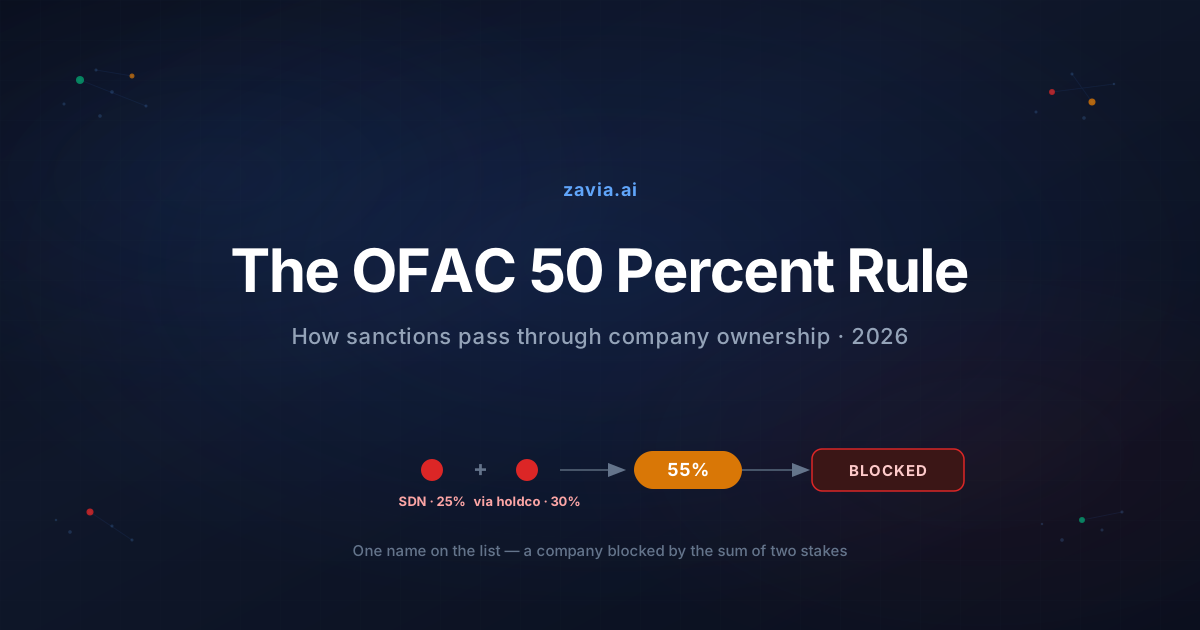
The names here are invented; the structure is ordinary. Meridian Materials DMCC, registered in Dubai, has three shareholders: 25% held directly by an individual, R. Volkov, added to the SDN List in 2024; 30% held by Sever Holdings Limited, a Cyprus company; and 45% by a Swiss commodities trader with no sanctions nexus.
Sever Holdings is on no list. Its Cypriot filing shows one shareholder: R. Volkov, 100%.
Run the rule. Sever Holdings is 100% owned by a blocked person, so Sever Holdings is itself blocked. Its 30% of Meridian is a blocked-person stake. Add the 25% Volkov holds in Meridian directly. 25 + 30 = 55%. Meridian Materials DMCC is blocked property under US law — no dealings, freeze on anything in US jurisdiction — even though the only name on the SDN List anywhere in this structure is one individual, and Meridian trades openly in a market where the beneficial-ownership register is not public.
Now change one number. Volkov holds 20% of Meridian directly instead of 25%. Aggregate: 20 + 30 = 50% — still blocked, because the rule is “50 percent or more.” Change it again to 15%: aggregate 45%, and Meridian is not automatically blocked. That 45% case — a sanctioned person just under the line — is what section 07 is about.
06Control, and where the US, EU and UK diverge
A compliance team screening one company often owes duties under all three regimes at once. They do not apply the same test.
| Regime | Ownership trigger | Control trigger | Aggregation |
|---|---|---|---|
| OFAC (US) | 50% or more, direct or indirect | No automatic block on control alone; OFAC urges caution and may designate separately | Yes — all blocked persons, across all programs |
| EU | More than 50% of proprietary rights or capital | Yes — an independent trigger: power to appoint or remove a majority of the board, or to exercise a dominant influence | Yes — holdings of multiple listed persons are added together |
| UK (OFSI) | More than 50% of shares or voting rights, direct or indirect | Yes — the ability to ensure the entity’s affairs are conducted in accordance with the person’s wishes | Yes |
The practical consequence: a 45% stake held by a sanctioned person, combined with the right to appoint the chair, is not an automatic block in Washington and quite possibly is one in Brussels and London. If your obligations are plural, you run the strictest test that applies, not the OFAC one by default.
07The March 2026 sham-transactions advisory: 50 percent stops being a safe harbour
For a decade the rule had a bright line, and people stood on it. A blocked person who divested from 60% to 49% took their entity out of automatic blocking — OFAC’s FAQ 402 said so, subject to “caution” and a check that the divestment was real. After the 2022 wave of Russia-related designations, divestments to just under 50% became a standard move.
The advisory tells firms to look past the number on the share register. Where a blocked person has divested to just under 50%, or moved holdings to family members, trustees, or long-standing business partners, the diligence obligation is to look for “indicia of a continuing interest” — and to treat a purported divestment as a sham until the evidence says otherwise. Was there real consideration? Was the timing suspicious relative to the designation? Did operational control stay behind? A near-miss with a blocked-person history is now an open question, not a cleared one.
A 49 percent stake used to be the edge of the rule. Since March 2026 it is the start of the diligence.
08Why the rule is hard to run: the data does not cooperate
The rule is arithmetic. The arithmetic needs inputs that most company registries do not publish. This is the catch that turns a one-sentence rule into a research project.
Zavia’s dataset is drawn directly from official company registries. Across a working sample of 6,210 company records:
So a real 50 Percent Rule check is rarely “read the cap table.” It is: obtain a cap table that usually is not public, resolve every corporate shareholder to its own owners in another country, repeat three or four times, and aggregate blocked-person stakes at every layer — against a list that changes most weeks. Circular holdings and layered structures built to frustrate exactly this exercise are common enough to have their own risk-scoring literature.
Zavia connects directly to official company registries in 173 countries, resolves each corporate shareholder to the next layer automatically, and returns the full ownership chain to the natural person — with sanctions and PEP flags applied at every node, so the aggregation math runs against a complete structure, not the one public layer.
For relationships you keep, an ownership-monitoring API re-runs the check whenever a shareholder changes or a new designation lands. See how it works · The UBO verification workflow
09How to check a company against the 50 Percent Rule
- Screen the entity itself. Name, aliases, registration number and addresses against the SDN List and every non-US list that applies. A hit here ends the analysis.
- Get the full cap table. Every shareholder, every percentage, with a date. Where the registry does not publish it, request it from the counterparty and reconcile against filed accounts.
- Resolve every corporate shareholder. For each holder that is itself a company, trust or foundation, pull its owners in its own jurisdiction. Repeat until every branch ends at a natural person, a listed company’s free float, or a documented dead end.
- Flag blocked persons at every node. Screen each individual and each intermediate entity. Mark any entity that is itself 50%+ owned in aggregate by blocked persons as blocked, and carry that status down.
- Aggregate and apply the 50% test, layer by layer. At each entity, add every blocked-person stake — direct holdings plus the full stake of any intermediate entity you marked blocked. 50% or more, in aggregate: blocked.
- Check control and divestment history. Below 50%, look for board control, management rights, and any stake that fell to just under the line after a designation. Since the March 2026 advisory, treat a near-miss with a blocked-person history as unresolved.
- Monitor. Ownership moves and the lists move. Re-run the check on shareholder changes and on new designations for any relationship you are not walking away from.
10Common failure modes
| The mistake | Why it fails |
|---|---|
| Screening only the entity name | The rule exists precisely for entities OFAC never named |
| Multiplying percentages down the chain | Once an intermediary crosses 50% it counts in full — 50% × 50% blocks the entity, it does not halve to 25% |
| Checking each shareholder in isolation | Aggregation adds separate blocked persons together, across different sanctions programs |
| Stopping at a corporate shareholder | 64% of disclosed cap tables name only companies; the answer is upstream |
| Treating 49% as clear | Since the March 2026 advisory, a sub-50% stake with a blocked-person history is a diligence task, not a pass |
| Applying only the OFAC test to an EU or UK obligation | Both add a control trigger the US rule does not have |
| Running the check once | A new designation can block a structure you cleared last month |
11Where this leaves you
The 50 Percent Rule is cheap to state and expensive to apply. The statement is one sentence OFAC has barely touched since 2014. The application is a cross-border ownership-resolution problem, run against a list that changes weekly, in a world where 86% of companies do not publish who owns them. The March 2026 advisory took away the one bright line people leaned on — 49% — and put a diligence standard in its place.
Build the check as a chain of yes/no ownership gates. Aggregate every blocked-person stake at every layer. Resolve each corporate shareholder to the next jurisdiction rather than stopping at it. And keep it running, because the inputs do not hold still. The alternative is hearing about the block from your bank.
Run the 50 Percent Rule against the whole structure
Ownership chains resolved from official registries in 173 countries, with sanctions and PEP flags applied at every node — not just the one layer that happens to be public.
12Glossary
13Frequently asked questions
What is the OFAC 50 Percent Rule?
It is OFAC’s guidance that any entity owned 50 percent or more, in the aggregate, directly or indirectly, by one or more blocked (sanctioned) persons is itself blocked — whether or not that entity appears on the SDN List. US persons must treat such an entity as a sanctioned party: no dealings, and any property within US jurisdiction is frozen. OFAC first issued the guidance on 14 February 2008 and revised it on 13 August 2014; the 2014 version, with its accompanying FAQs, is the version in force.
Does a company have to be on the SDN List to be blocked?
No. That is the entire point of the rule. A company that OFAC has never named is blocked by operation of the 50 Percent Rule the moment sanctioned persons own 50 percent or more of it in aggregate. These entities are sometimes described as “blocked pursuant to the 50 Percent Rule.” Screening a name against the SDN List and getting no hit does not answer the ownership question.
How does aggregation work under the 50 Percent Rule?
You add together the stakes of every blocked person in the same entity. OFAC’s example: if one blocked person owns 25 percent and another owns 25 percent, the entity is blocked, even though neither holds a majority. Aggregation applies across different sanctions programs — a Russia-program designee’s stake and a separate designee’s stake still combine. A screening process that evaluates each shareholder in isolation will not see this.
Do you multiply ownership percentages down a chain?
No. Once an intermediate company is owned 50 percent or more in aggregate by blocked persons, that company is itself treated as a blocked person, and its full stake in the next entity counts as a blocked-person stake. So a blocked person owning 50 percent of Company A, which owns 50 percent of Company B, blocks Company B — you do not multiply to 25 percent. Conversely, if the second link is only 40 percent, Company B is not automatically blocked. Each link is a separate yes/no test.
Does controlling a company trigger the 50 Percent Rule?
Under the US rule, no — not automatically. OFAC’s FAQ 398 (11 August 2020) states that an entity controlled, but not 50 percent-owned, by blocked persons is not automatically blocked. OFAC does warn that it “urges caution” and may designate such an entity separately. The EU and UK regimes are different: both treat control as an independent trigger that can block a minority-owned entity outright.
What changed with the March 2026 sham-transactions advisory?
On 31 March 2026 OFAC issued an advisory warning that formal ownership percentages are not the end of the analysis. Where a blocked person has divested to just under 50 percent, or moved holdings to relatives, trustees or long-standing associates, firms are expected to look for indicia of a continuing interest and to treat a purported divestment as a possible sham until diligence shows the transfer was genuine. Sanctions counsel characterised it as eroding the rule’s bright line; one client alert was titled “50 Percent Is Not Enough.”
Is a 49 percent stake held by a sanctioned person safe to deal with?
It is not an automatic block under the US rule, because the rule triggers at 50 percent or more. But since the March 2026 advisory it is not a clearance either. A sub-50 percent stake held by a blocked person — especially one that dropped below the line after a designation, or is held through a family member or associate — is a due-diligence assignment: verify real consideration, non-suspicious timing, and that operational control did not stay with the sanctioned party.
How is the EU and UK approach different from OFAC’s?
OFAC applies an ownership-only test: 50 percent or more, aggregated. The EU asset-freeze test adds control as an independent trigger — for example, the power to appoint or remove a majority of the board, or to exercise a dominant influence — and uses a “more than 50 percent” ownership threshold. The UK (OFSI) similarly applies more than 50 percent ownership or control, defined as the ability to ensure the entity’s affairs are conducted in accordance with the person’s wishes. A minority holder can be caught under EU or UK rules and not under OFAC’s.
How do you actually verify a company against the 50 Percent Rule?
Screen the entity itself first. Then obtain the full cap table with dates, resolve every corporate shareholder to its owners in its own jurisdiction, and repeat until each branch ends at a natural person or a documented dead end. Screen every individual and intermediate entity, mark any entity that is 50 percent-plus owned by blocked persons as blocked, and aggregate blocked-person stakes at each layer to apply the test. Then check for control and post-designation divestments, and monitor for shareholder changes and new listings.