UBO Verification: The Complete Guide to Identifying Ultimate Beneficial Owners in 2026

UBO Verification: The Complete Guide to Identifying Ultimate Beneficial Owners in 2026
Every year, regulators fine institutions hundreds of millions of euros for one recurring failure: not knowing who actually stands behind a company. Danske Bank's Estonian branch alone moved an estimated €200 billion in suspicious transactions before its UBO checks were exposed as a formality rather than a safeguard. The fallout — a €2 billion settlement, a fired CEO, ten arrests — is now the textbook case for why UBO verification isn't paperwork. It's the difference between knowing your counterparty and gambling on them.
This guide covers what UBO verification actually involves, how to do it properly, what regulators require across major markets, and why most of the time and risk in this process comes down to one thing: how close your data is to the original government source.
What Is UBO Verification?
UBO verification is the process of confirming the identity of the natural person(s) who ultimately own or control a legal entity — even when that person's name never appears on a share register or incorporation document.
The Financial Action Task Force (FATF) defines a UBO as the natural person who ultimately owns or controls a customer, or the person on whose behalf a transaction is conducted, including anyone who exercises ultimate effective control over a legal entity or arrangement.
In practice, most jurisdictions apply a 25% ownership or voting rights threshold (some, like South Africa and Colombia, go as low as 5-10%). But ownership percentage is only half the picture — control matters just as much. Someone with no shares at all can still be a UBO if they control the entity through a shareholder agreement, a trust arrangement, or a senior management role used as a fallback when no natural person meets the ownership threshold.
A quick distinction that trips up a lot of compliance teams:
- Legal owner — the name on the official paperwork.
- Beneficial owner (UBO) — the person who actually controls or profits from the entity, regardless of what the paperwork says.
- Beneficiary — someone who receives a financial benefit (e.g., from a trust) but doesn't necessarily control anything.
These aren't interchangeable. A legal owner and a UBO are very often two different people — and that gap is exactly what UBO verification exists to close.
Why UBO Verification Matters
Three forces make UBO verification non-negotiable for regulated and semi-regulated entities alike:
- Regulatory compliance. AML and CFT frameworks in the EU, US, UK, and most of APAC require obliged entities to identify and verify beneficial owners before or during onboarding — and to keep verifying, not check once and move on.
- Fraud and money laundering prevention. Shell companies and multi-layered ownership structures remain the go-to tool for disguising illicit fund flows. Without UBO verification, a business can unknowingly become the entry point for laundered money.
- Reputational and financial risk. Beyond fines, being linked — even indirectly — to a sanctioned individual or a criminal network causes damage that outlasts any single penalty.
There are also legitimate reasons a UBO might stay out of public view: personal safety, protection from extortion, or simply competitive privacy. Verification isn't about assuming bad intent — it's about being able to tell the difference between a private owner and a hidden one.
How to Conduct UBO Verification: A Step-by-Step Process
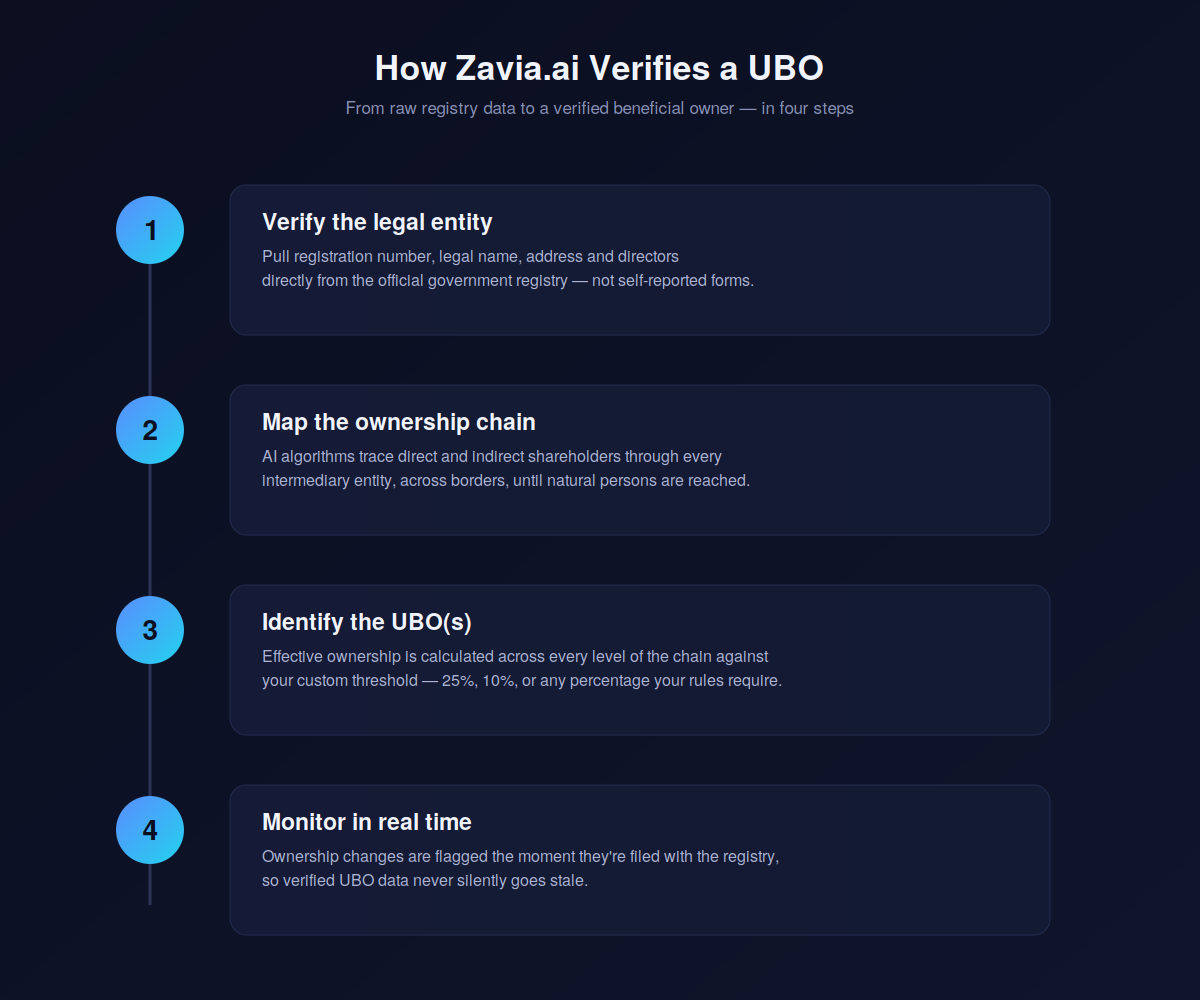
1. Verify the legal entity itself
Before you can find the people behind a company, confirm the company is real. Pull the registration number, legal name, registered address, entity type, and list of directors or top management from an official or authoritative source, not just what the counterparty supplies.
2. Map the ownership chain
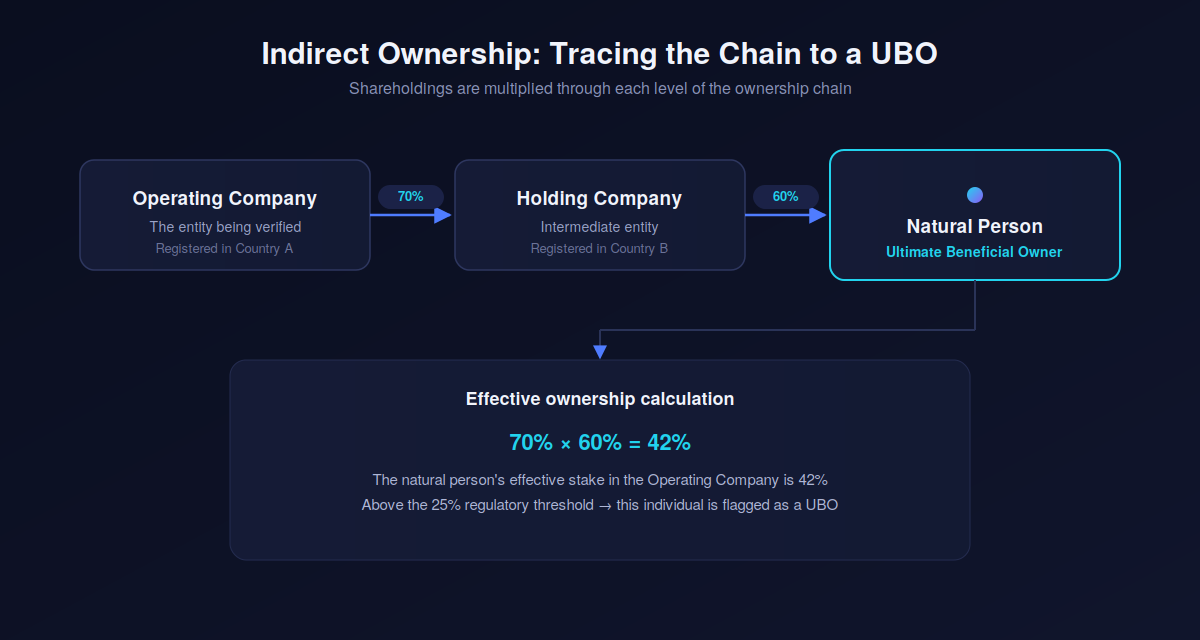
Trace every shareholder and controller, direct or indirect. Where shares are held through intermediary entities — holding companies, trusts, nominee arrangements — the chain has to be followed all the way up until you reach natural persons. This is where ownership structures spanning multiple jurisdictions become genuinely difficult without cross-border registry access.
3. Identify the ultimate beneficial owner(s)
Calculate the effective ownership or control percentage for each individual identified in the chain — indirect shareholdings are multiplied through each level, then combined for the same person. Anyone crossing the jurisdiction's threshold — typically 25%, sometimes lower — is a UBO. If no one meets the threshold, the senior managing official is treated as the UBO by default in most frameworks.
4. Verify identity and screen for risk
Each identified UBO then goes through standard KYC checks: government-issued ID verification, and screening against sanctions lists, PEP (politically exposed persons) databases, and adverse media. This is also where risk-based due diligence kicks in — low-risk UBOs may only need a documented identity check, while higher-risk profiles trigger Enhanced Due Diligence (EDD).
5. Monitor continuously
Ownership changes. Mergers, share transfers, restructurings, or a UBO landing on a sanctions list can all happen after onboarding. A UBO verification process that stops at onboarding is only half a process — real-time monitoring is what keeps a compliance program actually compliant rather than just documented.
UBO Verification Requirements Around the World
UBO rules share a common backbone — usually FATF recommendations — but the details differ enough that cross-border businesses need to track them market by market.
| Jurisdiction | Key requirement |
|---|---|
| United States | Corporate Transparency Act requires disclosure of name, birthdate, address, ID number, and ID image to FinCEN. |
| European Union | Public registers restricted since 2022 to authorities and "legitimate interest" parties; new AML Regulation clarifies indirect shareholding calculations (25%, or 15% for high-risk sectors). |
| United Kingdom | UBOs registered as "People with Significant Control" (PSCs) via Companies House — one of the few fully public registries. |
| Singapore | Register of Registrable Controllers (RORC), accessible to ACRA but not the public. |
| Australia | No standalone UBO requirement yet; "Tranche 2" reforms expected to align with FATF. |
| Malaysia | Tightened beneficial ownership reporting ahead of its 2025 FATF mutual evaluation. |
| UAE | Disclosure required for 25%+ direct or indirect ownership since 2020. |
The pattern across all of these: thresholds and terminology vary, but the underlying question is always the same — who really controls this entity, and can you prove it with a source the regulator will accept?
Why Most UBO Verification Fails at the Data Layer, Not the Process
Compliance teams generally understand the four steps above. Where it actually breaks down is earlier:
- Opaque, multi-jurisdiction ownership structures. A company incorporated in one country, owned by a holding entity in a second, controlled by an individual in a third — each link requires access to a different registry, in a different language, under different disclosure rules.
- Aggregated, third-party data that's already stale. Many "UBO databases" are built from periodic scrapes or self-submitted filings rather than live connections to the registry of record.
- Manual cross-border checks that don't scale. Piecing together ownership from national registries one country at a time works for a handful of cases a week, not hundreds.
- Ownership that changes quietly. A UBO verified six months ago may no longer be accurate — restructurings and share transfers happen without an alert unless something is actively watching the registry.
How Zavia.ai Solves UBO Verification
Zavia.ai was built around a simple idea: UBO data is only as reliable as its source. Instead of aggregating third-party datasets, Zavia.ai connects directly to official government registries in 100+ countries, then applies AI to do the part that used to take analysts days.
- Direct government data access. Company and ownership records are pulled straight from the registry of record — not scraped, not resold, not delayed by a syncing schedule.
- AI-powered ownership mapping. Proprietary algorithms and LLMs trace direct and indirect shareholdings across borders, surfacing relationships that manual document review typically misses.
- Customizable UBO thresholds. Set your own ownership threshold — 25%, 10%, or whatever your jurisdiction or internal policy requires — instead of working around a single fixed default.
- Real-time monitoring. Ownership and structure changes are flagged as they're filed, so a verified UBO file doesn't quietly go out of date.
- Instant visualization. Corporate hierarchies, parent-subsidiary relationships, and UBOs render as an interactive map instead of a stack of PDFs.
- Multilingual support. Registry data and insights are available in the language your team actually works in, which matters the moment your counterparties span more than one region.
For financial institutions, legal and compliance teams, M&A due diligence, and corporate governance functions, that means UBO verification stops being a research project and becomes a lookup.
UBO Verification FAQ
What is UBO verification?
UBO verification is the process of identifying and confirming the natural person(s) who ultimately own or control a legal entity, through direct or indirect ownership of shares, voting rights, or other means of control, and then checking that person's identity and risk profile.
What ownership percentage makes someone a UBO?
Most jurisdictions use a 25% threshold of shares, capital, or voting rights, though some countries set it as low as 5-10%, and thresholds can be customized internally for stricter risk policies.
How does Zavia.ai identify Ultimate Beneficial Owners?
Zavia.ai connects directly to official government registries in 100+ countries and uses proprietary AI algorithms to map ownership structures, trace indirect shareholdings across borders, and flag natural persons who cross your chosen UBO threshold.
Can UBO thresholds be customized?
Yes. Zavia.ai lets you set custom ownership thresholds — 25%, 10%, or any percentage required by your jurisdiction or internal compliance policy — instead of relying on a single fixed default.
How do you verify UBOs in complex, multi-layered ownership structures?
By tracing the ownership chain through every intermediary entity until natural persons are reached, then multiplying the ownership percentage at each level and summing it per individual. This is far faster with direct, real-time registry access than with manually collected documents.
Is UBO verification a one-time check?
No. Ownership structures change through share transfers, mergers, and restructurings, so UBO data needs ongoing monitoring and periodic re-verification, not just a check performed once at onboarding.
Try 3 free UBO searches, or get unlimited API access to 300M+ company records across 100+ countries.