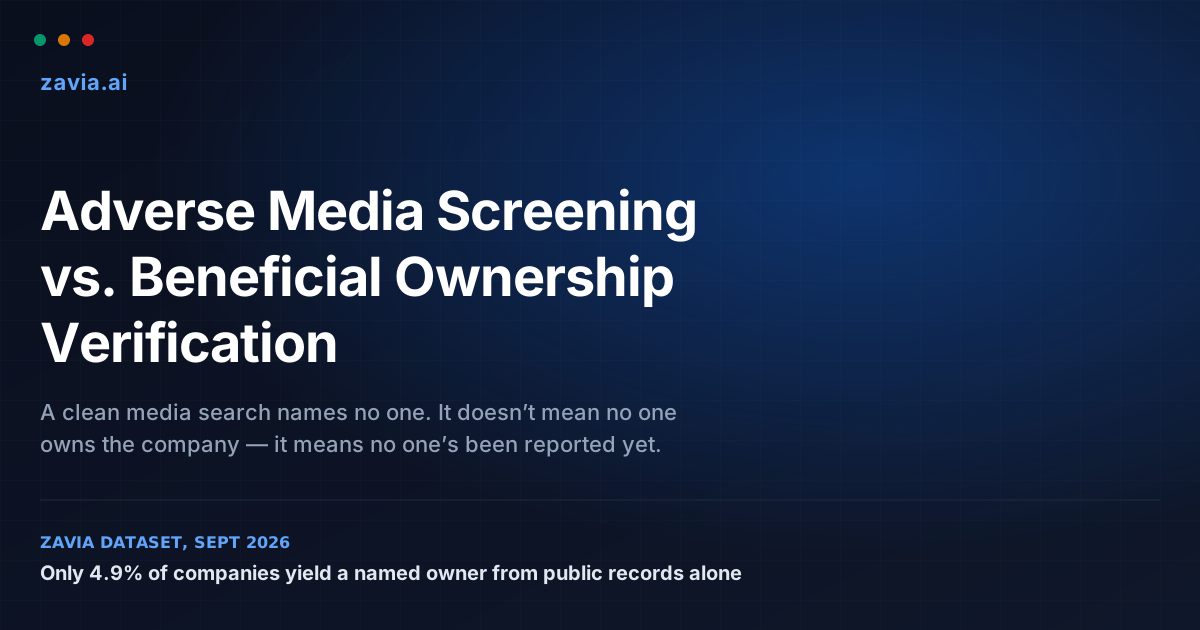

A company and its named directors can return a perfectly clean adverse media screening — zero hits, nothing negative ever published, no litigation, no sanctions actions, no fraud allegations anywhere in the public record. That clean result proves nothing about who owns the company. Adverse media screening can only surface people who have already been written about. In Zavia’s dataset (live query of 240 companies, run 30 September 2026), fewer than 1 in 6 — 37 companies, 15.4% — yield a named natural-person owner from the public record at all. The rest sit one, two, sometimes several ownership or group-structure layers above anything a media screen could ever return a hit against.
The two checks get bundled together in most onboarding stacks as if they answer the same question. They don’t. Adverse media screening asks: has anything negative been published about this name? Beneficial ownership verification asks: who actually controls this entity, named anywhere or not? A program that runs only the first check is measuring reputation. A program that runs only the second is measuring structure. Real risk lives at the point where the two disagree.
01What adverse media screening actually checks
Adverse media screening runs a name — a company, a director, a beneficial owner if one happens to be named — against publicly reported negative information: news archives, court filings, regulatory enforcement notices, sanctions and politically-exposed-person (PEP) lists, NGO and watchdog reporting. The output is a hit or a clean result, usually scored by category (fraud, bribery, terrorism financing, environmental crime, and so on) and by recency.
It is a name-matching exercise at its core. That is both its strength and its ceiling. It works well when the input name is correct, unique, and already attached to something reportable. It works only against that name. A screen run on “Larkspur Consulting Group Ltd” and its listed director never touches an owner one layer above who has never appeared in the company’s own filings under that name.
Adverse media screening requires an input name before it can produce an output. If the true owner has never been named — in a registry, a filing, or a related entity’s disclosure — there is no name to run, and no absence of a hit means anything.
02What beneficial ownership verification actually checks
Beneficial ownership verification starts from the entity, not from a name someone already handed you. It asks who holds equity or control, traces that holding up through however many corporate layers exist, and keeps tracing until it lands on a natural person or exhausts the available record. A ultimate beneficial owner (UBO) is that natural person — the individual who ultimately owns or controls the entity, directly or indirectly, above whatever threshold the applicable regime sets. A UBO is not the same thing as a legal owner of record: a legal owner is whoever is named on the share register or in the registry filing, which can be a nominee, a trust, or another company entirely, none of which is a natural person.
This process does not depend on anything having been reported anywhere. It depends on filings existing and being accessible — share registers, annual returns, incorporation documents, trust and foundation disclosures where jurisdictions require them. Where those filings exist, ownership verification finds the same answer whether the owner has a spotless reputation or a criminal record. That is the structural advantage: it does not need a scandal to work.
It is also the structural limit. Where filings don’t exist, don’t disclose natural persons, or stop at a nominee, ownership verification hits a wall the public record cannot get past. That is exactly what the 86% figure above describes — not a screening failure, but a disclosure gap no amount of better technology closes by itself.
03The paradox: clean media, unclear ownership
Run the two checks side by side on the same company and one uncomfortable pattern shows up constantly: the adverse media result gets cleaner as the ownership picture gets murkier. A shell with no operating history, no press coverage, and a nominee director has nothing for a media screen to flag — and, per the figures above, a 55.8% chance of returning no shareholder list at all. The absence of a hit is not evidence of a clean owner. It is evidence that no one has looked, or that no one who looked ever published anything.
Adverse media screening is a check against publication. Beneficial ownership verification is a check against structure. A company can fail the second while passing the first indefinitely — for as long as its real owner stays unreported, which per the 15.4% figure, is most of the time.
04Illustrative example: Larkspur Consulting Group
Consider an illustrative example — not a real case — built to show exactly where the two checks part ways: “Larkspur Consulting Group Ltd,” a UK-incorporated consultancy.
An onboarding team runs standard due diligence. The entity name and its sole listed director, “J. Ashford,” both come back clean on adverse media screening — zero hits, nothing negative anywhere in the public record for either. On the strength of that result alone, the file looks low-risk.
Ownership verification, run separately, traces the equity chain instead of a name someone supplied. Larkspur is wholly owned by “Meridian Holdings B.V.,” a Dutch intermediate holding company that has never appeared in any filing under Larkspur’s own name and has no press footprint of its own. Meridian, in turn, is 70%-owned by a named natural person, “R. Voss” — who has never been listed as a director of either company, but who, under that same name, has a real and findable adverse history: an illustrative fraud conviction dated 2021. A media screen run on “Larkspur Consulting Group” or “J. Ashford” would never surface it, because neither of those names is attached to it anywhere.

Neither check was run incorrectly. Adverse media screening did exactly what it is built to do: it checked the names it was given and found nothing against them. The gap is not an execution failure — it is what happens when a name-dependent check is asked to answer a structural question. Only ownership verification, working from the equity chain rather than a supplied name, was positioned to reach layer 3 at all.
05What each discipline catches — and where each goes blind
Laid out side by side, the two disciplines barely overlap. Adverse media screening’s territory is publication: it catches whatever has already made it into press, court records, or sanctions data under a name you supplied. Ownership verification’s territory is structure: it catches whoever holds equity or control, published about or not. The overlap — a named owner who is also press-flagged — is the easy case. Most real files aren’t the easy case.

06Adverse media screening vs. beneficial ownership verification
The two disciplines differ on every operational axis that matters to a compliance program: what triggers an update, where the data comes from, and what a clean result is actually allowed to mean.
| Dimension | Adverse media screening | Beneficial ownership verification |
|---|---|---|
| What it checks | Whether a supplied name has been linked to negative reporting | Who actually holds equity or control of the entity |
| Required input | A name — entity, director, or owner if already known | The entity itself; owners are discovered, not supplied |
| Primary data source | News archives, court records, sanctions & PEP lists, NGO reporting | Official company registries, share registers, filings |
| Update trigger | A story gets published — irregular, unpredictable | A filing gets made — set by statute, not by newsworthiness |
| What a clean result means | Nothing negative published about that name — not that nothing happened | No disqualifying owner found in the accessible record — bounded by disclosure limits |
| Structural blind spot | Anyone never named anywhere public, by design or by obscurity | Jurisdictions with no shareholder disclosure, nominee arrangements, closed registers |
| Cross-border behaviour | Coverage drops sharply outside major media markets and languages | Depends on registry access in each jurisdiction the chain crosses |
07Reactive and name-dependent vs. structural: the real difference
Strip away the tooling and the two disciplines rest on opposite logical foundations. Adverse media screening is reactive by design. It cannot detect a risk before someone else has detected, investigated, and published it first. Every hit in an adverse media database is downstream of somebody else’s reporting, prosecution, or regulatory action. The screen adds speed and coverage across sources a human couldn’t read alone. It adds no independent detection capability of its own.
Why adverse media fails silently
Ownership verification is structural. It does not wait for anyone to report anything. It follows the equity and control relationships that exist whether or not they are newsworthy, and it produces an answer — complete, partial, or blocked by non-disclosure — based on what the registries actually contain. That answer doesn’t improve when a scandal breaks. It was already sitting in the filing.
This is why the two checks fail differently. Adverse media screening fails silently: a real risk that has never been reported returns a clean result indistinguishable from an actual clean owner. There is no error message, no flagged gap — just an absence that looks identical whether the underlying owner is unremarkable or genuinely high-risk.
Why ownership verification fails visibly
Ownership verification fails visibly instead: a jurisdiction with no shareholder disclosure returns an explicit gap — no shareholder list, no natural person identified — that a risk team can see and act on. A visible gap is a decision point. A silent false clean is not.
The practical consequence: adverse media screening should never be the sole basis for closing a file as low-risk, because its clean result and an actual clean owner are not distinguishable from the outside. Ownership verification should never be treated as complete on the basis of one registry pull, because a 76.7% share of sampled companies return a linked group structure at all, most of which run three or more layers deep (79.3%) and cross borders (67.9%) — meaning the chain frequently continues past the first jurisdiction checked. See Multi-Layered Corporate Structures for how to score escalation decisions once a chain gets that deep.
08Source currency: what “real-time” means for each
Vendors on both sides describe their products as real-time. The word means something different in each case, and conflating the two leads teams to overestimate how current a result actually is.

What real-time means for adverse media
For adverse media, real-time means the screen re-runs continuously against live news and enforcement feeds, so a fresh hit surfaces quickly after publication. It says nothing about whether a hit will ever exist for a given name. Silence is the default state, not a verified outcome.
What real-time means for ownership data
For ownership verification, real-time means the platform reflects the registry as filed, as close to the filing date as the registry itself allows. Some jurisdictions publish changes within days; others carry months of lag between an actual ownership change and its appearance in the public record. Either way, the ownership answer is bounded by what has been filed — not by what has been noticed.
09Sequencing: where each belongs in a real onboarding flow
Order matters more than most workflow diagrams admit. Run adverse media screening before ownership is resolved and the screen only ever touches the names on the application form — the entity and whichever officers were disclosed. Resolve ownership first, and adverse media screening gets a complete list of names to check, including owners the applicant never volunteered.
- Identity and entity verification. Confirm the entity exists, is active, and the application data matches the registry record.
- Ownership resolution. Trace the equity chain through every corporate layer to the natural persons at the top, following the UBO verification workflow from initial check through to a documented ownership chart.
- Full-name adverse media screening. Screen the entity, its officers, and every UBO surfaced in step 2 — not just the names the applicant disclosed.
- Risk scoring and escalation. Combine the ownership structure’s complexity (layers, jurisdictions, disclosure gaps) with any adverse media hits into a single risk decision.
- Ongoing monitoring. Re-screen media on a recurring basis; re-check the ownership record whenever a triggering event (renewal, transaction size, jurisdiction change) calls for it.
The most common sequencing mistake
Reversing steps 2 and 3 is the most common structural mistake in onboarding design. A media screen run before ownership resolution can only ever be as complete as the disclosure it was given — which, per the figures above, names an actual owner in roughly 1 case in 6.
10Cross-border, multi-layer ownership breaks name-based screening further
Adverse media coverage is uneven across languages and jurisdictions in ways that compound the layering problem. A holding company registered in one country, owned through an intermediate entity in a second, ultimately controlled from a third, forces a media screen to work across three separate media markets, three sets of naming conventions, and three transliteration risks — before it can even attempt the coverage a single-country screen manages reasonably well.
Zavia’s live dataset puts real weight behind how common this is: of the 184 sampled companies with a linked group structure, 67.9% (125) cross two or more countries, and 79.3% (146) run three layers or deeper. Circular arrangements compound the same problem from a different angle — an ownership loop can make a chain look resolved when it has actually just returned to its starting point. See Circular Ownership Structures for how those loops get built and how to detect one before treating it as a clean resolution.
Neither gap closes by screening harder. It closes by connecting directly to the registries that hold the ownership record in the first place. Zavia connects directly to official company registries in 173 countries, which matters most exactly where adverse media coverage thins out fastest — the cross-border layers a name-based screen was never built to follow.
11What regulators actually expect from each check
AML and KYC frameworks generally treat adverse media screening and beneficial ownership identification as separate obligations, not interchangeable proof of due diligence. The US customer due diligence (CDD) rule requires financial institutions to identify and verify any individual who owns 25% or more of a legal entity customer, and any individual who controls it — a beneficial ownership obligation that a clean adverse media result does not satisfy on its own. That obligation has become more central to US beneficial-ownership visibility since August 2026, when FinCEN’s final rule permanently eliminated Corporate Transparency Act beneficial ownership information reporting for domestic companies and US persons, leaving the CDD rule as the primary federal source of beneficial-ownership data available to financial institutions and law enforcement. International standards from the Financial Action Task Force push in the same direction, treating a risk-based approach to negative news as one input among several, not a substitute for establishing who actually stands behind an entity.
Thresholds and disclosure rules also vary sharply by jurisdiction, which is precisely why a single global ownership check is harder to standardize than a global media check. See UBO Regulations by Country for how ownership thresholds and registry access differ across major jurisdictions. Programs that treat adverse media screening as the harder, more rigorous check often have the relationship backwards: it is the more automatable check, not the more complete one.
12A five-step workflow for running both disciplines together
- Pull the registry record first. Get the entity’s current officers and, where disclosed, shareholders directly from the source registry — not from the application form.
- Resolve ownership to natural persons or to a documented stop point. Trace every corporate layer. Where the trail ends at a nominee, a closed register, or a jurisdiction with no disclosure, record that as an explicit gap rather than an assumed clean result.
- Screen every name the ownership trace surfaced. Entity, officers, and every UBO identified in step 2 — run through adverse media, sanctions, and PEP checks together.
- Score the file on both axes. Ownership complexity (layers, jurisdictions, disclosure gaps) and media risk (hits, category, recency) are separate inputs into one risk decision, not one signal standing in for the other.
- Re-run both on a schedule, not just at onboarding. Ownership can change through a share transfer that never makes the news; adverse media can surface years after an ownership structure was last checked. Neither check ages well left alone.
What this looks like in practice
Investigators applying this combined approach in practice look a lot like the workflow Kroll’s investigators use to build cases faster by mapping ownership before chasing every name through media archives, and it mirrors how SAP embeds UBO discovery into supply-chain due diligence ahead of downstream screening, rather than after it.
13Glossary
A clean media screen is not a clean ownership record
Zavia connects directly to official company registries in 173 countries, so ownership resolution starts from the filing, not from whatever name an applicant chose to disclose.
14Frequently asked questions
Is adverse media screening the same as beneficial ownership verification?
No. Adverse media screening checks whether a supplied name has been linked to negative reporting. Beneficial ownership verification traces who actually owns or controls an entity, independent of whether that person has ever been named anywhere public. They answer different questions and neither substitutes for the other.
Can a company pass adverse media screening and still have a high-risk owner?
Yes, and per Zavia’s dataset (live query of 240 companies, run 30 September 2026) this is closer to the norm than the exception: fewer than 1 in 6 sampled companies (15.4%, 37 of 240) even yield a named natural-person owner from the public record. An owner who has never been named cannot generate a media hit, clean or otherwise.
Which check should run first in an onboarding flow?
Ownership resolution should generally precede adverse media screening. Resolving ownership first produces a complete list of names — entity, officers, and every UBO identified — for the media screen to check, rather than limiting the screen to whatever names the applicant chose to disclose.
Does a clean adverse media result mean an entity is low-risk?
It means nothing negative has been published about the names checked. It does not confirm those names include the actual owners, and it does not confirm the ownership structure itself is simple, disclosed, or free of undisclosed control. Ownership complexity is a separate risk dimension that adverse media screening cannot see.
What is the difference between a legal owner and a beneficial owner?
A legal owner is whoever is named on the share register or registry filing — which can be a nominee, a trust, or another company. A beneficial owner (UBO) is the natural person who ultimately owns or controls the entity, directly or indirectly, regardless of whose name sits on the filing. Conflating the two is a common and consequential error in due diligence.
Why does adverse media coverage vary so much by country?
Adverse media screening depends on what has been reported, and press infrastructure, court record accessibility, and language coverage vary enormously across jurisdictions. In Zavia’s live dataset, 67.9% of linked group structures (125 of 184) cross two or more countries, each crossing adding a separate media market with its own coverage gaps.
How often should adverse media screening and ownership verification be repeated?
Adverse media screening is typically re-run on a recurring schedule (commonly daily to monthly, depending on risk tier) since new hits can appear at any time. Ownership verification should be re-checked whenever a triggering event occurs — renewal, a transaction above a set threshold, or a jurisdiction change — since ownership can shift through a share transfer that never generates a headline.
What does it mean when a company has no public shareholder list?
It means the registry of incorporation does not require, or does not publish, shareholder-level disclosure for that entity type. In Zavia’s dataset (live query of 240 companies, run 30 September 2026), this applies to 55.8% of sampled companies (134 of 240). It is a disclosure gap, not evidence that the underlying ownership is simple or low-risk.
Is negative news screening the same thing as adverse media screening?
Yes. “Negative news screening” and “adverse media screening” are used interchangeably across AML and KYC literature to describe the same practice: checking a name against publicly reported negative information.
See also Sanctions Screening and Beneficial Ownership for the adjacent screening discipline this piece contrasts against, and FATF Recommendation 24 and 25 Explained for the regulatory standard both disciplines ultimately answer to.