Who Is the Beneficial Owner of a Trust? Settlor, Trustee, Beneficiary Explained

A trust has no owner. Not “an owner who is hard to find” — no owner in the structural sense a company has one. There are no shares, no equity, no cap table. When the Financial Action Task Force (FATF) tried to make beneficial ownership rules cover trusts, “shareholder” simply didn’t apply, so FATF had to invent a new category from scratch: parties to the arrangement. That single phrase is the whole story of why the beneficial owner of a trust is such a different question from the beneficial owner of a company, and why trusts break every beneficial-ownership register built for companies.
This is a horizontal explainer, not a jurisdiction guide. It covers how the settlor-trustee-beneficiary structure maps — or fails to map — onto the ownership-percentage tests compliance teams already know, why the beneficial owner of a trust is a different question from who owns a trust, and how a verifier actually works a trust file when the public record runs out. For jurisdiction-specific trust registers, see the Jersey, BVI, Cayman and Liechtenstein posts. This one covers the mechanism underneath all of them.
01A trust has no owner — and that absence breaks the UBO model
Beneficial ownership rules were written for companies first and retrofitted onto everything else. A company has a defined ownership instrument: shares. Add up who holds them, apply a threshold — typically 25% under FATF Recommendation 24 — and you have a UBO (ultimate beneficial owner, the natural person who ultimately owns or controls an entity, regardless of what the paperwork says). It is imperfect but mechanical.
A trust holds no shares in itself. It splits ownership into two separate legal concepts that a company never separates: legal title, held by the trustee, and equitable interest, held by the beneficiaries. Neither party is “the owner” in the company sense. The trustee owns the assets on paper and can be sued over them, but cannot spend them for personal benefit. The beneficiary can eventually receive the assets but holds no title to them today. Ownership itself is the thing that has been split.
A register built to answer “who holds the shares” cannot ask that question of a trust. There is nothing to hold a share of. Every AML regime that extends beneficial-ownership rules to trusts has had to write a separate legal test for them — not a modified version of the corporate test, a different one.
02The FATF fix: “parties to the arrangement,” not shareholders
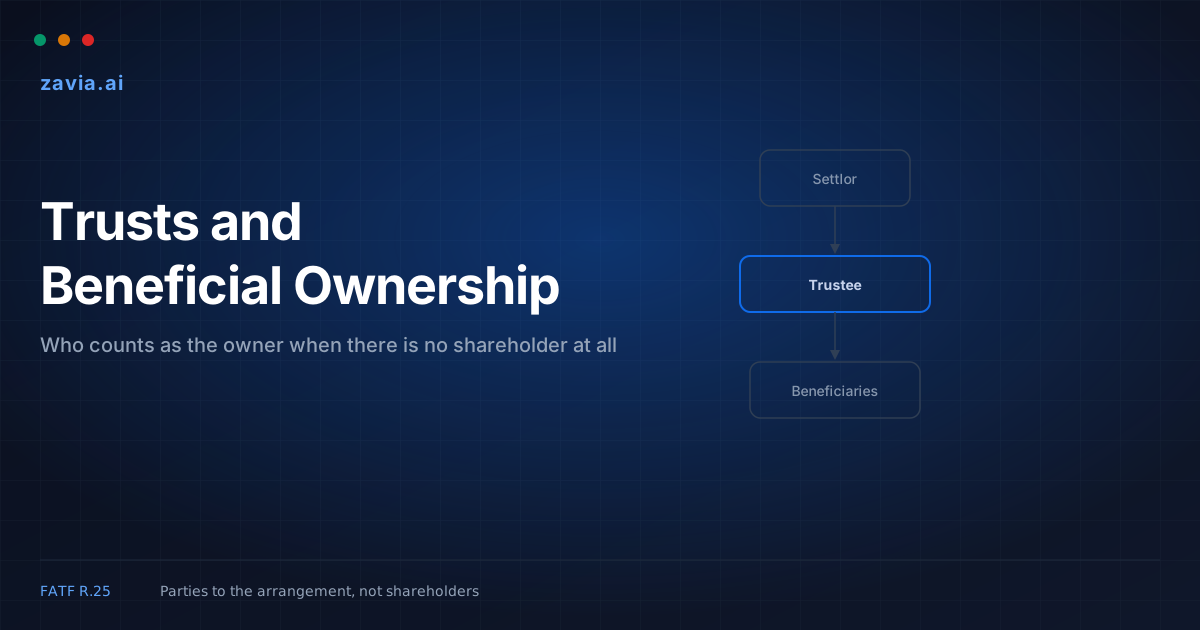
FATF Recommendation 25 governs “legal arrangements” — trusts and trust-like vehicles — separately from Recommendation 24, which governs “legal persons,” meaning companies. That split exists because FATF’s own drafters concluded a single ownership test could not cover both. Instead of asking who owns 25% of the trust, Recommendation 25 requires that countries ensure adequate, accurate and timely information is available on every party to the arrangement: the settlor, the trustee(s), the protector (if any), the beneficiaries or class of beneficiaries, and any other natural person exercising ultimate effective control.
Note what changed. The corporate test asks one question — how much do you own? — and treats everyone below the threshold as irrelevant. The trust test asks a different question — are you a party to the arrangement at all? — and if yes, you are in scope regardless of whether you hold anything close to a quantifiable 25% stake. A discretionary beneficiary with a 1-in-40 chance of ever receiving a distribution is still a party. A shareholder with a 1% stake is not a UBO under the corporate test. That is a structurally different bar, not a stricter or looser version of the same one.
03Settlor, trustee, beneficiary: who counts as the beneficial owner of a trust
Every trust runs on the same three roles, and each one fails the corporate UBO test in a different way.
The settlor creates the trust and transfers assets into it. In an irrevocable trust properly administered, the settlor gives up control permanently — which is precisely why irrevocable trusts are used to move assets outside a person’s taxable or reportable estate. A settlor who retains the power to revoke the trust, redirect its assets, or dictate distributions is functionally still the owner and should be named as a UBO. A settlor who has genuinely relinquished control is a historical fact, not a current beneficial owner. The two look identical on a one-page trust summary; only the deed’s revocation and control clauses tell them apart.
The trustee holds legal title and administers the assets under a fiduciary duty to the beneficiaries. This is the only role that reliably appears in a registry, because trustees are the ones who sign contracts, open accounts, and get named on share registers. But a professional or corporate trustee holding assets on behalf of clients is not the beneficial owner of those assets — it is a service provider. Naming the trustee and stopping there is the single most common shortcut in weak KYB files, and it is functionally equivalent to naming a nominee director as a company’s UBO.
The beneficiary holds the equitable interest — the right to eventually benefit — but frequently holds no present, fixed, or even certain entitlement. A beneficiary under a fixed trust has a defined percentage share and maps onto the corporate ownership test reasonably well. A beneficiary under a discretionary trust has no fixed share at all; the trustee decides who receives what, when, entirely at their discretion within the terms of the deed. Section 6 covers why that second case is the one that actually breaks the math.

04Worked example: the Hartwell Family Trust
The Hartwell Family Trust is not a real filing, company, or family. Names, figures and structure are invented to walk through how a corporate ownership threshold does and doesn’t apply to a trust.
Eleanor Hartwell settles a discretionary trust in 2019, contributing $12 million in cash and a 40% stake in an operating company, Hartwell Logistics Ltd. She retains no power to revoke the trust or direct its trustee. The trustee is Meridian Trust Co., a licensed corporate trustee. The named beneficiaries are Eleanor’s two adult children, Julian and Priya, plus a residual class benefiting a community foundation on the trust’s eventual wind-up.
Now run this through a standard 25%-threshold UBO test, the way an analyst would run it on a normal shareholder register:
- Eleanor (settlor) — no revocation power, no reserved control. Under most regimes she is not a current UBO, only a historical fact worth recording.
- Meridian Trust Co. (trustee) — holds the legal 40% stake and is named in Hartwell Logistics’ share register. It is a corporate body, so naming it and stopping is exactly the nominee-shareholder problem compliance teams already know from corporate structures: a name on file that isn’t a natural person.
- Julian and Priya (discretionary beneficiaries) — each has a chance of receiving a distribution, but no fixed percentage exists to test against 25% because the trustee has not yet exercised discretion in either’s favor. Both are still “parties to the arrangement” under FATF and should be recorded, but neither clears a percentage threshold that was never built to test them.
- The community foundation — a residual, non-natural-person beneficiary, often excluded from natural-person UBO registers as a class rather than named individually.
The result: a verifier working this file ends up with five names on paper and zero clean answers to “who owns 40% of Hartwell Logistics.” That is not a failure of the analyst. It is the correct output of applying a percentage test to an arrangement that was never built around percentages.

05Corporate ownership vs. trust arrangements, side by side
The two disclosure regimes look similar on the surface — both aim to surface a natural person — and diverge almost everywhere underneath.
| Dimension | Corporate ownership | Trust arrangement |
|---|---|---|
| Ownership instrument | Shares or equity interests | None — split into legal title and equitable interest |
| FATF basis | Recommendation 24 (legal persons) | Recommendation 25 (legal arrangements) |
| Qualifying test | Ownership or control above a threshold, typically 25% | Membership in a defined role — settlor, trustee, protector, beneficiary — regardless of share |
| Who’s disclosed | Natural persons above the threshold | Every party to the arrangement, including those with no fixed interest |
| Public register coverage | Wide but shallow — most jurisdictions require some filing | Narrow — most jurisdictions keep trust registers closed to the public or to regulators only |
| Typical single point of failure | Nominee shareholder standing in for the real owner | Corporate trustee named on file in place of any natural person |
| Discretionary case | Rare — most equity is fixed | Common — no fixed % share exists to test |
06Discretionary trusts: beneficiaries who don’t know they’re beneficiaries
Fixed trusts are the easy case. A fixed trust names beneficiaries with defined, quantified shares — “40% to Julian, 40% to Priya, 20% to the foundation” — and those percentages map onto a corporate-style threshold test almost directly. Treat the trust as if it were a company with three shareholders, apply the 25% rule, and Julian and Priya clear it.
Discretionary trusts are the common case, and they don’t work this way. A discretionary beneficiary is a member of a defined class — “my children and their descendants,” “employees of Hartwell Logistics” — with no entitlement to any specific share, or indeed to any distribution at all, until the trustee exercises discretion. Some beneficiaries named in the deed may never receive a cent. Others outside the initially obvious class may be added later. A beneficiary can, in the strict legal sense, be a party to the arrangement without knowing the trust exists.
This is where “beneficial owner of a trust” and “who owns a trust” genuinely diverge as questions. Ownership implies a quantifiable stake. A discretionary interest is not a stake; it’s a possibility. Regulators handled this by widening the definition rather than trying to quantify the unquantifiable — FATF’s Recommendation 25 and the EU’s anti-money-laundering directives both require that the class of beneficiaries be described with enough detail to identify a member of it when needed, even where no individual can be named in advance. FATF’s guidance is explicit that where beneficiaries aren’t yet ascertainable, trustees must still hold information on the class and its characteristics rather than leaving the field blank.
07When a trust sits inside a corporate ownership chain
Trusts rarely appear in isolation in a KYB file. They usually show up as one link in a longer chain: Company A is owned by Holdco B, which is owned by a trust, whose trustee is a corporate entity in a third jurisdiction, whose beneficiaries are natural persons in a fourth. Every link before the trust behaves like ordinary corporate ownership. The trust link is where the chain’s logic changes without warning.
Two patterns recur:
- Trust as shareholder. A trust (via its trustee) holds shares directly in an operating company. The share register names the trustee, not the beneficiaries. Standard corporate lookups stop here unless the analyst knows to ask “is this shareholder a trustee?” and go one layer further.
- Corporate entity as trustee, feeding back into itself. A corporate trustee is sometimes owned, in turn, by another trust — a structure that can, in principle, loop. Verifying it requires treating the trust link as a distinct node with its own set of parties, not folding it into the ownership percentage of the entity above or below it.
Of a live sub-sample of 60 companies confirmed to have a real multi-entity ownership tree, the average depth is 5.4 layers, the deepest observed runs 14 layers, and 82% (49 of 60) run three or more layers — Zavia’s dataset (live query, run 2026-09-30). That sample is stratified across ten of Zavia’s largest markets, so it likely skews toward bigger multinational structures than a global average would. A trust anywhere in that chain doesn’t just add a layer; it changes what “layer” even means at that point, because the layer stops being measured in ownership percentage and starts being measured in roles.
08Why “who owns a trust” is the wrong question
“Who owns a trust” presumes a trust is a thing capable of being owned, the way a company is. It isn’t. A trust is not a legal person; it’s a legal relationship — a set of obligations the trustee owes to the beneficiaries over specific assets. Asking who owns that relationship is a category error, not a hard version of an easy question.
“Who are the parties to the arrangement” is the question FATF actually answers, and it’s the correct reframe for three reasons. First, it doesn’t require an ownership percentage to exist before it can be answered — a discretionary beneficiary with no fixed share is still a valid answer. Second, it captures control that ownership language misses entirely, such as a settlor with a retained revocation power or a protector with a veto right, neither of whom “owns” anything in even the loosest sense. Third, it forces the disclosure to be enumerated rather than thresholded — you list every party, rather than filtering for the ones above a cutoff, which is exactly why trust beneficial-ownership registers (where they exist) tend to be closed to the public: enumerating every party to every family trust is a materially larger privacy exposure than publishing a company’s 25%-plus shareholders.
The practical consequence for a verifier: stop trying to force a percentage out of a trust file. Build a party list instead, tag each party’s role and control level, and risk-rate the arrangement as a whole rather than hunting for a single UBO name the structure was never designed to produce.
09Where trusts get registered, and where they don’t
Most jurisdictions that require corporate beneficial-ownership disclosure treat trust disclosure as a separate, usually stricter-access, system — see the UBO Regulations by Country guide for how the corporate-side thresholds vary before a trust layer is even added. A handful of patterns show up repeatedly across the offshore centers most commonly used for trust structures:
- Registered but closed to the public. The trustee, beneficiaries and settlor are recorded with a regulator or registrar, but the register is accessible only to competent authorities, not the public. This is the dominant model in most well-regulated trust jurisdictions, including the register models covered in the Jersey and BVI posts.
- Registered only when the trust interacts with a reporting company. The trust itself files nothing, but if it holds a qualifying stake in a company that must disclose beneficial ownership, the trustee (and sometimes the underlying parties) must be named in that company’s filing instead.
- Not centrally registered at all. Common-law jurisdictions without a dedicated trust register rely on the trust deed itself — a private document a verifier typically only sees if a bank, counterparty or court compels its production.
- Civil-law substitute vehicles. Jurisdictions without a common-law trust concept use analogous foundations and establishments — the Stiftung and Anstalt covered in the Liechtenstein post — which raise the identical parties-not-shareholders problem under different labels.
The practical effect is that a verifier can rarely resolve a trust’s parties from a public registry query alone, in sharp contrast to corporate ownership, where at least some public filing usually exists even if it’s incomplete.
| Access model | What’s recorded | Who can see it |
|---|---|---|
| Regulator-only register | Settlor, trustee, protector, beneficiaries | Competent authorities only |
| Piggyback on company filing | Trustee named as a shareholder of the reporting company | Whoever can see that company’s UBO filing |
| No central register | Nothing filed; only the private trust deed | Whoever can compel production of the deed |
| Civil-law substitute vehicle | Founder, council, beneficiary class of a foundation/establishment | Varies by jurisdiction — often regulator-only, as with Liechtenstein’s VwbP |
10What the registry data shows before a trust even enters the picture
It’s worth establishing the baseline, because trusts make an already-thin disclosure environment thinner. Across a live sample of 250 companies queried directly, stratified across ten of Zavia’s largest markets — the US, New Zealand, UK, Netherlands, Germany, Italy, Singapore, Spain, France and Ireland — 118 (47%) return no shareholder-level data at all — Zavia’s dataset (live query, run 2026-09-30). Of the 132 that do disclose shareholder-level data, 65% (86) list only corporate or institutional shareholders, and 77% (102) have two or more distinct shareholders. Roughly 1 company in 5 — 46 of 250, 18% — yields a named natural-person shareholder directly.
This figure runs meaningfully higher than the fixed-sample citation this update replaces (18% naming a natural person now, versus 4.9% before), which most likely reflects the broader base of filings a live query reaches rather than any real shift in how much companies disclose. The steadier comparison is the share of disclosing companies that name a natural person at all — 35% now against 36% previously — which held roughly constant even though the absolute counts moved.
That’s the starting point for a chain with no trust in it. Add a trustee as one of those corporate shareholders, and the chain now requires a second, entirely different disclosure regime — one that is more often closed than open — before a natural person can be reached at all.
A shareholder register that stops at “Meridian Trust Co.” is not a gap in that one filing — it’s the expected output of a corporate registry meeting a trust structure it was never designed to see through. Zavia connects directly to official company registries in 173 countries, which resolves the corporate side of a chain reliably; the trust side still requires knowing which registers are open, which are regulator-only, and which don’t exist, because no registry connection substitutes for that jurisdiction-by-jurisdiction knowledge.
11Red flags: trust structures built to obscure a natural person
Most trusts in a KYB file are legitimate estate-planning or asset-protection vehicles. A minority are chosen specifically because the disclosure gap described above is a feature, not a side effect. Patterns worth escalating:
- A corporate trustee with no other visible role in the deal. Legitimate corporate trustees are licensed, regulated, and administer many unrelated trusts. A one-off corporate trustee with no regulatory license and no other clients is a red flag for a trust set up purely as a disclosure shield.
- A settlor who is also the sole discretionary beneficiary. This collapses the legal separation the trust exists to create and, in most regimes, triggers look-through rules treating the settlor as the current beneficial owner regardless of the trust’s formal terms.
- Serial re-settlement. Assets moved from trust to trust across jurisdictions with no commercial rationale, each move resetting the disclosure clock in the new jurisdiction.
- A protector with unchecked veto power and no beneficiary relationship. A protector role with real control but no economic interest and no disclosed identity is a documented method for retaining control while staying off any beneficiary list.
- Trust-owned shell layered above a trust-owned shell. Circular or nested trust-and-company layering with no operating business at any level is the strongest indicator of deliberate opacity rather than estate planning; see the dedicated post on circular ownership structures for how these loops get built.
12How a verifier actually works a trust file
A trust encountered mid-chain calls for a different procedure than a corporate shareholder does. This is the sequence that holds up across jurisdictions:
- Confirm it’s actually a trust, not a foundation or company with “trust” in its name. The word appears in plenty of corporate names with no legal trust behind it.
- Identify the trustee first — it’s usually the only party on public record. Confirm whether it’s a licensed corporate trustee (check the relevant regulator’s register) or a private individual acting as trustee.
- Request the trust deed, or a certified summary of it, rather than relying on the registry entry alone. The deed is the only document that states whether the trust is fixed or discretionary, and whether the settlor retained any control.
- Classify the trust type — fixed, discretionary, purpose, charitable — because the classification determines whether a percentage test can be applied at all.
- Enumerate every party to the arrangement: settlor, trustee(s), protector (if any), named beneficiaries, and the defined class for any unnamed beneficiaries.
- Test the settlor for retained control — revocation power, ability to direct distributions, or ability to replace the trustee. Any of these converts a “historical settlor” into a current UBO.
- Test the trustee for independence. A trustee following someone else’s instructions in substance, regardless of the deed’s formal wording, is not independent, and the instructing party becomes the relevant UBO.
- For fixed beneficiaries, apply the ownership-percentage threshold as usual. This is the one step that behaves like ordinary corporate KYB.
- For discretionary beneficiaries, record the class and risk-rate the arrangement rather than forcing a percentage. Escalate rather than close the file on an unresolved discretionary interest.
- Document the jurisdiction’s trust-register access level (open, regulator-only, none) so the next reviewer knows whether the gap is a data problem or a legal one.
13Glossary
The corporate side of the chain shouldn’t be the bottleneck
Trust disclosure will always depend on deeds, regulators and jurisdiction rules a database can’t fully substitute for — but the corporate entities feeding into and out of a trust structure don’t have to be a guessing game. Zavia connects directly to official company registries in 173 countries, so the shareholder, trustee and holding-company links in a chain resolve from primary sources.
14Frequently asked questions
Who is the beneficial owner of a trust?
There is rarely a single answer. Under FATF Recommendation 25, the beneficial owners of a trust are all “parties to the arrangement”: the settlor (if control was retained), the trustee (if not acting purely as an independent administrator), any protector with real control, and the beneficiaries, whether fixed or discretionary. A trust can have several simultaneous beneficial owners, or none who cleanly fit a company-style single-owner picture.
Is the trustee the beneficial owner of a trust?
Usually not. A trustee, especially a licensed corporate trustee, holds legal title and administers the assets under a fiduciary duty but has no personal economic interest in them. A trustee becomes relevant as a beneficial owner only if it is not genuinely independent — for example, if it follows instructions from an undisclosed party in substance rather than exercising independent judgment.
Can a settlor still be a beneficial owner after settling a trust?
Yes, if the settlor retains any meaningful control — a power to revoke the trust, redirect its assets, or direct distributions. A settlor who has genuinely and irrevocably relinquished control is generally treated as a historical fact rather than a current beneficial owner, though most regimes still require the settlor’s identity to be recorded.
What happens when a beneficiary is discretionary, not fixed?
A discretionary beneficiary has no defined percentage share, so a corporate-style ownership threshold cannot be applied. Regulators handle this by requiring the beneficiary class to be described precisely enough that a member of it can be identified when needed, rather than requiring a named person and percentage up front.
Why doesn’t the 25% ownership rule apply to trusts?
Because trusts have no ownership instrument to measure — no shares, no equity, nothing to calculate a percentage of. FATF Recommendation 25 replaces the percentage test with a role-based test: anyone who is a settlor, trustee, protector, or beneficiary is in scope, regardless of what share, if any, they hold.
Are trust beneficial ownership registers public?
Rarely. Most jurisdictions that maintain a trust register restrict access to regulators, law enforcement, or parties who can demonstrate a legitimate interest. This is the opposite default from most corporate beneficial-ownership registers, which increasingly lean toward at least partial public access.
How is a trust different from a foundation for UBO purposes?
A foundation, like the Liechtenstein Stiftung, typically has its own legal personality, unlike a trust, which is a relationship rather than an entity. In practice, though, foundations raise a near-identical beneficial-ownership problem: they’re often governed by a council rather than shareholders and benefit a class of persons rather than fixed owners, so the “parties to the arrangement” logic applies in substance even where the legal form differs.
What’s the single biggest red flag in a trust-owned structure?
A settlor who is also the sole discretionary beneficiary, with a nominally independent trustee that in practice follows the settlor’s instructions. This configuration collapses the legal separation a trust exists to create while preserving the appearance of third-party control.
Can a company be the trustee of a trust that owns part of that same company?
Not directly in a simple case, but layered variants exist — a corporate trustee owned by a separate trust whose beneficiaries have an interest in the original operating company. Verifying these requires treating the trust as a distinct node with its own party list at each point it appears, rather than assuming the ownership percentage carries through unchanged.
For the FATF standard this notification regime implements, see FATF Recommendation 24 and 25 Explained. For the parallel concealment mechanism in corporate, not trust, structures, see Nominee Directors and Nominee Shareholders.