
Nine out of ten shell companies never launder a dollar. They exist to hold a patent, park a subsidiary’s tax position, or ring-fence a single ship or property, exactly as the law intends. That is precisely why shell company red flags matter more than the term itself: a company can be 100% legal and 100% a shell, and still be the exact structure a fraud, a sanctions evasion scheme, or a shell-layering operation would choose on purpose. The job is not to spot a shell. The job is to spot which shell is doing something else.
This is a checklist for the moment before you say yes — the point where a new counterparty, vendor, or investor has shown up with a company name, a registration number, and not much else. It works from the outside, using only what an ownership record can tell you, because that is usually all you have.
01Why “shell company” isn’t a legal category — and why that’s the problem
No statute anywhere defines a shell company. FinCEN describes one functionally — an entity with no independent operations, few or no employees, and no physical presence commensurate with its stated business — but that description also fits a legitimate special-purpose vehicle set up last week to hold a single real-estate asset. The Financial Action Task Force (FATF) does not outlaw shells either; its Recommendation 24 requires countries to make the beneficial ownership behind any legal person available to competent authorities, precisely because the entity type itself is not the risk signal.
That absence of a legal definition is not a loophole. It is the design. Holding companies, joint-venture vehicles, single-asset SPVs, and IP-licensing shells are all shell companies by the functional definition, and all are routine, defensible corporate structuring. A jurisdiction that banned “no independent operations” entities would ban most private equity.
So what flips a shell from routine to a compliance problem is never the shell itself. It is the combination of an opaque ownership record with a transaction, a relationship, or a claim that the record cannot support. A dormant holding company with a named parent and a filed reason for existing is inert. The same dormant company, freshly incorporated, with no named owner, moving money that doesn’t match its stated business, is the profile FATF’s guidance and virtually every AML typology treats as high-risk. The legal status never changes. The record around it does.
A legal owner is whoever’s name sits in the registry — the shareholder or director of record. A UBO (Ultimate Beneficial Owner) is the natural person who actually controls the company or receives its economic benefit, however many layers away. A shell company’s defining trait is that these two can diverge by design, and a red-flag review exists to find out how far. See What Is a UBO? Ultimate Beneficial Owner Guide for 2026 for the fuller definition and thresholds.
02A fully worked example: reading the record layer by layer
Consider an illustrative example — not a real filing, not a real company — a vendor called “Northgate Trading Ltd” that has just been introduced as a supplier for a mid-sized import contract. Here is what a routine ownership pull shows, one layer at a time.

Layer one: Northgate Trading Ltd, UK, incorporated fourteen months ago. Nothing wrong yet — plenty of legitimate trading companies are young. Layer two: its sole shareholder is Meridian Capital Partners SA, Panama, whose registered address is a corporate services office that hosts several thousand other entities. Still, a Panamanian holding company is not itself disqualifying. Layer three: Meridian’s own sole shareholder is Silverline Holdings Ltd, Marshall Islands, and Silverline’s listed director is also the listed director of more than forty other unrelated companies on file with the same registered agent. Layer four: the trail stops. No natural person is named at any point in the chain.
None of these four facts is independently disqualifying — young companies, offshore holding structures, and corporate service directors all exist for lawful reasons. Stacked together, on a vendor being onboarded for a live contract, they are exactly the combination that should trigger enhanced due diligence before the first invoice, not after the first suspicious payment.
03What the public record actually gives you
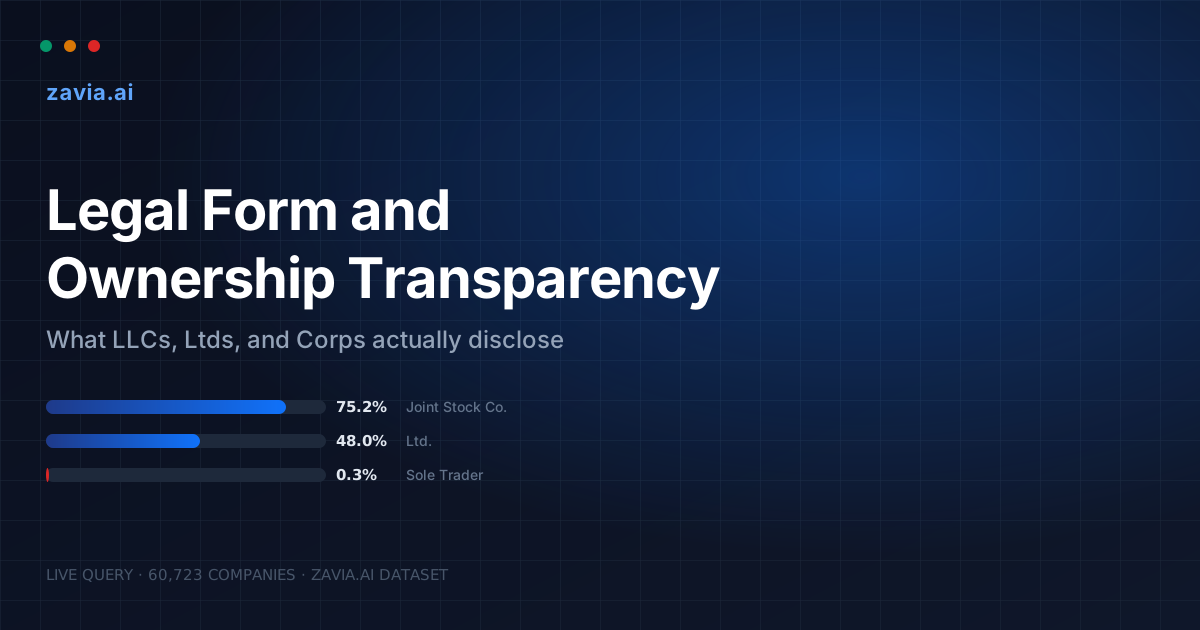
Most reviewers assume the registry will simply hand over an owner’s name if asked correctly. To test that assumption against current data rather than a fixed snapshot, we ran a live query across a stratified sample of 227 companies against Zavia’s dataset on 30 September 2026 — pulling both the shareholder-disclosure and group-structure record for each company across fifteen countries. That live query found the assumption still fails more often than it holds, though the live numbers land meaningfully differently from an earlier static dataset snapshot; see the methodology note beneath the figure for what changed.
Methodology note: earlier versions of this figure cited a fixed internal dataset snapshot of 6,210 records analysed in September 2026. The numbers above instead come from a live query against Zavia’s dataset, run on 30 September 2026 across a sample of 227 companies. Shareholder disclosure and group-structure prevalence both came back meaningfully higher in the live sample than in the old snapshot, while the cross-border share among multi-entity structures held almost exactly steady (63% vs. 64%).
Of the 88 companies in the sample that do disclose shareholder-level data, 64.8% (57) list only corporate shareholders — no named individual appears even at the first layer — while 35.2% (31) name at least one natural person, and 47.7% (42) show two or more distinct shareholders. In practice, that means most reviewers are not choosing between “transparent” and “opaque” companies. They are choosing how many proxy signals to stack when the direct answer isn’t available.
This is the specific limitation a checklist like this one has to solve for: the registry will usually tell you the shape of the ownership chain before it tells you who’s at the top of it. Zavia connects directly to official company registries in 173 countries, which matters here because a chain that crosses borders — as 63% of multi-entity structures in this sample do — is only checkable at all if each jurisdiction in it is reachable from the same place. A reviewer working from one country’s registry portal cannot see layer three sitting in a different country’s system.
04Red flag: the registered address is doing too much work
A registered office is a legal requirement, not a claim about where a business operates. The distinction collapses the moment you check who else uses the same suite number. One legitimate small business at a shared serviced-office address is unremarkable. Several hundred unrelated entities at the identical unit, with no other public presence, is a registered-agent drop box wearing a street address.
- Check the address density. Search the registered address itself, not just the company name. A cluster of dozens or hundreds of entities at one unit is the single fastest tell.
- Compare the address type to the stated business. A logistics company with no listed depot, warehouse, or fleet registration anywhere is describing an activity its own footprint doesn’t support.
- Look for a registered-agent naming pattern. Corporate service providers often appear as “care of” or “c/o” on the filing itself — a direct admission that the address is administrative, not operational.
05Red flag: no named natural person anywhere in the chain
Every legal owner in the filing is another company. That is not automatically sinister — a joint venture between two corporate parents can legitimately have zero individuals at the first layer — but it means the UBO question is still fully open, and it is the question that actually matters. A legal owner tells you who signs the paperwork. A UBO tells you who benefits if the paperwork is a fraud.
With roughly 1 company in 7 (14%, per Zavia’s dataset, live query run 30 September 2026, sample of 227 companies) yielding a named individual from the public record alone, treat “no natural person found” as the expected starting position, not a red flag by itself. What turns it into one is what happens next: does the counterparty’s own onboarding disclosure name a UBO that the public record can independently support, or does every avenue — registry, disclosure, and follow-up request — terminate in another corporate shell? The second pattern, not the absence of a public name, is the actual signal.
06Red flag: ownership moved right before or after the deal
A shareholder transfer, director change, or registered-address update filed in the weeks immediately surrounding a major contract, loan, or account opening deserves a specific question: what commercial event does this correspond to? Genuine restructurings usually have an answer — a merger, a succession plan, an investment round. A transfer with no disclosed reason, timed tightly to an external transaction it has no visible connection to, is the pattern regulators call round-tripping when it recurs on the same entities.
- Pull the filing history, not just the current snapshot. A registry’s “current officers” view hides exactly this kind of pre-deal reshuffle.
- Cross-reference the transfer date against the deal timeline. Weeks, not years, of proximity is the threshold that warrants a question.
- Ask the counterparty directly. A legitimate reason is usually short and specific. A vague or deflected answer is itself data.
07Red flag: the same director sits on dozens of unrelated companies
Moody’s KYC research on shell company risk indicators found outlier directorships — a single individual or nominee listed across an implausible number of entities — to be the single most prevalent shell-risk indicator in its dataset, appearing more often than any of the other six indicators it tracked (Moody’s, 2024). Professional company-formation agents legitimately provide nominee director services, and using one is not itself wrongdoing. The red flag is density: a director tied to a handful of related group entities is routine; a director tied to dozens or hundreds of unconnected businesses across unrelated industries is a corporate-services placeholder, not an operator.
A high director count is a screening trigger, not a verdict. Some of the world’s largest corporate service providers legitimately supply nominee directors to thousands of compliant entities. The mistake is stopping at the count instead of using it to decide how hard to push on the next four checks.
08Red flag: incorporation date and contract size don’t match
A company registered six months ago has no track record, no audited financials of any depth, and no operating history to underwrite the risk it’s asking a counterparty to take on. That alone is normal for a genuine startup. It stops being normal when the same young entity is signing a seven-figure supply agreement, requesting a large credit facility, or opening an account with transaction volumes that assume years of established banking relationships it cannot possibly have. Financial Crime Academy’s review of shell company indicators lists exactly this mismatch — production or transaction capacity that outstrips the entity’s demonstrable footprint — among its core red-flag transaction patterns (Financial Crime Academy, 2023).
09Red flag: ownership crosses borders with no operating reason
International structuring is routine for genuine multinational groups — a French manufacturer with a Dutch holding company and an Irish IP licensing entity is unremarkable to anyone who has looked at a real corporate group chart. It becomes a flag when the jurisdictions involved have no relationship to where the business actually operates, sells, or employs anyone, and especially when one of those jurisdictions is a closed or weakly disclosed register with no independent way to verify what sits behind it.
In Zavia’s dataset (live query, run 30 September 2026, sample of 227 companies), 75% (169 of 225 queried) show a linked, multi-entity group structure, and 63% of those (107 of 169) cross two or more countries. Most of those structures are modest — a typical one links around a dozen affiliated entities — though a handful of large multinational groups in the sample linked well over a hundred entities across a dozen or more jurisdictions. Breadth and cross-border structure are common on their own. The question that actually separates routine from suspect is simpler than counting entities: does every jurisdiction in the chain correspond to somewhere the business plausibly does something?
10Red flag: dormancy that doesn’t match the activity being proposed
A registry filing that shows years of nil accounts, no employees, and no filed activity is not disqualifying for a genuine holding vehicle waiting to be used. It is a serious mismatch when that same long-dormant entity suddenly proposes a large, active commercial relationship with no transition period, no new hires on record, and no operational build-up visible anywhere in the filing history. Dormancy is a state. The flag is a dormant company behaving, overnight, like an established operator.
11Legitimate holding structures vs. red-flag patterns
The same surface fact — an offshore parent, a young subsidiary, a nominee director — reads differently depending on what surrounds it. The table below separates the two readings side by side.
| Surface fact | Legitimate reading | Red-flag reading |
|---|---|---|
| Offshore parent company | Group treasury or IP holding entity with a disclosed, named ultimate parent and filed group accounts | Offshore parent with no further disclosure, at a registered-agent address shared with thousands of entities |
| Recently incorporated entity | New venture, SPV for a single transaction, or subsidiary set up for a specific, disclosed purpose | Months-old entity proposing a transaction sized for a company with years of track record |
| Nominee director | Corporate services provider named on a modest, related cluster of group entities | Same individual listed across dozens of unrelated businesses in unrelated industries |
| Multi-layer, cross-border ownership | Layers correspond to real operating footprint — manufacturing, sales, or IP location | Layers correspond to secrecy jurisdictions with no link to where the business actually operates |
| Dormant filing history | Vehicle held in reserve, disclosed as such, with no active transactions until a stated trigger event | Years of nil accounts followed overnight by large, active commercial transactions |
| Recent ownership transfer | Tied to a disclosed, verifiable event — succession, merger, funding round | Untied to any disclosed event, timed to weeks around an external deal |
12The six flags, in one view

13What to do when two or more flags trip
A single flag is a note in the file. Multiple confirmed flags on the same company are a decision point, and the decision should be procedural, not improvised in the moment.
- Count only confirmed flags, not suspicions. “The address looks generic” is a lead to check, not a flag until the address density is actually confirmed.
- Zero or one flag: proceed under standard monitoring. Log what was checked and revisit at the next scheduled review, not before.
- Two or three flags: move to enhanced due diligence. Pull source documents directly from the registry, request UBO disclosure from the counterparty, and reconcile the two.
- Four or more flags: escalate before the relationship proceeds further. This is a senior sign-off decision, not a front-line one.

For structures that fail this test in a specific way — ownership that loops back on itself through two or more entities — the pattern deserves its own deeper read: see Circular Ownership Structures: How Companies Use Loops to Hide Beneficial Owners. And for teams that need to move past a yes/no flag count into a weighted score across many simultaneous signals, Multi-Layered Corporate Structures: A Risk-Scoring Framework for Escalation Decisions covers the scoring model this checklist feeds into once an investigation is already underway.
14Building the check into onboarding, not after it
Every flag in this piece is checkable before a relationship starts, not just after something goes wrong. The procedure that makes that practical is short:
- Pull the registered address and run a density check — how many other entities share it, and does the number match a normal serviced office or a mass-registration agent.
- Pull the full filing history, not the current snapshot — ownership and director changes only show up in the history, and timing against your own deal only makes sense against dates.
- Trace ownership to a named natural person or to the point where the trail legitimately ends — a regulated fund, a listed public company, or a disclosed government entity are all valid stopping points; another opaque private company is not.
- Cross-check every director against other entities they appear on — a handful is normal, dozens across unrelated sectors is not.
- Compare incorporation date and dormancy history against the size and nature of what’s being proposed — and require an explanation, not an assumption, for any mismatch.
- Document the count of confirmed flags and route the decision per the escalation flow — before the first payment moves, not after the file gets reopened.
This six-step sequence is the first-pass version of a longer discipline. For the full lifecycle — from the initial check through ongoing monitoring after onboarding is complete — see UBO Verification Workflow: From Initial Check to Ongoing Monitoring.
The recurring obstacle to all six steps is the same one the data above quantifies: most registries won’t hand over a UBO directly, and a chain that crosses borders needs each jurisdiction in it to actually be reachable from wherever the check is being run. A domestic-only registry search simply cannot see layer three sitting in a different country’s system, which is why step three above so often stalls exactly where the ownership tree turns international.
15Two registries worth knowing before you check them
The mechanics above are horizontal, but every actual check runs into a specific jurisdiction’s disclosure rules. Two are worth flagging because they sit at opposite ends of the transparency spectrum, and both moved during 2025–2026. Delaware, the default US incorporation state for a large share of shell entities flagged in financial-crime cases, has never disclosed beneficial ownership at the state level, and the brief federal backstop created by the Corporate Transparency Act no longer fills that gap for domestic entities: FinCEN narrowed BOI reporting to foreign reporting companies in March 2025 and, in a final rule effective 14 August 2026, permanently eliminated the requirement for US companies and US persons altogether. Only foreign entities registering to do business in the US must still report, and only their non-US-person owners — see Delaware LLC UBO Verification in 2026: The Post-CTA Compliance Guide for the detail. In practice, a domestic Delaware entity’s UBO is often unverifiable through any public federal or state channel at all. The UK sits at the other end: Companies House’s beneficial ownership register is nominally open, and the verification gap that used to undercut it is closing on a fixed schedule — identity verification became mandatory for new directors and People with Significant Control from 18 November 2025, with existing PSCs required to complete verification by 18 November 2026 — covered in UK Beneficial Ownership & UBO Data: The 2025–2026 Compliance Guide. Knowing which end of that spectrum a counterparty’s jurisdiction sits on changes how much weight to put on “the registry didn’t show an owner.”
16Glossary
17Frequently asked questions
Is a shell company always a red flag by itself?
No. A shell company is a functional description — no independent operations, minimal staff, footprint disproportionate to its stated business — and that description fits holding companies, SPVs, and IP-licensing entities used for entirely lawful structuring. The red flag is a shell combined with an ownership record that can’t support the relationship or transaction being proposed, not the shell status on its own.
What’s the single fastest check to run on a new counterparty?
Search the registered address itself, not just the company name. If dozens or hundreds of unrelated entities share the identical suite number with no other public presence, that single check surfaces the most common shell-risk pattern faster than any other step in this list.
How many red flags justify walking away from a deal?
There’s no universal number, but most compliance programs treat two or three confirmed flags as the threshold for enhanced due diligence and four or more as an escalation requiring senior sign-off before the relationship proceeds. The count should reflect confirmed findings, not suspicions still being checked.
Why do so few registries name an actual owner?
In Zavia’s dataset (live query, run 30 September 2026, sample of 227 companies), 60% returned no public shareholder list at all, and 14% yielded a named natural-person owner from the public record alone. Most jurisdictions require beneficial ownership disclosure to authorities, not to the public, and many still permit corporate shareholders to stand in place of a named individual at the first layer.
Is a nominee director always suspicious?
No. Nominee directors are a standard, lawful service offered by corporate formation agents, and appear on large numbers of fully compliant entities. The flag is density — the same individual listed across dozens or hundreds of unrelated businesses in unrelated industries, rather than a modest cluster of related group entities.
Does a cross-border ownership structure automatically mean higher risk?
Not automatically. In Zavia’s dataset (live query, run 30 September 2026, sample of 227 companies), 63% of companies with a linked multi-entity group structure cross two or more countries, and most of that is routine multinational structuring. The relevant question is whether each jurisdiction in the chain corresponds to somewhere the business plausibly operates, sells, or employs people — not whether the structure crosses a border at all.
What should I do if the ownership trail dead-ends in a closed registry?
Treat the dead end itself as the finding and document it as such, rather than treating “no data available” as equivalent to “no risk found.” Request UBO disclosure directly from the counterparty, compare it against whatever partial registry data does exist, and weight the relationship’s overall risk score higher for jurisdictions with historically weak or closed beneficial ownership disclosure.
Is this checklist different from a risk-scoring framework?
Yes. This is a first-pass, externally-focused review for someone meeting a company for the first time, built around what an ownership record shows on its face. A risk-scoring framework is a later-stage tool for weighting multiple simultaneous signals once an investigation is already underway — see Multi-Layered Corporate Structures: A Risk-Scoring Framework for Escalation Decisions for that stage of the process.
Check the record before you sign the contract
Zavia connects directly to official company registries in 173 countries, so a cross-border ownership chain is one lookup instead of a dozen separate registry portals.
Related reading: nominee arrangements are one of the most common ways a shell’s real owner stays off the filing — see Nominee Directors and Nominee Shareholders. For why a shell can also simply be mismatched to the wrong entity record, see Entity Resolution and Ownership Graphs. If the first check you ran was an EIN, see EIN Lookup for what that number does and doesn’t confirm.
For a real-world example of these red flags being applied at onboarding scale across a two-sided marketplace, see Case Study: How Uber Identifies the Real Owners Behind Fleet Partners and Freight Operators.